


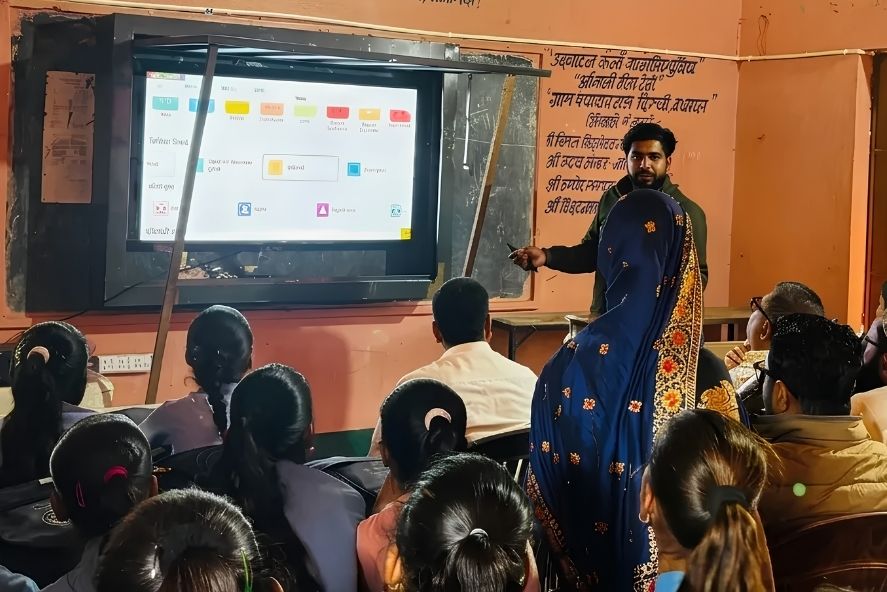
A classroom in Sarai Tand, Bihar, is showing how digital education can reach students even where reliable internet access remains a challenge. Government Higher Secondary School has introduced an offline Smart Classroom that is now being used by 660 students and 14 teachers.
Located nearly 63 km from Gaya’s district centre, the school serves children from 6 nearby villages. Many students walk or use shared vehicles to reach the school, which remains an important link to opportunities beyond their villages.
One room at the school has been converted into a dedicated Smart Classroom. Teachers use an interactive digital panel to make lessons more visual and engaging.
Lessons that once relied mainly on textbooks, blackboards and verbal explanations can now include animations, visual demonstrations, practice activities and assessments. Students who may struggle to understand a concept through words alone can use videos and visual content to explore the same topic in a different way.
The classroom’s learning material is stored offline, allowing teachers to continue digital lessons without depending on a reliable internet connection.
The initiative is part of a wider expansion of digital learning across Indian schools. More than 1.49 lakh schools are covered under government ICT and digital learning initiatives. The government has also sanctioned more than 1.76 lakh smart classrooms and 1.79 lakh ICT laboratories.
Digital tools are changing everyday classroom practices in several ways. Teachers can use 3D models instead of drawing complex diagrams, while students can revisit difficult concepts through videos and take part in interactive activities.
Access to digital infrastructure is also expanding. Computer availability in schools has reached around 57–64.7%, while internet connectivity stands at around 53.9–63.5%. States including Kerala, Tamil Nadu, Punjab and Haryana report digital facility access of more than 98–99% across their government school systems.
Initiatives such as DIKSHA and PM e-VIDYA have further expanded access to digital educational content, textbooks, television-based learning and other resources. Under Samagra Shiksha, government support is also being used to improve ICT infrastructure, smart classrooms and connectivity.
At Sarai Tand, the school created a separate room for digital learning, installed desks and electrical fittings, and prepared the space for regular use. Teachers were also trained to use digital content, including animated videos, practice modules and assessments, as part of their lessons.
The experience highlights that technology becomes more effective when teachers actively integrate it into everyday teaching rather than treating it as another piece of equipment.
Digital access remains uneven across India, with some schools still working to improve computers, connectivity and internet availability. However, the experience at Sarai Tand shows how offline digital tools can add another layer to classroom learning.
For the students sitting in this Bihar school, technology does not replace the teacher, textbook or blackboard. It gives them another way to see, explore and understand what they are learning.
Also read: Viksit Workforce for a Viksit Bharat
Do Follow: The Mainstream LinkedIn | The Mainstream Facebook | The Mainstream Youtube | The Mainstream Twitter
About us:
The Mainstream is a premier platform delivering the latest updates and informed perspectives across the technology business and cyber landscape. Built on research-driven, thought leadership and original intellectual property, The Mainstream also curates summits & conferences that convene decision makers to explore how technology reshapes industries and leadership. With a growing presence in India and globally across the Middle East, Africa, ASEAN, the USA, the UK and Australia, The Mainstream carries a vision to bring the latest happenings and insights to 8.2 billion people and to place technology at the centre of conversation for leaders navigating the future.