


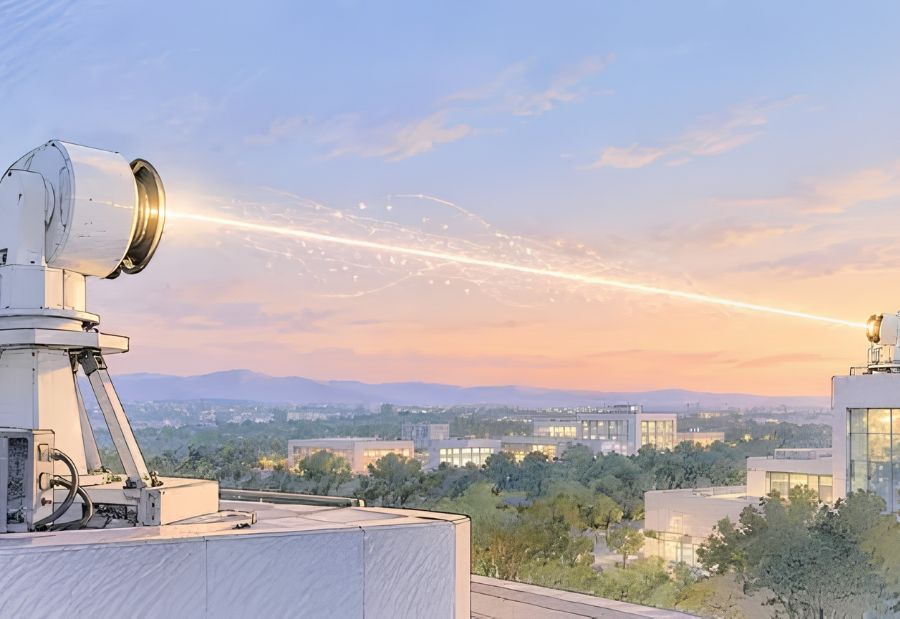
India has taken a step forward in quantum-secure communication after deep-tech startup QNu Labs, in collaboration with the Bhaskaracharya National Institute for Space Applications and Geo-informatics (BISAG-N) and IIT Gandhinagar, successfully demonstrated a free-space quantum key distribution (QKD) link spanning 5.56 km.
Free-space QKD enables the secure exchange of digital encryption keys through light particles travelling across open air rather than fibre-optic cables. Based on quantum mechanics, the technology can detect interception attempts because measuring or observing the photons changes their state.
Unlike conventional QKD systems, which face signal loss through fibre-optic cables, free-space links support secure communication across open terrain, water and areas where installing cables is difficult. The technology also provides a foundation for transmitting encryption keys between Earth and orbiting satellites, supporting the development of a global quantum-secure internet network.
According to the IT and electronics ministry, the field trial took place on the night of September 27–28. It established a secure quantum communication channel between BISAG-N and IIT Gandhinagar.
Using QNu Labs’ pointing, acquisition and tracking system, the demonstration maintained a stable quantum bit error rate below 5% and generated secure keys at a rate of 230–260 bits per second.
The generated keys were integrated with BISAG-N’s Vedic Kavach platform, which supports post-quantum cryptography. This enabled successful end-to-end encryption and decryption of test messages.
Vinay Thakur, Director General of BISAG-N, said integrating Vedic Kavach with QNu Labs’ QKD technology marks an important step towards practical quantum-resilient communication systems.
Sunil Gupta, Co-founder and CEO of QNu Labs, said the successful 5.56 km demonstration opens the way for longer-distance quantum-secure networks and satellite-based quantum communication.
Cmde Manish Tripathi (Retd.), In-charge of ISTF at IIT Gandhinagar, highlighted the value of the field trial in advancing practical quantum communication technologies. He also noted how academic research, indigenous technology and real-world experimentation can work together to address emerging secure communication needs.
The demonstration lays the groundwork for strengthening India’s secure communication infrastructure and improving its resilience against emerging security threats in the quantum era.
Also read: Viksit Workforce for a Viksit Bharat
Do Follow: The Mainstream LinkedIn | The Mainstream Facebook | The Mainstream Youtube | The Mainstream Twitter
About us:
The Mainstream is a premier platform delivering the latest updates and informed perspectives across the technology business and cyber landscape. Built on research-driven, thought leadership and original intellectual property, The Mainstream also curates summits & conferences that convene decision makers to explore how technology reshapes industries and leadership. With a growing presence in India and globally across the Middle East, Africa, ASEAN, the USA, the UK and Australia, The Mainstream carries a vision to bring the latest happenings and insights to 8.2 billion people and to place technology at the centre of conversation for leaders navigating the future.