


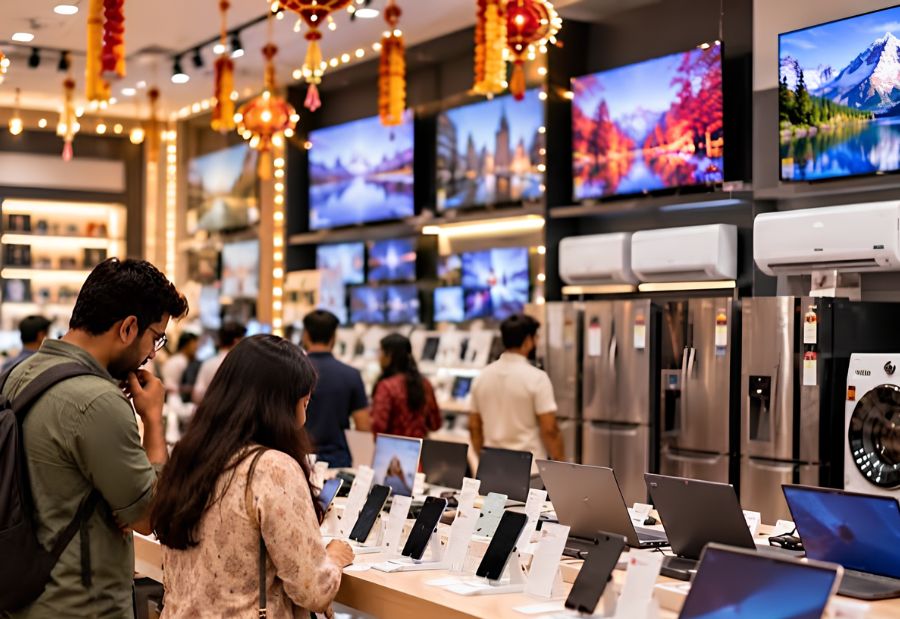
Consumer electronics companies and retailers are preparing for a festive season marked by higher product prices, as rising component, commodity and freight costs reduce the room for traditional discounts.
Prices of air-conditioners, LED TVs, washing machines and other appliances are expected to increase, while financing, exchange and buyback schemes are becoming more important in supporting demand.
Flipkart Vice-President of Payments and SuperCoins Gaurav Arora said around one-third of the platform’s mobiles, large appliances and electronics gross merchandise value is expected to come through EMI options during the festive season. Nearly half of high-value electronics purchases are also expected to use some form of affordability option.
Memory costs have become a major pressure point for smartphones. Counterpoint Research reported that smartphone memory prices increased more than 80% quarter-on-quarter in Q2 2026. Its bill-of-materials analysis showed that component costs for similar low-end smartphone configurations increased 70% year-on-year, with most of the rise coming from memory. DRAM has also overtaken the processor as the most expensive individual component in some smartphones.
Consumer durable manufacturers are facing additional pressure from commodity and logistics costs. Freight costs have more than doubled in recent months, while shipment delays have extended beyond 15 days due to disruptions in Southeast Asia and continuing issues around Red Sea shipping routes.
Arjun Bajaj, director of Videotex International, said, “As a manufacturer, we are seeing recent escalations in freight costs and supply disruptions that could push television prices up by up to 20 per cent for smaller screen sizes and up to 10 per cent for larger screen sizes, depending on the screen size. However, these increases are unlikely to be fully reflected during the festive season, with consumers likely to see a new base price for consumer electronics emerge after Diwali.”
Air-conditioner prices are expected to rise 5-8% from October 1, while some manufacturers are increasing prices of washing machines, refrigerators and LED TVs by 3-4%. Haier India President NS Satish said the company plans to raise room AC prices by around 5% and increase prices of categories such as LED TVs and washing machines by 2-3%.
SPPL, the brand licensee for Thomson, Kodak and Blaupunkt, plans to increase TV prices by around 7% after October, while prices of some appliances have already risen by 4-5%.
As higher input costs limit the scope for direct discounts, companies are increasingly using affordability programmes. Samsung offers eligible Galaxy buyers 24-month no-cost EMIs with assured buyback through its Galaxy Forever programme, while Google’s Pixel Upgrade Program combines a 24-month no-cost EMI with an assured buyback option.
Samsung has also introduced no-cost EMI plans of up to 30 months for its Galaxy Z foldable smartphones. In appliances, LG and retailers such as Croma are offering exchange programmes covering products including TVs, refrigerators, washing machines and air-conditioners.
Counterpoint expects financing to account for 42% of smartphone sales in India in 2026, compared with 35% in 2025. Longer-tenure EMIs, exchange offers and other affordability measures are expected to gain importance as device prices increase.
Flipkart’s Arora said credit-card EMI options become more relevant for purchases of Rs 20,000-30,000 and above, while cardless EMI sees strong adoption in Tier-II cities and beyond.
Payment methods could also influence festive purchases following the introduction of merchant discount rates on high-value UPI transactions. At Vijay Sales, around 15% of transactions are made through UPI, with purchases ranging from Rs 5,000 to Rs 20,000, according to director Nilesh Gupta.
For consumers, the festive offer may increasingly come through a combination of EMI financing, exchange benefits, cashback and card discounts rather than a lower listed price. However, financing does not eliminate higher product costs; it spreads the expense over a longer period and depends on consumers’ access to credit and willingness to take on monthly payments.
Also read: Viksit Workforce for a Viksit Bharat
Do Follow: The Mainstream LinkedIn | The Mainstream Facebook | The Mainstream Youtube | The Mainstream Twitter
About us:
The Mainstream is a premier platform delivering the latest updates and informed perspectives across the technology business and cyber landscape. Built on research-driven, thought leadership and original intellectual property, The Mainstream also curates summits & conferences that convene decision makers to explore how technology reshapes industries and leadership. With a growing presence in India and globally across the Middle East, Africa, ASEAN, the USA, the UK and Australia, The Mainstream carries a vision to bring the latest happenings and insights to 8.2 billion people and to place technology at the centre of conversation for leaders navigating the future.