


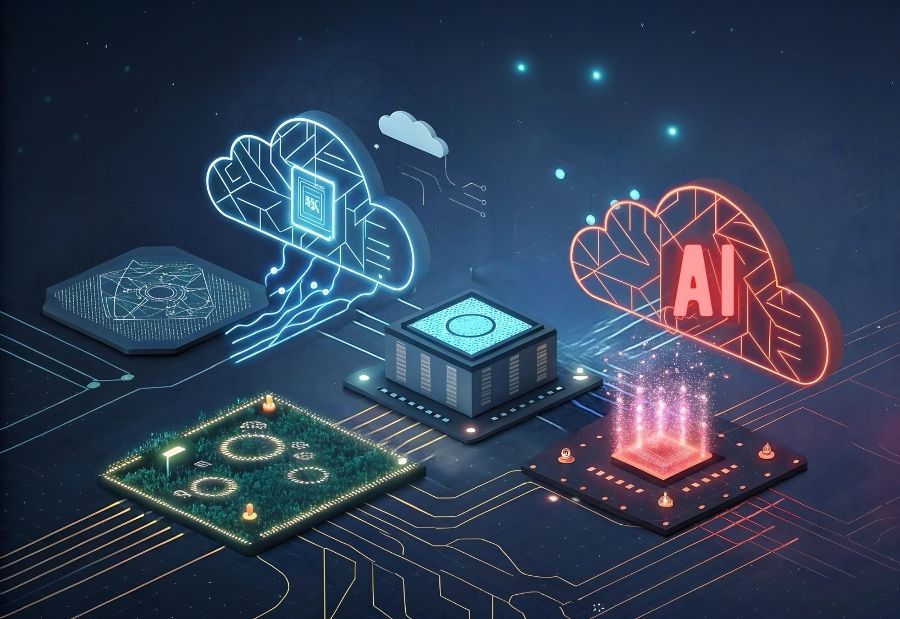
Artificial intelligence and cloud computing are becoming closely connected in modern technology strategies. AI applications need scalable infrastructure, data processing capabilities and access to a range of computing resources. Cloud platforms can provide much of this flexibility, but adopting both technologies together also creates new decisions for CIOs.
The challenge is not simply choosing AI and Cloud technologies. CIOs need to understand how these capabilities fit into the wider technology strategy, business priorities, security model and operating environment.
Why are AI and Cloud becoming closely connected?
Many AI applications require substantial computing and storage resources. Cloud platforms can provide access to infrastructure without requiring businesses to build every capability internally.
At the same time, cloud environments increasingly host the data platforms, applications and services that AI systems depend on.
This makes the relationship between AI and Cloud an important part of technology planning.
Start with business use cases
CIOs should begin with the business problem rather than the technology.
AI may support customer service, forecasting, fraud detection, software development or operational automation. Each use case can have different infrastructure and data requirements.
Understanding the expected outcome helps technology leaders determine whether cloud-based AI services, dedicated infrastructure or a hybrid approach makes the most sense.
Consider infrastructure requirements
AI workloads can behave differently from traditional business applications.
Some may require specialized processors, high-performance computing or large amounts of storage. Others may have fluctuating demand.
CIOs need to consider performance, scalability and availability when determining how workloads should be hosted.
Cloud platforms can provide flexibility, but cost and capacity still need to be managed carefully.
Data is at the center
AI systems depend heavily on data.
Businesses may already store information across cloud platforms, databases, SaaS applications and legacy systems. CIOs therefore need to consider how AI workloads will access this information.
Data movement, integration, governance and security should be part of the technology strategy.
A poorly designed data architecture can limit the value of both AI and cloud investments.
Control AI and Cloud costs
Both AI and cloud usage can create variable technology spending.
AI workloads may increase computing consumption, while cloud services may introduce additional storage, networking and platform costs.
CIOs should establish visibility into resource usage and understand the cost of individual workloads.
Cost optimisation should not focus only on reducing spending. It should also consider whether the infrastructure is delivering useful business outcomes.
Security and Governance need to work together
AI introduces new considerations around data, models and access.
Cloud environments also require strong identity, configuration and monitoring controls.
CIOs should therefore bring AI governance and cloud governance closer together where appropriate. This can help organisations manage access, data protection, compliance and operational risk consistently.
Build the right operating model
Managing AI and Cloud together may require collaboration between infrastructure, data, cybersecurity, application and business teams.
CIOs can establish clear ownership for infrastructure, AI platforms, data and governance.
A shared operating model can reduce duplication and make technology decisions easier to coordinate.
Avoid technology for technology’s sake
The growing availability of AI services and cloud capabilities can make it tempting to adopt new tools quickly.
CIOs should instead assess whether a technology solves a meaningful business problem, fits the current architecture and can be managed over the long term.
This helps prevent unnecessary technology sprawl.
The Mainstream perspective
AI and cloud are becoming major themes in technology leadership conversations. The Mainstream continues to cover AI transformation, cloud computing and CIO strategy as organisations work to connect emerging technologies with business objectives.
Final Thought
Balancing AI and Cloud requires CIOs to look beyond individual platforms. Business use cases, data, infrastructure, cost, security and operating models all need to work together. A clear strategy can help organisations use both technologies effectively while maintaining control over complexity and long-term investment.