


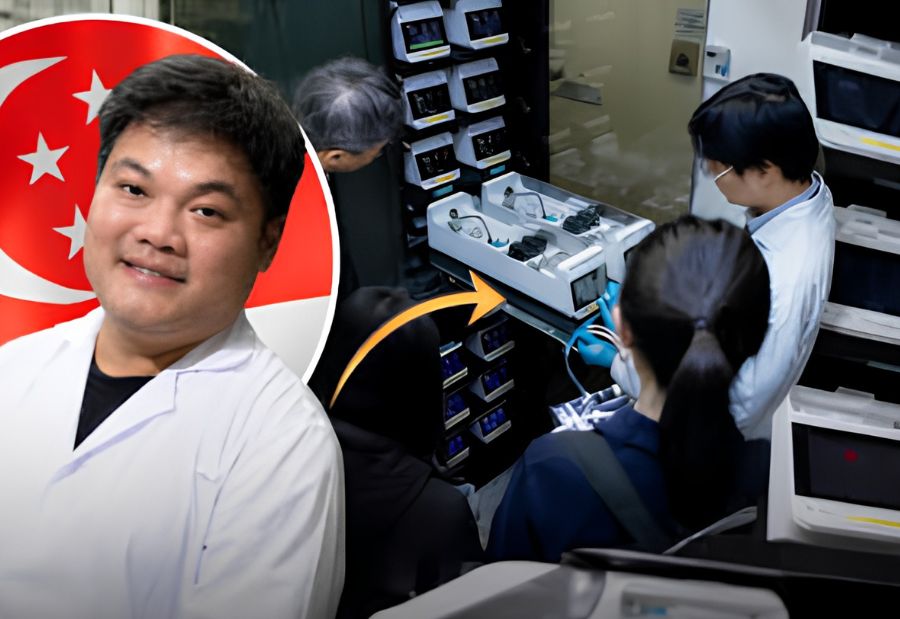
Singapore is exploring whether living human brain cells can become part of future computing systems, with researchers building a prototype that places millions of lab-grown neurons inside a server rack.
The project was developed by the Yong Loo Lin School of Medicine at the National University of Singapore (NUS Medicine), data-centre operator DayOne and Australian biological computing company Cortical Labs.
The prototype consists of 20 CL1 units installed in 1 server rack at the NUS Life Sciences Institute. Each CL1 contains about 800,000 lab-grown human neurons, giving the full system roughly 16 million neurons. These living cells act as biological processors that receive electrical signals, process information and send signals back to the computer.
NUS describes the 20-unit setup as the world’s first independently operated biological server rack.
Cortical Labs grows the neurons from human stem cells and places them on a silicon platform fitted with tiny electrodes. The electrodes send electrical signals to the neurons and record their responses.
The neurons are connected to Cortical Labs’ biological intelligence operating system, known as biOS. The software creates a feedback loop between the computer and the biological network. Information is sent to the neurons, their responses are recorded and those responses are then used by the computer. This allows the living cells to respond to information and learn from changing conditions rather than simply following fixed instructions.
The approach differs from conventional computers, which rely on silicon chips, electronic circuits and transistors for processing. Here, living neurons perform part of the processing by responding to electrical signals and adapting through interaction.
Keeping the biological components alive is one of the biggest challenges. The CL1 has a built-in life-support system, and Cortical Labs says the neurons can survive for up to 6 months. At the Singapore facility, technicians feed the cells every 3 days with sugar, nutrients and pH buffers. The system also provides oxygen, carbon dioxide and nitrogen to maintain the cells.
Power efficiency is a major reason researchers are exploring the technology. The human brain processes large amounts of information while consuming relatively little energy. Researchers want to determine whether biological neurons can perform certain computing tasks with less power than conventional chips.
Cortical Labs also believes CL1 systems could be useful when AI systems have limited training data or operate in environments that constantly change. Potential applications include humanoid robots, cybersecurity and fraud detection, where systems need to learn and adapt quickly.
The technology could also support drug discovery, medical research and the study of brain diseases. Researchers hope it can provide deeper insights into how human neurons learn and adapt.
Also read: Viksit Workforce for a Viksit Bharat
Do Follow: The Mainstream LinkedIn | The Mainstream Facebook | The Mainstream Youtube | The Mainstream Twitter
About us:
The Mainstream is a premier platform delivering the latest updates and informed perspectives across the technology business and cyber landscape. Built on research-driven, thought leadership and original intellectual property, The Mainstream also curates summits & conferences that convene decision makers to explore how technology reshapes industries and leadership. With a growing presence in India and globally across the Middle East, Africa, ASEAN, the USA, the UK and Australia, The Mainstream carries a vision to bring the latest happenings and insights to 8.2 billion people and to place technology at the centre of conversation for leaders navigating the future.