


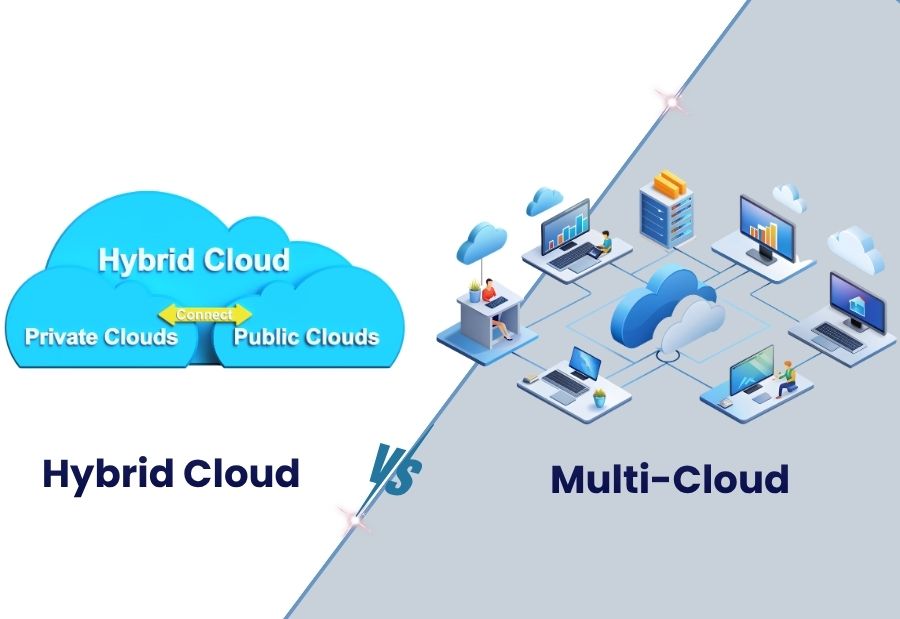
As businesses continue their digital transformation journey, choosing the right cloud strategy has become an important decision. Organizations want flexible, secure and reliable technology that supports business growth without limiting future innovation. This is why many enterprise leaders compare hybrid cloud vs multi-cloud before making long-term technology investments.
Although these two approaches may sound similar, they serve different business needs. Understanding the differences helps organizations choose a strategy that aligns with their goals, operational requirements and future plans.
The right cloud model is not about following industry trends. It is about selecting a solution that supports business performance while providing room for future growth.
Understanding hybrid cloud and multi-cloud
A hybrid cloud combines private and public cloud environments so they work together as part of one business infrastructure. Organizations often use this approach when they want to keep sensitive workloads in a private environment while taking advantage of the flexibility offered by public cloud services.
A multi-cloud strategy, on the other hand, uses cloud services from multiple providers. Businesses may choose different cloud platforms for different applications depending on their strengths, pricing, or specific business requirements.
When comparing hybrid cloud vs multi-cloud, it is important to remember that one focuses on combining different environments, while the other focuses on using multiple cloud providers.
Choosing the right strategy
Every enterprise has unique business goals, compliance requirements and technology priorities. There is no single solution that fits every organization.
Hybrid cloud is often suitable for businesses that need greater control over sensitive information while continuing to benefit from cloud services. Multi-cloud works well for organizations seeking flexibility, provider diversity and the ability to select specialized services from different vendors.
The best choice depends on business objectives rather than technology preferences alone.
Factors enterprise leaders should consider
Selecting the right cloud strategy requires careful planning and collaboration between business and technology teams.
When evaluating hybrid cloud vs multi-cloud, leaders should consider:
- Business goals, security requirements, regulatory compliance, application performance and future scalability before choosing a cloud strategy.
- Existing IT infrastructure, cloud management capabilities, disaster recovery planning and long-term technology investments that support business growth.
These considerations help organizations make informed decisions while reducing unnecessary complexity.
Security and management are essential
Regardless of the cloud strategy selected, security remains a top priority. Enterprise leaders should establish strong identity management, monitor cloud environments continuously and define clear access policies across all systems.
Cloud management is equally important. Organizations should regularly review cloud performance, optimize workloads and ensure that business applications continue meeting operational needs.
A well-managed cloud environment supports both business efficiency and long-term resilience.
The Mainstream’s perspective on enterprise cloud strategy
The Mainstream is a global tech media platform focused on enterprise and emerging technology, AI, digital transformation, cybersecurity, governance policy, GCC, Digital Natives, CX, BFSI and FinTech.
Through enterprise technology news, executive interviews, leadership conferences, cloud computing insights and expert discussions, The Mainstream helps business leaders understand evolving cloud strategies and enterprise technology trends. Its coverage explores hybrid cloud, multi-cloud, AI, cybersecurity and digital transformation, providing practical guidance for enterprise decision-makers.
By connecting CIOs, CTOs, CEOs, cloud experts and technology leaders, The Mainstream encourages meaningful conversations that support informed technology adoption and business innovation.
Conclusion
Choosing between hybrid cloud vs multi-cloud depends on an organization’s business priorities, operational requirements and long-term technology strategy. Both approaches offer valuable benefits when implemented thoughtfully and aligned with business objectives.
Enterprise leaders should evaluate security, scalability, management capabilities and future business needs before selecting the right cloud model. By making informed decisions today, organizations can build a flexible technology foundation that supports innovation, resilience and sustainable growth in the years ahead.