


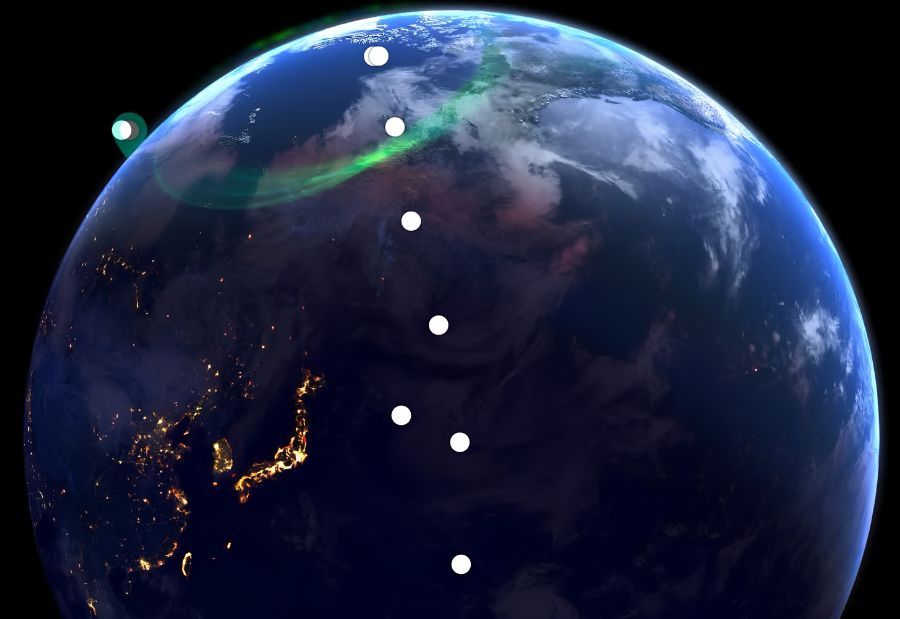
Russia has launched a 2nd batch of Rassvet communications satellites, increasing the constellation to nearly 40 satellites in orbit, according to Serhiy “Flash” Beskrestnov. The satellites are expected to serve as a domestic alternative to Starlink, although they have not yet reached their designated orbital positions.
Beskrestnov said the current constellation is still too small to support effective military operations. “To start using the Rassvet constellation for military purposes, the enemy needs to launch at least several hundred satellites,” he said.
For comparison, SpaceX’s Starlink network has more than 15,000 satellites, while OneWeb operates around 600–700 satellites. Amazon’s low Earth orbit constellation is also expanding toward a planned network of about 4,000 satellites.
The Rassvet project is being developed by Bureau 1440, a Russian company building a global broadband communication system based on a low Earth orbit satellite constellation. The project began with the launch of the 1st 3 experimental Rassvet-1 satellites in June 2023. In May 2024, Russia launched 3 more Rassvet-2 satellites to test technologies for future operational spacecraft. The company also said it successfully tested inter-satellite laser communication with data transfer speeds of up to 10 Gbps.
In March 2026, Bureau 1440 launched the 1st 16 operational satellites, marking the next phase of the project.
According to Defense Express, Bureau 1440 plans to make the system operational after deploying the 1st phase of 288 satellites. The company says this will provide global coverage and enable commercial services to begin as early as 2027.
Defense Express also noted that a constellation of 288 satellites would remain relatively small and offer limited capabilities. However, analysts believe it could support a limited number of military users, particularly after Russian forces in Ukraine lost access to SpaceX’s Starlink terminals. Looking ahead, Russia plans to expand the constellation to 730 satellites by 2030 and 900 satellites by 2035.
Also read: Viksit Workforce for a Viksit Bharat
Do Follow: The Mainstream LinkedIn | The Mainstream Facebook | The Mainstream Youtube | The Mainstream Twitter
About us:
The Mainstream is a premier platform delivering the latest updates and informed perspectives across the technology business and cyber landscape. Built on research-driven, thought leadership and original intellectual property, The Mainstream also curates summits & conferences that convene decision makers to explore how technology reshapes industries and leadership. With a growing presence in India and globally across the Middle East, Africa, ASEAN, the USA, the UK and Australia, The Mainstream carries a vision to bring the latest happenings and insights to 8.2 billion people and to place technology at the centre of conversation for leaders navigating the future.