


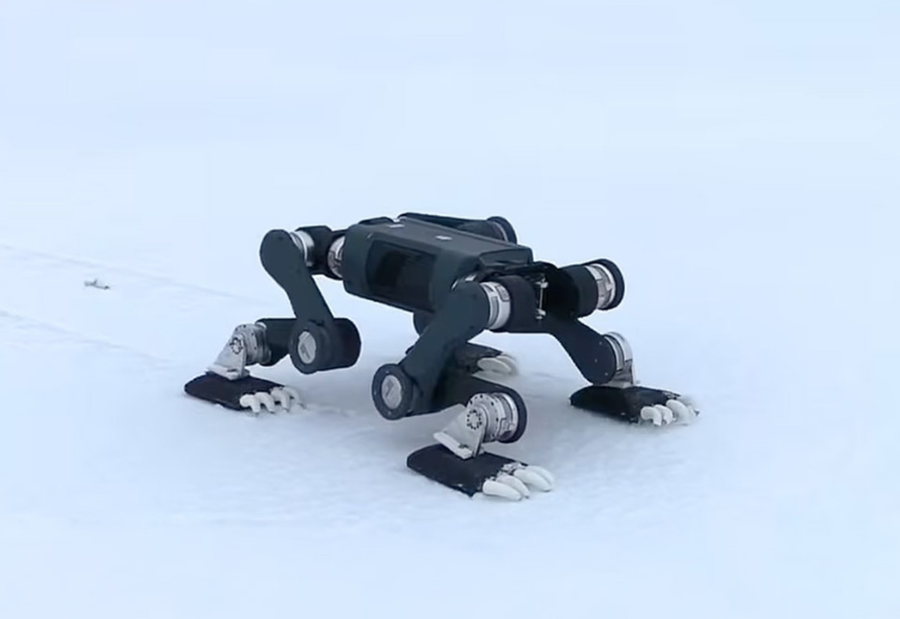
In a breakthrough for autonomous robotics, a modified Lynx S10 robot has successfully navigated Arctic Ocean ice floes, becoming the first quadruped robot to operate in one of the world’s most challenging environments.
Developed by China-based DEEP Robotics, the AI-powered robot was tested on unstable Arctic terrain where hidden meltwater pools, shifting ice, and snow-covered hazards make exploration difficult and risky for humans.
The mission demonstrated that compact autonomous machines can safely navigate unpredictable ice and snow conditions while collecting valuable environmental data. According to the DEEP Robotics team, “The Lynx S10 enables autonomous path planning and intelligent obstacle avoidance.”
Weighing less than 20 kilograms with its battery installed, the robot is designed for single-person transport and rapid deployment. It features 16 precision joints that allow it to bend, twist, and maneuver through complex terrain. The standard version can travel at speeds of up to 8 m/s, climb obstacles up to 50 centimeters high, and switch between wheeled and legged movement depending on surface conditions.
To navigate independently, the uses 4 ultra-wide-angle HDR cameras along with front and rear LiDAR sensors that create detailed 3D maps of its surroundings. These systems enable real-time obstacle detection and route planning without constant human control.
For the Arctic expedition, engineers introduced several modifications. Standard wheels were replaced with large biomimetic paws inspired by polar bear feet, helping distribute weight more effectively across snow and ice. Anti-slip textures and integrated crampons improved traction, while the it’s protection rating was upgraded from IP66 to IP67 for enhanced resistance to water intrusion.
Additional design changes allowed the robot’s limbs to function like paddles in mixed ice-and-water environments, enabling movement through slushy terrain that would challenge conventional robotic systems.
During testing, the Lynx S10 successfully crossed areas where snow concealed water beneath the surface and maintained stability across terrain that appeared solid but was actually floating above hidden meltwater pockets.
Researchers believe the technology could support environmental monitoring, climate research, and search-and-rescue operations in locations that are difficult or dangerous for humans to access. Data collected during the Arctic mission is now being used to further improve future versions of the robot.
Also read: Viksit Workforce for a Viksit Bharat
Do Follow: The Mainstream LinkedIn | The Mainstream Facebook | The Mainstream Youtube | The Mainstream Twitter
About us:
The Mainstream is a premier platform delivering the latest updates and informed perspectives across the technology business and cyber landscape. Built on research-driven, thought leadership and original intellectual property, The Mainstream also curates summits & conferences that convene decision makers to explore how technology reshapes industries and leadership. With a growing presence in India and globally across the Middle East, Africa, ASEAN, the USA, the UK and Australia, The Mainstream carries a vision to bring the latest happenings and insights to 8.2 billion people and to place technology at the centre of conversation for leaders navigating the future.