


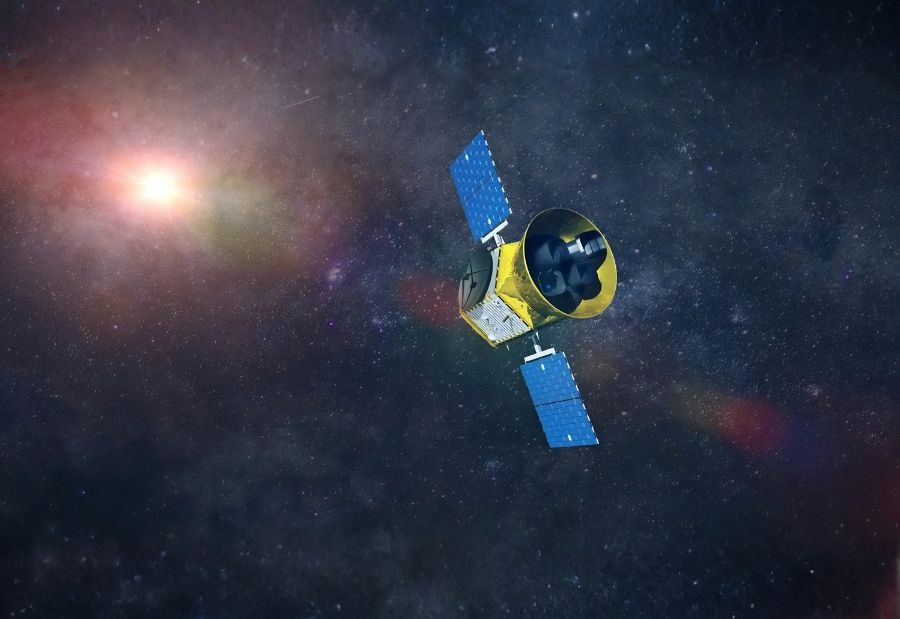
National Aeronautics and Space Administration (NASA) scientists have identified 27 new exoplanet candidates using data from the Transiting Exoplanet Survey Satellite (TESS), expanding the mission’s ability to detect worlds beyond the solar system through a new observational method.
Unlike traditional exoplanet discoveries that rely on planetary transits, the latest study focused on eclipsing binary star systems, where 2 stars orbit and periodically eclipse each other. Researchers analyzed subtle timing variations in these eclipses to identify the gravitational influence of possible planets.
Since its launch, TESS has discovered 885 confirmed exoplanets and identified more than 7,900 candidates, most of which were found through transit observations. Before this study, only 18 transiting planets had been identified in binary star systems, including 2 discovered by TESS.
Margo Thornton, doctoral candidate at University of New South Wales and lead author of the study, said: “Identifying transits in binary systems clearly is challenging, but we’d like to know more about the range of planets that can form around two gravitationally bound stars.”
The findings were published on May 4 in the journal Monthly Notices of the Royal Astronomical Society.
Researchers explained that studying planetary orbits in binary systems could help scientists better understand how planets form around multiple stars. Some theories suggest planets form close to the orbital plane of the stars, while others indicate more chaotic formation processes that create tilted or wider planetary orbits.
The team analyzed 1,590 binary systems using at least 2 years of TESS observations. According to co-author Benjamin Montet from UNSW Sydney, the extensive TESS dataset made it possible to calculate various orbital influences affecting eclipse timing and identify promising planet candidates.
Scientists estimate the newly identified candidates range from around 12 Earth masses to nearly 3,200 Earth masses, roughly equivalent to 10 times the mass of Jupiter. Future ground-based observations will be required to confirm the discoveries by measuring the gravitational pull exerted on host stars.
TESS has been operating since 2018 and continuously scans large sections of the sky, capturing images every 3 minutes to support a broad range of astronomical studies.
Allison Youngblood, TESS project scientist at NASA Goddard Space Flight Center, said: “The mission’s continuing data collection is a treasure trove that enables new findings across a wide range of astronomical topics.”
Also read: Viksit Workforce for a Viksit Bharat
Do Follow: The Mainstream LinkedIn | The Mainstream Facebook | The Mainstream Youtube | The Mainstream Twitter
About us:
The Mainstream is a premier platform delivering the latest updates and informed perspectives across the technology business and cyber landscape. Built on research-driven, thought leadership and original intellectual property, The Mainstream also curates summits & conferences that convene decision makers to explore how technology reshapes industries and leadership. With a growing presence in India and globally across the Middle East, Africa, ASEAN, the USA, the UK and Australia, The Mainstream carries a vision to bring the latest happenings and insights to 8.2 billion people and to place technology at the centre of conversation for leaders navigating the future.