


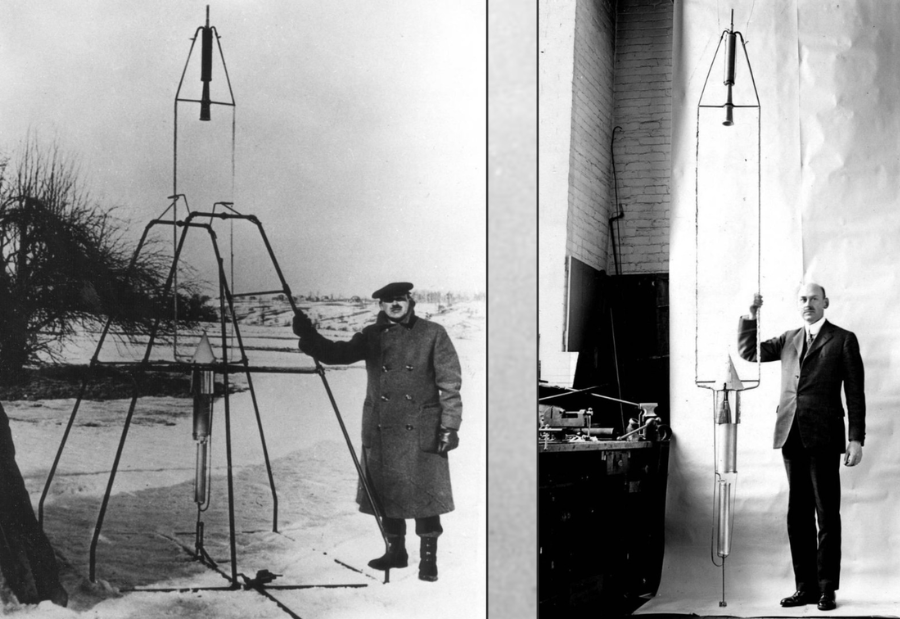
A century after the first liquid-fueled rocket took flight, its core technology continues to drive modern space exploration as NASA prepares to send astronauts back to the moon under the Artemis program.
On 16.03.1926, physicist Robert Goddard launched the world’s first liquid-fueled rocket from a field in Auburn, Massachusetts. The rocket rose just 40 feet, but marked the beginning of modern rocketry and laid the foundation for future space missions, including the first moon landing within 50 years.
Following this milestone, Goddard developed advanced systems that shaped the evolution of rockets used in military, satellite, and human spaceflight missions. His innovations became the basis for technologies still used in modern launch vehicles.
Today, Goddard is widely regarded as the father of modern rocketry. Several of his breakthroughs, including turbopumps, gimbaled engines, and gyroscopic guidance, remain critical to current rocket systems. His legacy continues through NASA’s Goddard Space Flight Center.
These technologies played a key role in historic missions such as Mercury, Gemini, Apollo, and later the Space Shuttle program. Now, they are central to NASA’s Artemis program, which aims to return humans to the moon.
Goddard’s original rocket, standing 10 feet tall, used liquid oxygen and gasoline at a time when most rockets relied on solid fuels. Unlike solid propellants, which burn continuously once ignited, liquid fuels allow controlled thrust and greater efficiency, making them essential for modern space missions.
NASA’s Space Launch System (SLS), a 322-foot rocket, uses a similar principle by combining liquid fuel and liquid oxygen to generate thrust. The system will power the upcoming Artemis 2 mission, which will carry astronauts Reid Wiseman, Victor Glover, Christina Koch, and Jeremy Hansen on a 10-day journey around the moon.
Artemis 2 will serve as the first crewed mission of the program and a critical step toward establishing a sustained human presence on the lunar surface. While this mission will not include a moon landing, it will test key systems for future missions.
NASA plans to follow this with Artemis 3 in 2027, focused on docking and lunar landing preparation, and Artemis 4 in 2028, expected to mark the first crewed lunar landing of the program.
The Artemis 2 launch is expected within the April 1–6 window, with the rocket scheduled to roll out from Kennedy Space Center on March 19.
From a 40-foot test flight to missions reaching beyond Earth, Goddard’s innovation continues to shape the future of space exploration.
Also read: Viksit Workforce for a Viksit Bharat
Do Follow: The Mainstream LinkedIn | The Mainstream Facebook | The Mainstream Youtube | The Mainstream Twitter
About us:
The Mainstream is a premier platform delivering the latest updates and informed perspectives across the technology business and cyber landscape. Built on research-driven, thought leadership and original intellectual property, The Mainstream also curates summits & conferences that convene decision makers to explore how technology reshapes industries and leadership. With a growing presence in India and globally across the Middle East, Africa, ASEAN, the USA, the UK and Australia, The Mainstream carries a vision to bring the latest happenings and insights to 8.2 billion people and to place technology at the centre of conversation for leaders navigating the future.