


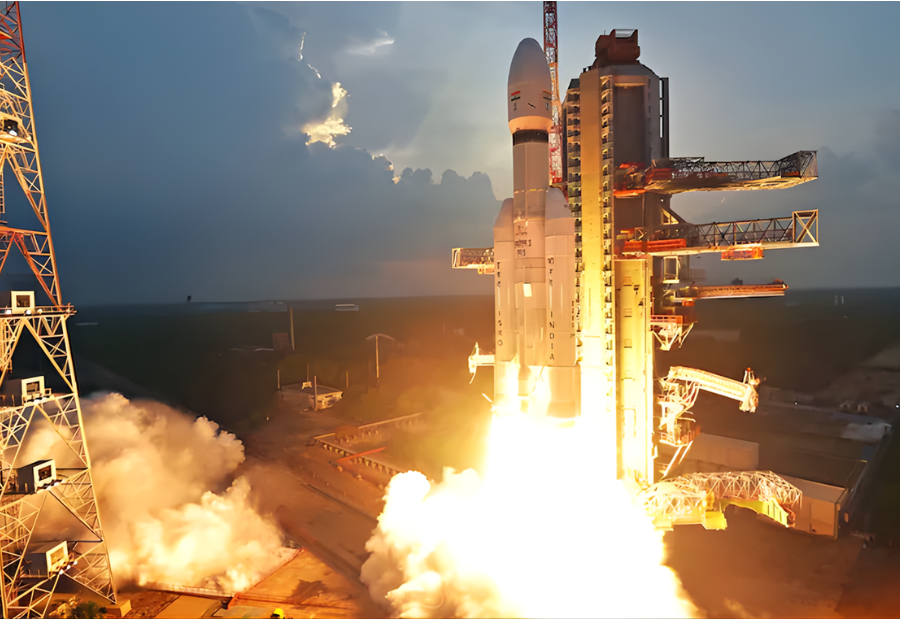
India’s space programme achieved a significant milestone after the Indian Space Research Organisation (ISRO) successfully tested a powerful CE20 cryogenic engine designed for the Launch Vehicle Mark-III (LVM3) rocket. The test was conducted at the ISRO Propulsion Complex in Mahendragiri, Tamil Nadu, marking a key step in strengthening India’s heavy-lift launch capabilities.
During the test, the CE20 engine achieved a 22-tonne thrust level, which is the force required to push a rocket upward against Earth’s gravity. The successful trial supports improvements to the LVM3, currently the most powerful rocket in ISRO’s fleet.
Advanced cryogenic technology
Cryogenic engines are among the most complex components of a rocket because they use fuels stored at extremely low temperatures. The CE20 engine operates on liquid hydrogen and liquid oxygen, which are cooled gases converted into liquid form.
Although these fuels are difficult to handle, they produce the high energy required to launch heavy satellites and space missions into orbit.
The recent test also evaluated several upgraded systems, including a nozzle protection mechanism that prevents the engine tail from overheating and a multi-element igniter, which works like a spark plug to ensure reliable engine ignition.
Engine performance validated
ISRO engineers tested the engine under high-pressure sea-level conditions to ensure reliable performance before launch. The engine ran for 165 seconds, demonstrating that it can withstand the extreme heat and stress experienced during real launch conditions.
The successful operation of the ignition system and nozzle protection mechanism confirmed that the upgraded engine design is more robust and reliable.
Key role in future space missions
The CE20 engine powers the upper stage of the LVM3 rocket, providing the thrust required once the rocket reaches higher stages of its flight. By pushing the engine to 22-tonne thrust, ISRO aims to ensure that the rocket can carry heavier payloads and advanced space missions.
The LVM3 rocket previously launched Chandrayaan-3, India’s historic lunar mission.
Supporting the Gaganyaan programme
Strengthening the CE20 engine is also important for India’s Gaganyaan human spaceflight programme. The mission aims to send Indian astronauts, known as Gaganyatris, into orbit.
The programme plans its first uncrewed flight in 2026, followed by a human spaceflight mission in 2027. The successful engine test demonstrates that the propulsion system can safely handle the thrust required for such missions.
With the CE20 engine proving its performance under demanding conditions, ISRO is moving closer to supporting heavier payload launches and future human spaceflight missions.
Also read: Viksit Workforce for a Viksit Bharat
Do Follow: The Mainstream LinkedIn | The Mainstream Facebook | The Mainstream Youtube | The Mainstream Twitter
About us:
The Mainstream is a premier platform delivering the latest updates and informed perspectives across the technology business and cyber landscape. Built on research-driven, thought leadership and original intellectual property, The Mainstream also curates summits & conferences that convene decision makers to explore how technology reshapes industries and leadership. With a growing presence in India and globally across the Middle East, Africa, ASEAN, the USA, the UK and Australia, The Mainstream carries a vision to bring the latest happenings and insights to 8.2 billion people and to place technology at the centre of conversation for leaders navigating the future.