


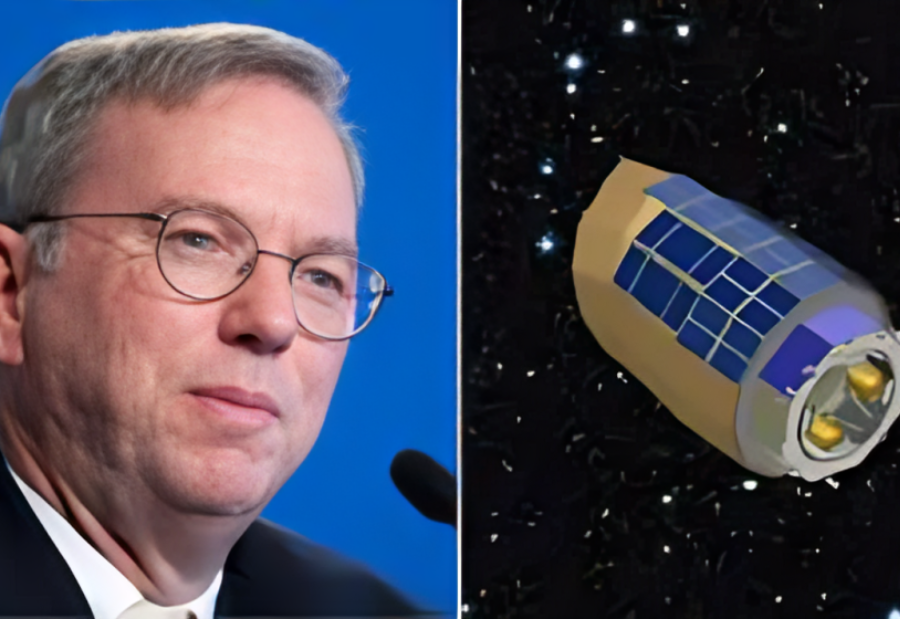
A new privately funded space telescope project could soon reshape the future of astronomy. Former Google chief Eric Schmidt and Wendy Schmidt are funding the development of a new observatory called Lazuli, which scientists say could be launched within 3–5 years.
The idea of private individuals supporting major scientific infrastructure is not new. When Yerkes Observatory opened in Wisconsin in 1897, it featured the world’s largest refractor telescope at the time, measuring 1 m (40 inches). The observatory also included advanced chemical and physical laboratories that supported the emerging field of astrophysics. The facility was funded by Charles Yerkes, a wealthy businessman whose fortune partly came from developing parts of the London Underground.
Private support for large scientific facilities was common in the past. However, after the Second World War, the scale and cost of projects increased significantly. Major telescopes and space missions, including Hubble, began to rely heavily on government funding. Today, large scientific observatories such as the James Webb Space Telescope and the Vera Rubin Observatory are mainly supported through public funding and national science agencies.
The newly announced Lazuli telescope could mark a shift back toward privately funded large-scale science projects. Lazuli will feature a 3 m (10 ft) mirror and will observe the universe in both optical and infrared wavelengths. This makes it larger than the Hubble Space Telescope.
The telescope will carry a sophisticated spectrograph and camera, along with a coronagraph designed to detect planets orbiting nearby stars. The entire project is being funded by Eric and Wendy Schmidt, with the investment likely reaching hundreds of millions of dollars.
According to the team behind the project, Lazuli could move faster than traditional space agency missions. The team plans to accept higher technical risks and use new technologies, particularly in camera design, that have not yet been proven in space.
If development stays on schedule, Lazuli could launch within 3–5 years.
By that time, astronomers expect a surge in alerts for short-lived cosmic events such as supernovae and novae. These alerts will come from new facilities like the Vera Rubin Observatory and gravitational-wave observatories.
Unlike Hubble, which usually requires several days to adjust to a new target, Lazuli is expected to respond to alerts in less than 4 hours, and possibly within 90 minutes. This rapid response capability could help scientists better understand the formation and evolution of black holes and other extreme cosmic objects.
The telescope may also contribute to solving the “Hubble Tension” problem in cosmology. This refers to the ongoing disagreement between different methods used to measure the expansion rate of the universe.
Lazuli’s onboard spectroscope will also allow scientists to quickly capture spectra from unusual cosmic explosions, including transient events such as AT2018cow. These observations may help explain why certain events remain bright in infrared light long after their initial explosion.
The telescope will also study the atmospheres of exoplanets using its 3 m mirror. In addition, the coronagraph will help discover planets in Jupiter-like orbits around nearby stars.
These discoveries could help prepare for future missions such as the Habitable Worlds Observatory, which aims to detect Earth-like planets around distant stars.
NASA’s upcoming Roman Space Telescope, expected to launch this year, also includes a similar instrument. However, Lazuli may gain a slight advantage because of its larger mirror and a design that prevents the secondary mirror from blocking the primary mirror.
If the accelerated timeline is achieved and the technical risks succeed, astronomers across many fields may benefit from this ambitious and generous privately funded scientific effort.
Also read: Viksit Workforce for a Viksit Bharat
Do Follow: The Mainstream LinkedIn | The Mainstream Facebook | The Mainstream Youtube | The Mainstream Twitter
About us:
The Mainstream is a premier platform delivering the latest updates and informed perspectives across the technology business and cyber landscape. Built on research-driven, thought leadership and original intellectual property, The Mainstream also curates summits & conferences that convene decision makers to explore how technology reshapes industries and leadership. With a growing presence in India and globally across the Middle East, Africa, ASEAN, the USA, the UK and Australia, The Mainstream carries a vision to bring the latest happenings and insights to 8.2 billion people and to place technology at the centre of conversation for leaders navigating the future.