


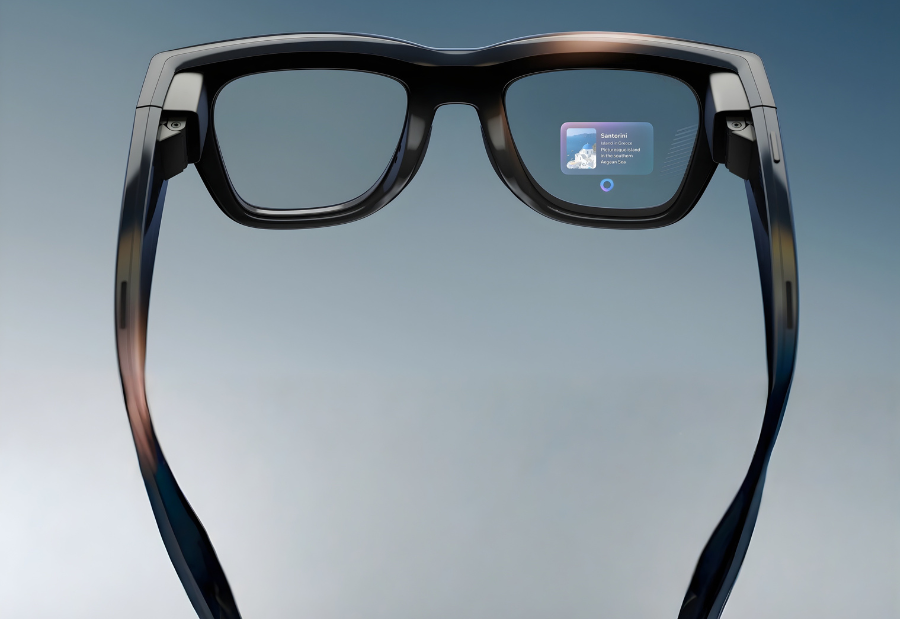
As interest in AI-powered eyewear grows, competition in the smart glasses market is intensifying. New players are preparing entries, and existing brands are pushing faster innovation. Among current challengers, Rokid’s AI Glasses Style, priced at $299, is drawing attention as one of the closest alternatives to Meta’s Ray-Ban smart glasses so far.
At first glance, the AI Glasses Style appear lightweight, listed at 38g. In real use, the weight rises to about 45g once lenses are fitted, only 3g lighter than Meta’s models at 48g–50g. This difference is noticeable but smaller than advertised. Comfort also differs. Rokid uses a nose-pad bridge, which can feel angular over time, while Meta’s smoother frame offers less pressure on the nose. Visually, Rokid’s design closely resembles classic Ray-Ban frames, though the plastic finish feels cheaper and slightly wider on the face.
Controls follow familiar gestures. Taps manage playback and assistant access, while swipes adjust volume. Rokid stands out with lens choices, offering prescription, progressive, polarized, transition, blue light, and tinted lenses.
Camera and audio are central features. The glasses use a 12MP Sony IMX681 sensor, shooting photos up to 3,024 × 4,032 pixels and video in 3K at 30fps. Multiple aspect ratios are supported, including 9:16, 3:4, and 4:3. Video recording lasts up to 10 minutes, compared with 3 minutes on Meta’s model. An LED light signals when recording. Audio is clear and loud, with music and podcast EQ modes, though sound is slightly tinny and calling can cause echo due to microphone pickup.
AI features expand usability. Navigation works by voice, offering turn-by-turn directions for walking, biking, or driving. Offline translation supports 6 languages: English, French, German, Japanese, Spanish, and simplified Chinese. Online translation uses a cloud AI model and is faster. “DuoTalk” converts speech into translated text and voice through the app. Other tools include reminders, call handling, audio recording with transcription, and image-based translation. The voice assistant responds quickly but may cut off input early.
Battery life is rated at 12 hours and held up under mixed use, compared with 8 hours on Meta’s model. Charging requires a magnetic dongle, and a charging case costs an extra $99. Bluetooth stability improved after a software update.
Overall, Rokid’s AI Glasses Style trade some comfort and finish for longer battery life and richer AI tools. While Meta still leads in design and audio balance, Rokid proves that competition in smart glasses is becoming serious.
Also read: Viksit Workforce for a Viksit Bharat
Do Follow: The Mainstream formerly known as CIO News LinkedIn Account | The Mainstream formerly known as CIO News Facebook | The Mainstream formerly known as CIO News Youtube | The Mainstream formerly known as CIO News Twitter
About us:
The Mainstream is a premier platform delivering the latest updates and informed perspectives across the technology business and cyber landscape. Built on research-driven, thought leadership and original intellectual property, The Mainstream also curates summits & conferences that convene decision makers to explore how technology reshapes industries and leadership. With a growing presence in India and globally across the Middle East, Africa, ASEAN, the USA, the UK and Australia, The Mainstream carries a vision to bring the latest happenings and insights to 8.2 billion people and to place technology at the centre of conversation for leaders navigating the future.