


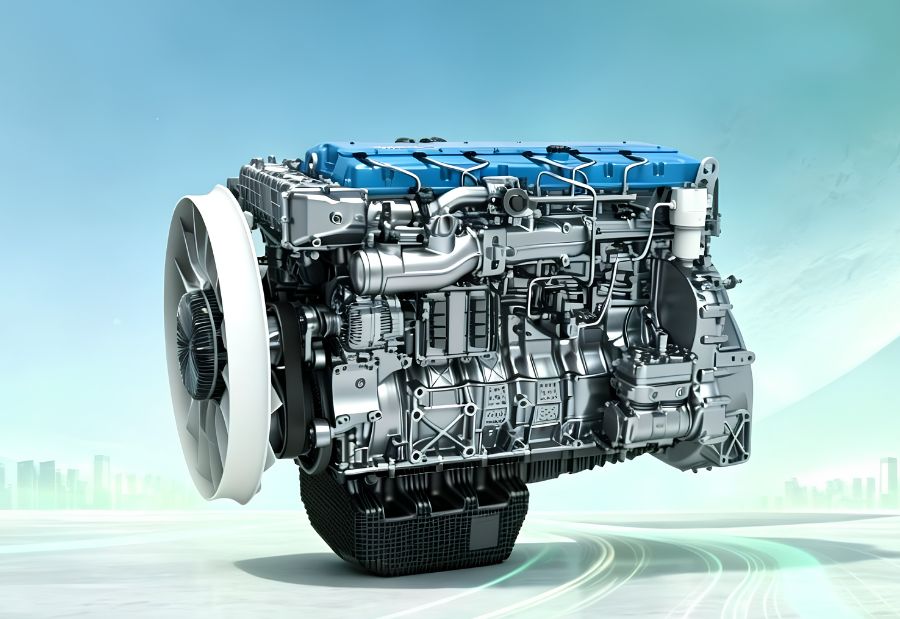
Marking a major step in hydrogen-powered transportation, China-based Weichai Power has announced that its WP15 hydrogen direct-injection engine has successfully met the China VI vehicle emission standard after completing testing at the CATARC Automotive Test Center.
The achievement makes it the world’s first heavy-duty hydrogen internal combustion engine to meet these regulatory requirements.
The 14.6-liter engine delivers 600 hp and 2,800 N·m of torque while achieving a peak brake thermal efficiency of 46.8%. Engineers evaluated the engine across a full operating cycle to test its structural stability and exhaust emissions.
“Testing covered a full range of operation conditions, including cold start, low-speed idling, high-speed full-load, and transient variable load changes, verifying the engine’s emission performance, reliability and stability in real-world applications,” said the company in a press release.
Unlike traditional port-fuel injection systems, the WP15 uses a dedicated hydrogen direct-injection, spark-ignited design. By injecting hydrogen directly into the combustion chamber, the engine reduces the risk of pre-ignition and backfiring, common challenges in port-injected hydrogen engines.
“Designed for zero-carbon heavy-duty transportation, the WP15 adopts a hydrogen direct-injection, spark-ignited architecture and delivers industry-leading performance,” added the press release.
The direct-injection system carefully controls the air-fuel mixture, allowing the engine to operate efficiently while preventing excessive pressure that could damage engine components. Optimized combustion geometry and precise spark timing help the engine convert more fuel energy into mechanical power, contributing to its 46.8% thermal efficiency.
From a manufacturing perspective, the engine shares more than 90% of its component architecture with conventional diesel powertrains. This allows it to fit into existing heavy-duty vehicle platforms with minimal modifications while maintaining standard load capacities and mounting configurations.
According to the company, the engine is suitable for long-haul trucks, mining dump trucks, port equipment, steel mill vehicles, and large hydrogen power generators. It can also operate on lower-grade hydrogen, reducing fuel purification requirements compared with fuel-cell systems.
The company said it will now accelerate mass production, support national hydrogen demonstration projects, and continue developing zero-carbon powertrain solutions for industrial decarbonization and the growth of the hydrogen energy sector.
Also read: Viksit Workforce for a Viksit Bharat
Do Follow: The Mainstream LinkedIn | The Mainstream Facebook | The Mainstream Youtube | The Mainstream Twitter
About us:
The Mainstream is a premier platform delivering the latest updates and informed perspectives across the technology business and cyber landscape. Built on research-driven, thought leadership and original intellectual property, The Mainstream also curates summits & conferences that convene decision makers to explore how technology reshapes industries and leadership. With a growing presence in India and globally across the Middle East, Africa, ASEAN, the USA, the UK and Australia, The Mainstream carries a vision to bring the latest happenings and insights to 8.2 billion people and to place technology at the centre of conversation for leaders navigating the future.