


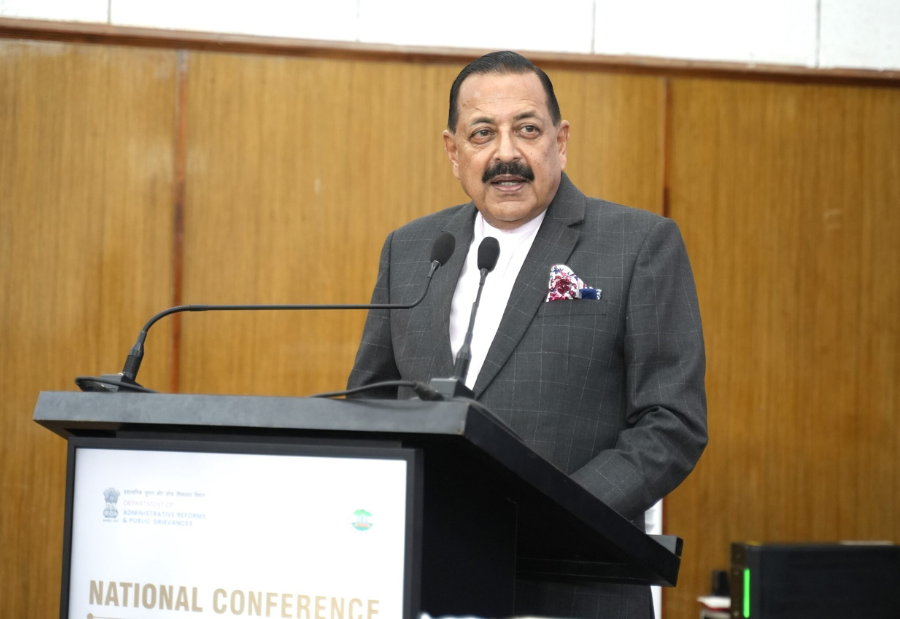
India is entering the next phase of governance transformation with a focus on artificial intelligence (AI), digital public infrastructure and citizen-centric administrative reforms, Union Minister Jitendra Singh said on Monday.
Inaugurating the two-day National Conference on Next Generation Administrative and e-Governance Reforms in Shillong, the minister said the government has laid the foundation for the next phase of reforms by removing nearly 2,000 obsolete rules over the past decade and shifting governance from regulation to facilitation.
Referring to Prime Minister Narendra Modi’s call for a “Reform Express” during the government’s third term, Singh said future reforms must integrate AI, cybersecurity, digital public infrastructure and digital citizen services to build an agile governance ecosystem capable of meeting the aspirations of Viksit Bharat@2047.
The conference has been jointly organised by the Department of Administrative Reforms and Public Grievances (DARPG) and the Government of Meghalaya. Meghalaya Chief Minister Conrad K. Sangma, DARPG Secretary Nivedita Shukla Verma, Chief Secretary Shakil P. Ahammed and senior officials from the Centre and states attended the inaugural session.
Describing administrative reforms as the backbone of India’s development journey, Singh said governance under Prime Minister Modi has been driven by transparency, accountability, digital empowerment and outcome-based administration. He added that citizens have increasingly become the focal point of policymaking and public service delivery.
The minister said organising governance conferences across different regions, rather than limiting them to New Delhi, has strengthened Centre-State collaboration and encouraged the sharing of best practices. Expressing confidence that the deliberations in Shillong would culminate in a “Shillong Declaration 2.0”, he said the outcome would help shape the next phase of governance reforms.
Highlighting the government’s focus on the Northeast, Singh said Prime Minister Modi’s nearly 80 visits to the region underscore its importance in India’s development agenda. He also praised Meghalaya’s governance initiatives, including the New Shillong Administrative City, and cited the Prime Minister’s recent mention of the state’s Living Root Bridges in Mann Ki Baat as recognition of its community-led development model.
On digital governance, Singh said more than 56 crore Jan Dhan accounts, Aadhaar-enabled service delivery, Direct Benefit Transfer (DBT) and the Unified Payments Interface (UPI) have transformed citizen-government interactions. He noted that UPI now processes over 18 billion transactions every month, making India a global leader in digital payments.
The minister also highlighted the expansion of the Centralised Public Grievance Redress and Monitoring System (CPGRAMS), saying annual grievances have risen from around two lakh in 2014 to nearly 25 lakh, reflecting growing public trust. The platform, he added, is now supported by AI-powered multilingual chatbots while retaining human oversight at the final stage of grievance redressal.
Listing key governance initiatives introduced over the past decade, Singh cited Digital Life Certificates based on facial recognition technology, e-Office, Prashasan Gaon Ki Ore, State Collaborative Initiatives and the National e-Services Delivery Assessment as measures that have improved transparency, efficiency and last-mile service delivery.
He said the government has repealed nearly 2,000 outdated rules and compliance requirements, replacing them with simpler and more citizen-friendly systems. Stressing that governance reforms are not limited to technology, Singh said administrative thinking must evolve alongside technological advancements.
The minister also highlighted the Special Campaign for Disposal of Pending Matters and Cleanliness, launched in 2021, saying it has generated over ₹4,000 crore through the disposal of scrap and obsolete materials while freeing nearly 700 lakh square feet of office space.
Calling on states and Union Territories to adopt successful governance models from one another, Singh said the next generation of reforms should prioritise AI-enabled public administration, integrated digital services, cybersecurity, process re-engineering, evidence-based policymaking and resilient institutions.
He said the conference should serve as a platform to accelerate governance reforms and contribute to the vision of Viksit Bharat@2047 through faster, smarter and more citizen-centric public administration.
Also read: Viksit Workforce for a Viksit Bharat
Do Follow: The Mainstream LinkedIn | The Mainstream Facebook | The Mainstream Youtube | The Mainstream Twitter
About us:
The Mainstream is a premier platform delivering the latest updates and informed perspectives across the technology business and cyber landscape. Built on research-driven, thought leadership and original intellectual property, The Mainstream also curates summits & conferences that convene decision makers to explore how technology reshapes industries and leadership. With a growing presence in India and globally across the Middle East, Africa, ASEAN, the USA, the UK and Australia, The Mainstream carries a vision to bring the latest happenings and insights to 8.2 billion people and to place technology at the centre of conversation for leaders navigating the future.