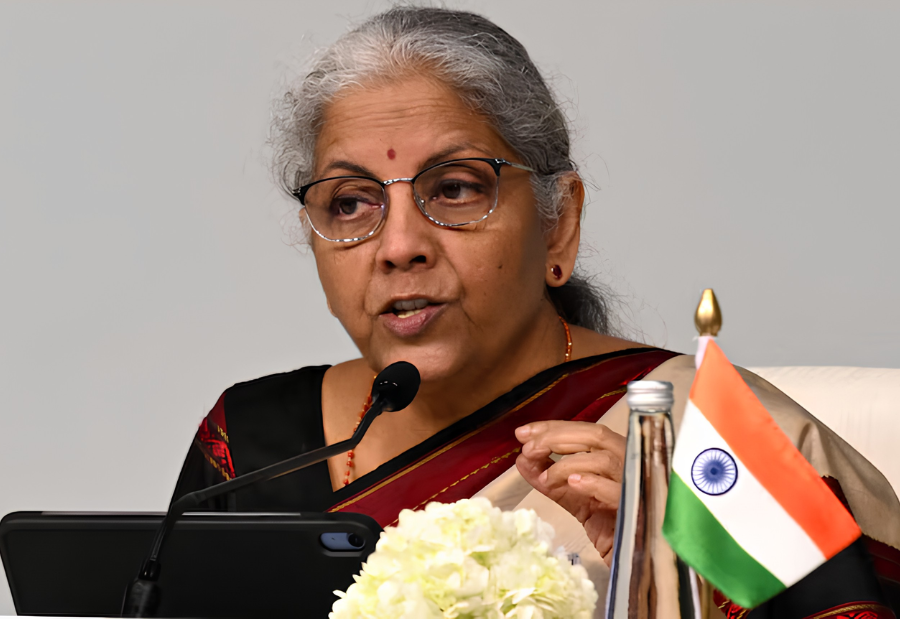
India’s improving fiscal health is enabling the government to balance growth priorities with economic stability, Finance Minister Nirmala Sitharaman said.
Addressing an event, she noted that disciplined fiscal management has created space to sustain capital expenditure and extend targeted support to sectors affected by the Middle East crisis. She added that this also gives the Reserve Bank of India flexibility to consider further rate cuts if required.
“Today, many countries with high debt and large deficits have no room to manoeuvre and they face a grim choice between austerity and instability,” she said. “India has fiscal space — room to maintain our capex programme, room for the RBI to cut rates, room to offer targeted support to affected sectors. This is the dividend of a decade of fiscal discipline. This is the strategic value of fiscal prudence that pays dividends across decades.”
India’s debt indicators remain stable. The general government debt-to-GDP ratio stands at about 81%, among the lowest for major economies after Germany. The IMF expects this to decline to 75.8% by 2030. External debt-to-GDP is at 19.1%, while foreign exchange reserves are above $688 billion, providing nearly 11 months of import cover.
The government has also taken steps to cushion the impact of rising crude oil prices. These include reducing excise duty on fuel and easing import duties on key petrochemical products to maintain supply stability.
Sitharaman highlighted growing global uncertainties, stating that the Middle East conflict has intensified energy risks and disrupted supply chains. Rising crude prices are also adding pressure on inflation and currency movements.
Despite these challenges, she said India’s macroeconomic position has strengthened due to sustained reforms and policy discipline. “This is not an involuntary outcome… it is the product of deliberate, sustained, and sometimes politically difficult choices made over years of fiscal management,” she said.
The Reserve Bank’s Monetary Policy Committee has begun its latest meeting, with expectations of a cautious approach amid inflation concerns linked to global volatility.
The government maintains that fiscal prudence will remain central to ensuring long-term growth, stability, and resilience.
Also read: Viksit Workforce for a Viksit Bharat
Do Follow: The Mainstream LinkedIn | The Mainstream Facebook | The Mainstream Youtube | The Mainstream Twitter
About us:
The Mainstream is a premier platform delivering the latest updates and informed perspectives across the technology business and cyber landscape. Built on research-driven, thought leadership and original intellectual property, The Mainstream also curates summits & conferences that convene decision makers to explore how technology reshapes industries and leadership. With a growing presence in India and globally across the Middle East, Africa, ASEAN, the USA, the UK and Australia, The Mainstream carries a vision to bring the latest happenings and insights to 8.2 billion people and to place technology at the centre of conversation for leaders navigating the future.