New findings from an international study have revealed that water ice buried in the Moon’s permanently shadowed regions (PSRs) has remained stable for billions of years, offering fresh insights into future lunar exploration.
The research involved scientists from Physical Research Laboratory, Indian Institute of Science Education and Research, and Indian Institute of Remote Sensing. The study, titled “Impacts into the lunar permanently shadowed regions”, was published in Nature on April 2.
“Moon’s permanently shadowed regions (PSRs) are capable of preserving water-ice and other frozen volatiles for billions of years if temperatures remain sufficiently low. Water ice is preserved on the PSRs of Moon’s South Pole, which have witnessed multiple impacts. (However,) 74% of PSRs are unaffected by impacts,” the study noted.
The findings come as global space agencies push toward crewed lunar missions, including Artemis II and India’s planned human mission to the Moon by 2040, with long-term goals of building lunar bases.
Using high-resolution orbital imagery and impact modelling, researchers mapped millions of craters ranging from 1 m to 20 m in size across PSRs between 85° and 90° south latitude. The study used data from NASA’s ShadowCam and the Chandrayaan-2 orbiter.
“In this study, 5 m-7 km diameter craters were mapped within the subset of PSRs greater than 1 km2 in area located between 85°–90°S latitude using ShadowCam, 1–20 m craters were mapped within the Connecting Ridge region near lunar south pole using both ShadowCam (Nasa) and Chandrayaan-2 Orbiter High-Resolution Camera (India) and an estimated count was produced,” the study said.
“Despite millions of impacts into the PSR and release of volatiles from the crater cavity, the lunar south pole region still has the potential to preserve shallow ice, making it a promising target for future India’s Chandrayaan-5 / LUPEX mission,” it added.
The study also suggests that while small craters may disturb buried ice, areas without impacts allow natural surface churning, known as “gardening”, to bring ice closer to the surface. This makes such regions ideal targets for future exploration and resource use.
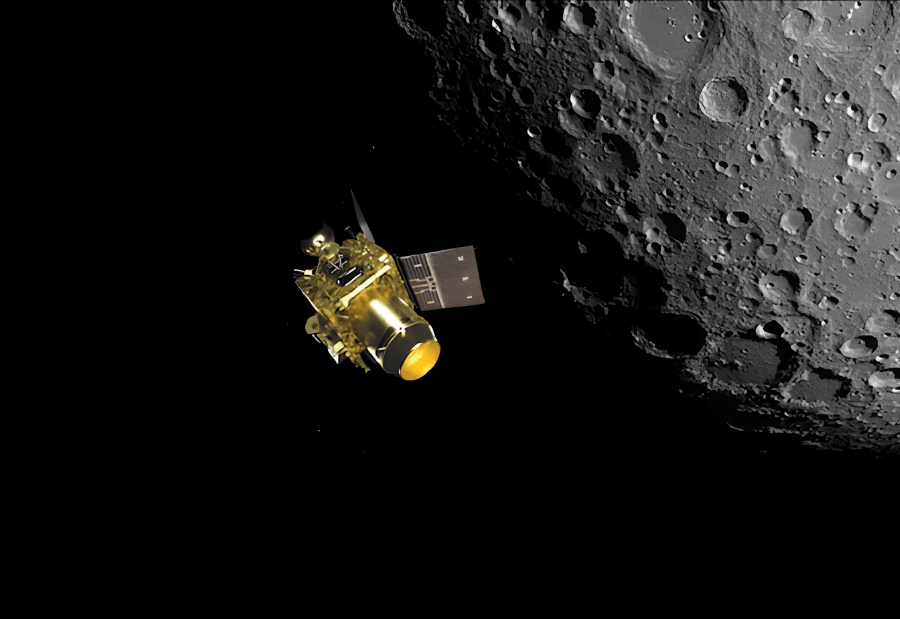
India’s Chandrayaan-1 first confirmed the presence of water on the Moon in 2008. Chandrayaan-2 validated its stability in polar regions, while Chandrayaan-3 provided further evidence of buried ice.
The upcoming Chandrayaan-5, a joint effort between ISRO and JAXA, is scheduled for launch around 2027-28. It aims to land near the Moon’s south pole using an Indian lander and a heavy Japanese rover to locate and analyse water ice.
Also read: Viksit Workforce for a Viksit Bharat
Do Follow: The Mainstream LinkedIn | The Mainstream Facebook | The Mainstream Youtube | The Mainstream Twitter
About us:
The Mainstream is a premier platform delivering the latest updates and informed perspectives across the technology business and cyber landscape. Built on research-driven, thought leadership and original intellectual property, The Mainstream also curates summits & conferences that convene decision makers to explore how technology reshapes industries and leadership. With a growing presence in India and globally across the Middle East, Africa, ASEAN, the USA, the UK and Australia, The Mainstream carries a vision to bring the latest happenings and insights to 8.2 billion people and to place technology at the centre of conversation for leaders navigating the future.