


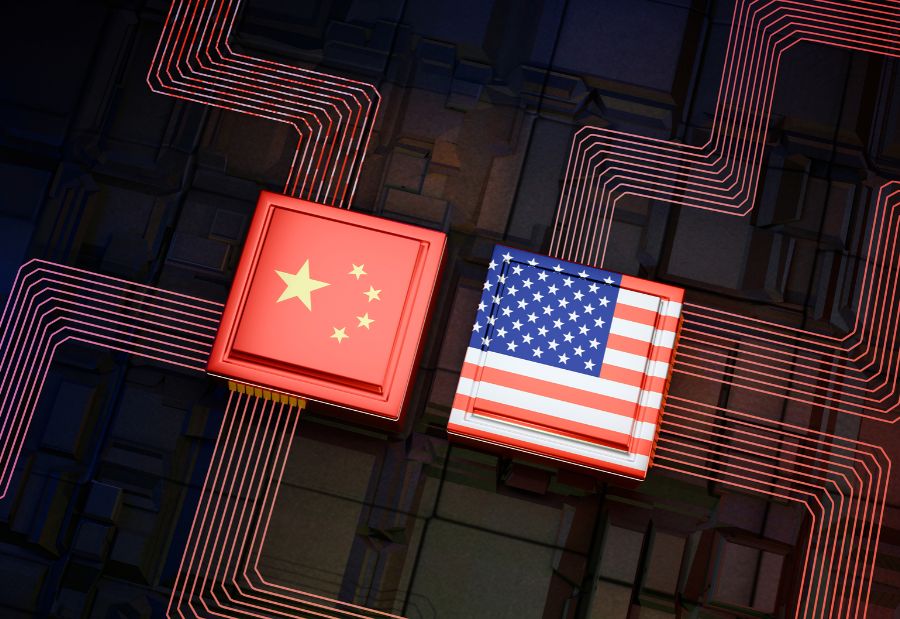
Artificial intelligence is rapidly becoming a defining factor in global economic and political power. But as the United States and China compete to establish leadership in the AI race, one question is becoming increasingly difficult to avoid: can the two countries cooperate on AI safety while fighting over control of the technology that makes it possible?
That question is expected to take centre stage as US President Donald Trump prepares to meet Chinese President Xi Jinping in Shenzhen during the Asia-Pacific Economic Cooperation (APEC) summit this week. While both countries are exploring ways to strengthen cooperation on artificial intelligence safety, growing tensions over semiconductor exports threaten to complicate the conversation.
At the heart of the disagreement is access to advanced AI chips. For Washington, restricting China’s access to sophisticated semiconductor technology is increasingly viewed through the lens of national security. For Beijing, these restrictions raise concerns about technological containment and the possibility of being locked out of the next phase of global economic growth.
The timing of the meeting is particularly significant. Renewed political scrutiny surrounding Nvidia and its co-founder Jensen Huang has added another dimension to the debate, strengthening calls among US lawmakers for tighter controls on advanced AI chip exports to China.
What is unfolding is no longer simply a trade disagreement between two economic powers. It is a contest over technological influence, computing infrastructure and the rules that could shape the global AI economy.
US-China Chip War: Why Semiconductor Export Controls Matter
Semiconductors have long been central to the global technology industry. However, the rapid expansion of artificial intelligence has elevated their importance from essential computing components to strategic national assets. Advanced AI processors are required to train and operate increasingly sophisticated models. They power everything from generative AI platforms and enterprise automation to scientific research, autonomous systems and military applications.
Companies such as Nvidia have consequently become central to the global AI ecosystem. Their chips provide the computing capabilities required by technology companies, cloud service providers, research institutions and governments seeking to expand their AI capabilities.
The United States has increasingly relied on semiconductor export controls to restrict China’s access to advanced processors and chip manufacturing technologies. Its concerns are rooted in the possibility that powerful computing capabilities could accelerate China’s military modernisation and strengthen its strategic capabilities.
China, meanwhile, has been working to reduce its dependence on foreign semiconductor technology while accelerating domestic innovation and manufacturing.
The resulting technology rivalry has created a difficult environment for global semiconductor companies. Access to one of the world’s largest technology markets is increasingly being weighed against export regulations, national security considerations and geopolitical relationships.
For businesses, the implications are substantial. Semiconductor restrictions can influence where products are sold, how supply chains are structured and where companies choose to invest in manufacturing and research.
The AI chip race is therefore becoming as much about controlling access to computing power as it is about developing the next generation of processors.
Nvidia Controversy Puts AI Chip Restrictions Under Fresh Scrutiny
The semiconductor debate has gained further momentum following the controversy surrounding Nvidia co-founder Jensen Huang.
According to Reuters, reports concerning Huang’s relationship with Alice Huang, a former executive at Singapore-based Megaspeed International, and US authorities’ suspicions about her alleged links to Chinese intelligence have intensified political scrutiny in Washington.
Huang has resigned from his leadership position following the controversy, while Nvidia’s independent directors have appointed an external law firm to investigate the matter. The allegations have not been independently established by Reuters, and US authorities have not reached a conclusion about Alice Huang’s alleged affiliation with the Chinese government. Beijing has also denied that she is a spy.
The controversy has nevertheless brought Nvidia’s role in the US-China semiconductor debate into sharper focus.
Huang had previously advocated allowing American semiconductor companies to continue selling advanced AI chips to China, arguing that maintaining access to the market would help preserve the competitiveness of US technology companies.
However, several US lawmakers have argued that providing China with access to powerful AI processors could accelerate its military and strategic capabilities.
The debate highlights the difficult balance facing Washington. Restricting exports may limit China’s access to advanced computing technology, but it could also affect the commercial interests of American semiconductor companies and encourage Chinese customers to accelerate the development of domestic alternatives.
A Reuters investigation published on November 11 adds another dimension to the issue. It reported that Northwestern Polytechnical University, a Chinese institution with defence-related research links and subject to US sanctions, had purchased Nvidia H200 chips through Chinese suppliers despite restrictions. The findings raised questions about the effectiveness of existing export controls and the challenges of monitoring indirect access to restricted technology.
The issue is no longer just about whether advanced chips can be exported. It is also about how effectively governments can monitor their movement across complex supply chains.
AI Safety Cooperation: Can Washington and Beijing Find Common Ground?
Despite their growing technology rivalry, the United States and China appear to recognise that the risks associated with increasingly powerful AI systems require some degree of international coordination.
According to known sources, officials from both countries have been discussing a proposed mechanism to notify each other about serious AI-related incidents that could potentially escalate into national security concerns. The proposal emerged from discussions involving US Treasury Secretary Scott Bessent and Chinese Vice Premier He Lifeng in September. The mechanism is intended to establish a communication channel through which both governments can share information about significant AI safety incidents.
However, the proposed arrangement is yet to become operational. Further discussions around the Shenzhen summit are expected to cover communication protocols and the exchange of best practices for testing advanced AI models. The proposal reflects an important shift in how AI governance is being approached. While governments continue to compete over AI capabilities, there is growing recognition that certain risks cannot be contained within national boundaries.
A serious AI-related security incident, for instance, could have consequences extending across financial systems, critical infrastructure, cybersecurity networks and national security institutions. Yet establishing meaningful cooperation will not be straightforward.
Questions remain around what qualifies as a serious AI incident, how much technical information countries would be willing to disclose and whether either side would share details that could reveal vulnerabilities in its own AI systems.
For two countries that increasingly view technological leadership as a strategic advantage, transparency comes with its own risks.
How the US-China AI Race Could Impact Global Businesses
The outcome of the US-China semiconductor rivalry will have consequences extending well beyond the two countries. Global technology companies operate through interconnected supply chains involving chip designers, manufacturers, equipment providers, cloud infrastructure companies and enterprise customers. Any significant change in semiconductor export policy can create ripple effects across this ecosystem.
For semiconductor manufacturers, tighter restrictions could mean reduced access to markets and greater regulatory uncertainty. For cloud service providers, access to advanced processors could influence infrastructure investments, capacity planning and the geographical expansion of AI services. Enterprise technology companies could also face new considerations when selecting AI infrastructure partners, deploying large-scale models or managing technology dependencies across markets.
The possibility of a more fragmented technology ecosystem is particularly important. As governments seek greater control over critical technologies, businesses may increasingly have to navigate different regulatory environments and technology standards.
This could lead to greater regionalisation of semiconductor supply chains, increased investment in domestic manufacturing and a stronger emphasis on technology sovereignty. The broader question is whether the global AI industry can continue to operate as an interconnected ecosystem while the countries controlling its most critical resources move towards competing technology blocs.
What US-China Semiconductor Tensions Mean for India’s AI Ambitions
For India, the evolving US-China technology rivalry presents both opportunities and challenges. As the country expands its artificial intelligence ambitions, access to advanced computing infrastructure, semiconductor technology and reliable global supply chains will become increasingly important.
India’s efforts to strengthen its semiconductor manufacturing ecosystem and expand domestic AI capabilities are taking place at a time when countries worldwide are reassessing their dependence on concentrated technology supply chains. A more fragmented semiconductor landscape could create opportunities for India to strengthen its position as a manufacturing, technology services and supply-chain partner.
However, building a competitive AI ecosystem will require more than attracting semiconductor investments. Access to advanced processors, reliable power infrastructure, data centre capacity, skilled talent and research capabilities will all play a role in determining how effectively India can scale its AI ambitions. The US-China rivalry also highlights the importance of strategic technology partnerships. India will need to balance its relationships across global technology markets while strengthening its domestic capabilities.
For Indian businesses, particularly those in banking, financial services, manufacturing, telecommunications and technology services, the availability and cost of AI computing infrastructure could become an increasingly important consideration. The semiconductor debate is therefore not a distant geopolitical concern. It has direct implications for the cost, availability and competitiveness of AI adoption in India.
The Future of AI Governance Will Depend on More than Technology
The upcoming Trump-Xi meeting brings a fundamental contradiction in global technology governance into focus. The United States and China recognise the importance of managing AI risks, yet remain deeply divided over access to the infrastructure that powers artificial intelligence. AI safety requires communication, transparency and cooperation. Technological competition, meanwhile, encourages countries to protect their capabilities, restrict access to critical resources and maintain strategic advantages.
Reconciling these competing priorities will be one of the biggest challenges for global AI governance. The Shenzhen discussions may not resolve the differences between Washington and Beijing. However, the willingness to establish even limited communication mechanisms could be an important step towards preventing technological competition from escalating into wider security concerns.
Ultimately, the global AI race will not be determined by algorithms and model capabilities alone. It will also depend on who controls the semiconductor supply chains, computing infrastructure and technology standards that underpin the industry. For businesses and governments around the world, the question is no longer whether the US-China AI rivalry will have an impact. It is how prepared they are for an AI economy increasingly shaped by geopolitical considerations.
Also read: Viksit Workforce for a Viksit Bharat
Do Follow: The Mainstream LinkedIn | The Mainstream Facebook | The Mainstream Youtube | The Mainstream Twitter
About us:
The Mainstream is a premier platform delivering the latest updates and informed perspectives across the technology business and cyber landscape. Built on research-driven, thought leadership and original intellectual property, The Mainstream also curates summits & conferences that convene decision makers to explore how technology reshapes industries and leadership. With a growing presence in India and globally across the Middle East, Africa, ASEAN, the USA, the UK and Australia, The Mainstream carries a vision to bring the latest happenings and insights to 8.2 billion people and to place technology at the centre of conversation for leaders navigating the future.