


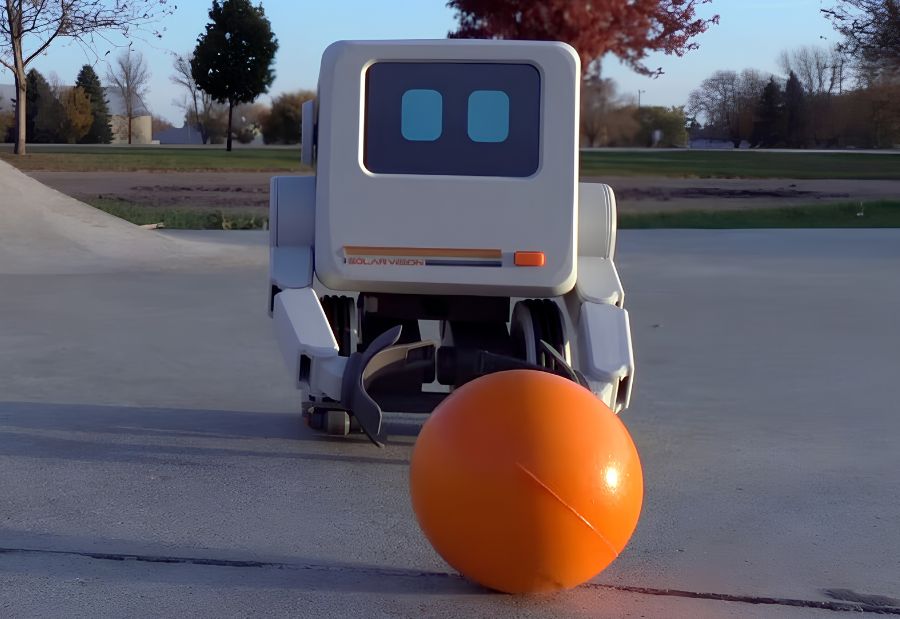
Affordable robotics is taking another step forward with a maker-built robot that can independently find, collect and return a ball without human assistance. Developed by Sector 07, the robot, named Fetch, completes the entire process using computer vision and autonomous movement. Built at an estimated cost of $300, the project demonstrates how focused AI technology can deliver practical results without expensive hardware.
Fetch operates through 4 stages: detecting a ball, approaching it, gripping it and returning it to a person. The robot moves across the floor while its camera searches for an orange ball. Once detected, its vision system uses the object’s bounding box to determine its position and guide the wheels towards it.
As it approaches the ball, Fetch extends its 2 3D-printed arms, moves forward and grips the object. Since the ball can disappear from the camera’s reliable viewing range at close distances, the robot uses a fixed forward-motion interval to complete the pickup. After securing the ball, it turns around, searches for a raised human hand, moves towards it and delivers the ball.
The robot is powered by an Arduino UNO Q. Its Linux-capable processor manages the camera feed and vision software, while a separate microcontroller controls the motors and servos. This division keeps movement responsive while handling demanding computing tasks. The board combines a Qualcomm processor with an STM32U585 microcontroller for real-time control. Most of Fetch’s body is 3D printed, with components designed to fit together using minimal screws.
Its detection system is trained to recognise only 2 objects: an orange ball and a human hand. Sector 07 used approximately 400 images, including 200 images for each category. These images were captured through the robot’s camera under different lighting conditions, floor surfaces and backgrounds.
The system uses Edge Impulse and YOLO-Pro, a compact object-detection framework that identifies objects through bounding boxes rather than creating a complete map of the surroundings. The robot’s control software converts these detections into specific actions, including approaching, gripping, turning and returning.
During initial testing, Fetch faced several challenges, including circular movement, close-range detection issues, failures under bright lighting and dropping the ball during release. The creator addressed these problems by adjusting motor speed ratios, grip timing and detection-confidence thresholds.
Mechanical reliability was established before software optimisation. The arms were tested for consistent gripping, while the chassis was checked for straight movement through manual trials. This helped reduce complications during autonomous testing. Similar focused robotic designs also demonstrate how machines built for specific tasks can perform effectively in challenging environments.
Fetch also features animated eyes, moving ear-like components and prerecorded voice lines created using ElevenLabs. These features do not control its movement or gripping functions. Instead, they make its internal operating states easier to understand and give the robot a distinct personality.
Sector 07 has made the complete project freely available through Arduino Project Hub, with Arduino sponsoring the build. The resources include 3D printing files, software code, circuit schematics, component lists, assembly instructions and development notes.
Other makers can use the project as a starting point to train the detector to recognise different objects or modify the robot’s structure for other tasks. Its documented AI model and separate computing architecture provide a practical foundation for building autonomous machines. At the other end of the robotics spectrum, humanoid projects such as the Melody Humanoid Robot highlight how development costs can reach $175,000.
Also read: Viksit Workforce for a Viksit Bharat
Do Follow: The Mainstream LinkedIn | The Mainstream Facebook | The Mainstream Youtube | The Mainstream Twitter
About us:
The Mainstream is a premier platform delivering the latest updates and informed perspectives across the technology business and cyber landscape. Built on research-driven, thought leadership and original intellectual property, The Mainstream also curates summits & conferences that convene decision makers to explore how technology reshapes industries and leadership. With a growing presence in India and globally across the Middle East, Africa, ASEAN, the USA, the UK and Australia, The Mainstream carries a vision to bring the latest happenings and insights to 8.2 billion people and to place technology at the centre of conversation for leaders navigating the future.