


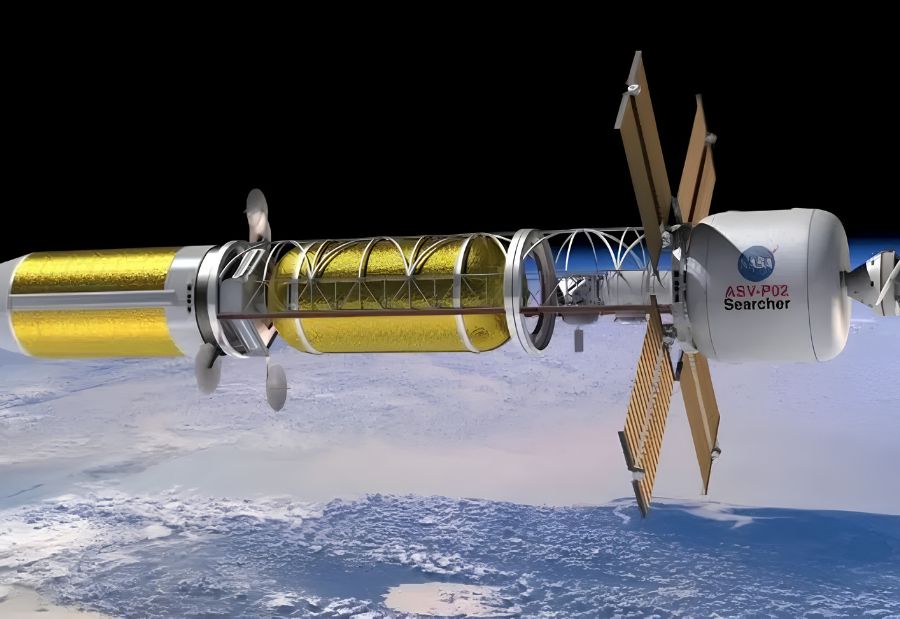
Nuclear technology is emerging as a promising option for future deep-space missions. NASA and the US Department of Energy (DOE) have signed a comprehensive agreement to develop, test and deploy advanced nuclear reactors and propulsion systems for space exploration. The partnership aims to support longer missions and expand human activity beyond Earth.
The agreement establishes a framework for cooperation across nuclear fuel production, advanced research, launch integration and operational safety. NASA Administrator Jared Isaacman and US Energy Secretary Chris Wright signed the deal at the Science: A Golden Age Summit in Washington, formalising a joint effort to strengthen US leadership in deep-space exploration.
“We are entering the ‘Nuclear NASA-era,’ which represents a major transformation for space exploration,” said Isaacman. “Nuclear power will allow us to go farther, operate longer, and field more capable spacecraft and instruments than ever before. The work we’re doing today is laying the foundation for the fission-powered spacecraft of tomorrow and opening an entirely new frontier for exploration and discovery.”
The agencies are advancing several nuclear technologies for future missions. The Space Reactor-1 Freedom mission, planned for 2028, will test fission-powered operations in deep space along a trajectory towards Mars. The mission is expected to lay the groundwork for the Lunar Reactor-1 surface power system, planned for 2030, which aims to supply electricity to lunar bases during extended periods of darkness.
Radioisotope power systems are also expected to support exploration missions. The Dragonfly rotorcraft, scheduled for launch in 2028, will use a radioisotope generator and 24 heater units to study the habitability of Saturn’s moon Titan. Similar radioisotope heater units will protect sensitive instruments aboard the European Space Agency’s Rosalind Franklin rover as it searches for signs of life in the cold Martian environment.
The agreement was signed during the summit hosted by the Office of Science and Technology Policy at the Donald J. Trump Institute of Peace in Washington. The partnership is scheduled to take effect on November 1, establishing a formal structure for cooperation between the 2 agencies.
“Thanks to President Trump, America’s nuclear renaissance is reaching a new frontier,” Wright said. “The Energy Department is proud to partner with NASA as we help American space missions reach uncharted territory.”
Nuclear electric propulsion could improve the efficiency of deep-space travel by providing continuous thrust. Compared with conventional chemical propulsion, these systems could help spacecraft achieve higher speeds and reduce travel times. Shorter journeys could also limit astronauts’ exposure to cosmic radiation, supporting crew health and improving safety during future crewed missions to Mars.
Interest in space nuclear technology is also growing internationally. China is developing compact megawatt-class fission reactors for deep-space travel and working with Russia on an automated nuclear power plant for the Moon to support a future joint research station.
Russia is also developing its Zeus nuclear-powered space tug. The system is designed to transport heavy payloads and remove orbital debris using megawatt-class electric propulsion.
Also read: Viksit Workforce for a Viksit Bharat
Do Follow: The Mainstream LinkedIn | The Mainstream Facebook | The Mainstream Youtube | The Mainstream Twitter
About us:
The Mainstream is a premier platform delivering the latest updates and informed perspectives across the technology business and cyber landscape. Built on research-driven, thought leadership and original intellectual property, The Mainstream also curates summits & conferences that convene decision makers to explore how technology reshapes industries and leadership. With a growing presence in India and globally across the Middle East, Africa, ASEAN, the USA, the UK and Australia, The Mainstream carries a vision to bring the latest happenings and insights to 8.2 billion people and to place technology at the centre of conversation for leaders navigating the future.