


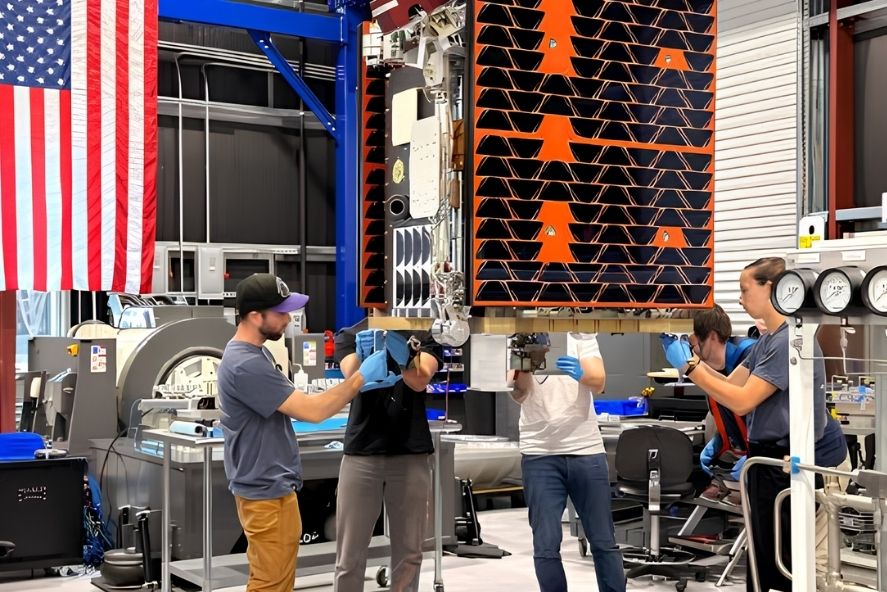
A new space mission supported by NASA aims to improve the safety of Earth’s orbit by testing technologies that could enable future satellite inspections, in-space repairs and orbital debris removal. The mission will bring a spacecraft close to satellites and other space objects that are no longer operational to assess their condition.
The Small Spacecraft Propulsion and Inspection Capability (SSPICY) mission launched on October 1, 2026, from Vandenberg Space Force Base in California. The technology demonstration will use an Otter spacecraft to approach up to 4 inoperable US-origin space objects in low Earth orbit, including satellites and rocket bodies.
In early 2027, the Otter spacecraft, developed by Starfish Space, will begin navigating to within hundreds of yards of each target to conduct inspections. It will use autonomous guidance and control software to operate with minimal input from ground controllers. Computer vision and onboard sensors will help the spacecraft make real-time navigation decisions as it approaches each object.
During these inspections, the spacecraft will collect information about each target, including its spin rate, orientation and surface condition. An electric propulsion system will help it travel between objects, while an articulating robotic boom will test the ability to direct the spacecraft’s thrusters for precise manoeuvres between different orbits.
The mission marks the first time these technologies will be tested together as an integrated system. The results could support the development of future autonomous spacecraft servicing and orbital debris inspection missions.
During SSPICY, the Otter spacecraft will not touch or dock with any satellites. Instead, it will test the technologies required for future missions to service or repair objects in orbit, or safely remove them by guiding them into Earth’s atmosphere for disposal.
The mission addresses growing concerns about orbital debris. Satellites and rocket bodies that malfunction or become inactive can break apart or collide with other objects, producing debris ranging from large fragments to tiny particles.
Thousands of satellites are launched each year to support communications, weather forecasting, navigation and other essential services. As activity in space increases, keeping Earth’s orbital environment safe for ongoing operations is becoming increasingly important.
Starfish Space developed and operates the Otter 24C spacecraft for the SSPICY mission. NASA’s Small Spacecraft and Distributed Systems program, part of the agency’s Research and Technology Mission Directorate, funds and manages the technology demonstration.
NASA’s Small Business Innovation Research / Small Business Technology Transfer programme has also supported Starfish Space through funding awards for the early development of the spacecraft’s key technologies and capabilities.
Also read: Viksit Workforce for a Viksit Bharat
Do Follow: The Mainstream LinkedIn | The Mainstream Facebook | The Mainstream Youtube | The Mainstream Twitter
About us:
The Mainstream is a premier platform delivering the latest updates and informed perspectives across the technology business and cyber landscape. Built on research-driven, thought leadership and original intellectual property, The Mainstream also curates summits & conferences that convene decision makers to explore how technology reshapes industries and leadership. With a growing presence in India and globally across the Middle East, Africa, ASEAN, the USA, the UK and Australia, The Mainstream carries a vision to bring the latest happenings and insights to 8.2 billion people and to place technology at the centre of conversation for leaders navigating the future.