


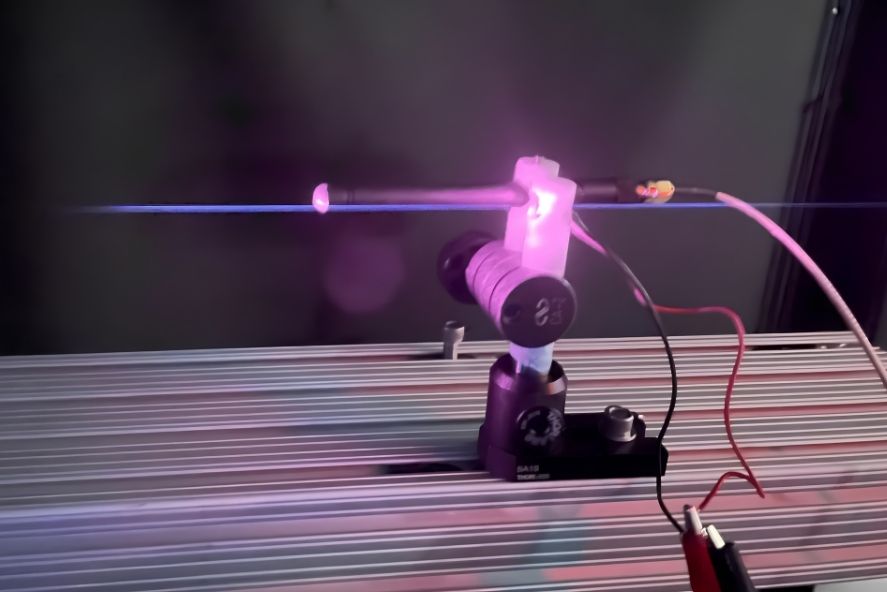
A new development in radio technology could change how antennas are designed and deployed. Researchers at North Carolina State University have demonstrated a laser-powered antenna that uses a narrow beam of plasma to transmit radio waves, resembling the glowing lightsabers from science fiction.
The technology could eventually enable antennas whose length and direction can be adjusted on demand. Potential applications include wireless communications, radar, satellites and space exploration.
“The plasma beam antenna looks like a lightsaber and is tunable, meaning we should be able to transmit across a broad range of frequencies,” said Prya Darshni, the corresponding author of the research paper and a Ph.D. student at North Carolina State University. She added that although the team has not yet demonstrated signal reception, the technology could potentially work as a receiver as well.
Paul Franzon, co-author of the paper and the Cirrus Logic Distinguished Professor of Electrical and Computer Engineering at the university, described the technology as a new approach to creating customised antennas without complex mechanical deployment systems.
Traditional antennas rely on their physical dimensions, particularly their length, to determine which radio frequencies they can transmit or receive efficiently. Adjusting these dimensions often requires mechanical components, which can create challenges in applications where equipment must remain compact, lightweight and reliable.
To address this limitation, the researchers explored using lasers to create antennas directly in the air. By adjusting the laser’s settings, they can control the length of the resulting plasma beam instead of physically extending or retracting a metal structure.
The process involves directing a laser through the air and controlling its power and beam diameter to ionise a narrow region. This strips electrons from atoms and molecules, producing plasma, often described as the 4th state of matter alongside solids, liquids and gases.
The resulting thin channel, known as a plasma filament, forms the antenna. However, transmitting radio waves also requires a way to deliver electrical energy to the plasma without a direct physical connection.
The team developed a contactless antenna feed using a metal ring that functions as a capacitor. The laser passes through the ring, creating a plasma filament within its electromagnetic field. When a radio frequency generator supplies a signal to the capacitor, the field interacts with the plasma and enables it to transmit radio waves.
Using this method, the researchers successfully demonstrated radio transmission at 30 megahertz (MHz), within the very high frequency (VHF) radio band.
The technology also offers potential control over the antenna’s direction. By steering the laser beam, users could adjust the plasma filament’s angle to direct radar sweeps or improve signal strength without relying on conventional mechanical systems.
Satellites and spacecraft are among the potential applications. Space missions face strict limits on equipment weight and size, while conventional antennas can require complex mechanisms to unfold after launch. A laser-generated antenna could eventually offer a more flexible alternative.
Franzon noted that low Earth orbit contains sufficient air to form plasma. However, the technology remains at an early experimental stage, and further research is needed to establish its performance under actual space conditions. Its ability to receive signals and operate across a wider range of frequencies also requires testing.
Darshni described the demonstration as an important first step, establishing that plasma filaments can function as transmitting antennas. The findings were published in the open-access paper “Laser-Induced-Plasma-Filament Antenna Transmitting 30 MHz VHF” in the IEEE Journal of Microwaves.
Arthur Dogariu, affiliated with Texas A&M University and Princeton University, co-authored the research and contributed to the experimental measurements. The team also acknowledged Chris Hewett, Byron Goode and Joe McElveen of NC State’s Instrument Shop for manufacturing the experimental components.
Also read: Viksit Workforce for a Viksit Bharat
Do Follow: The Mainstream LinkedIn | The Mainstream Facebook | The Mainstream Youtube | The Mainstream Twitter
About us:
The Mainstream is a premier platform delivering the latest updates and informed perspectives across the technology business and cyber landscape. Built on research-driven, thought leadership and original intellectual property, The Mainstream also curates summits & conferences that convene decision makers to explore how technology reshapes industries and leadership. With a growing presence in India and globally across the Middle East, Africa, ASEAN, the USA, the UK and Australia, The Mainstream carries a vision to bring the latest happenings and insights to 8.2 billion people and to place technology at the centre of conversation for leaders navigating the future.