


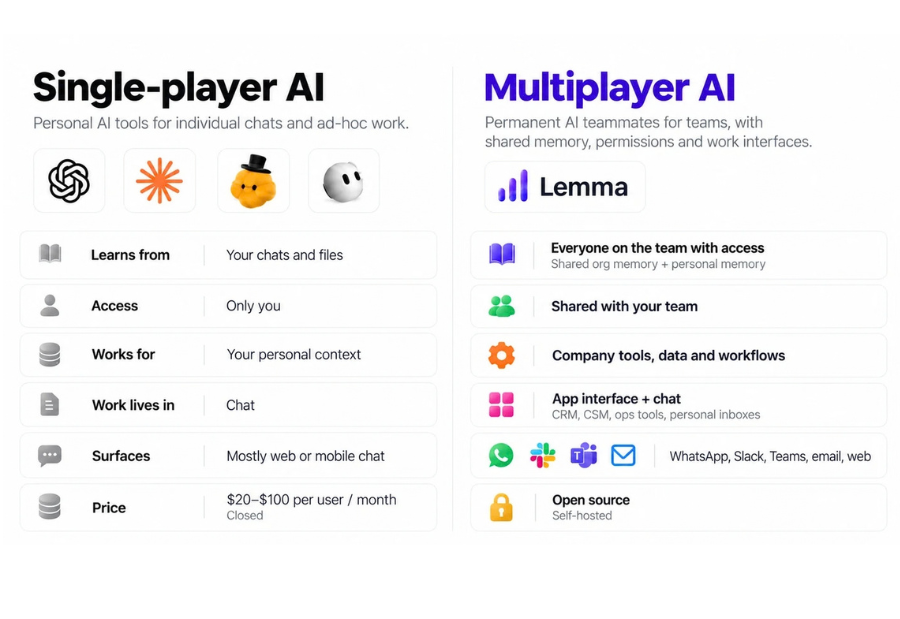
AI at work is moving beyond the chat window.
While most workplace AI tools today are built around individual conversations, Lemma is taking a different approach: AI teammates that can work with an entire team, retain context, take responsibility for ongoing tasks and continue working after employees log off.
The company has launched Lemma as an open-source platform for creating, training and sharing AI coworkers. Its vision is to move AI from being a tool people consult to becoming a persistent part of how work gets done.
From AI assistants to AI teammates
The first generation of workplace AI largely revolves around a simple interaction: a person opens a chat, explains what they need and receives an answer. The context often remains tied to that individual conversation.
Lemma is designed around a shared environment instead.
A team can give an AI teammate a defined responsibility, such as managing a product launch, coordinating customer onboarding, researching prospects or handling support requests. The teammate can then work with the people involved, learn from their instructions and corrections, and retain that knowledge for future work.
This creates a model where the AI is not simply answering questions but participating in an ongoing business process.
According to Lemma, each AI teammate operates within a persistent environment that brings together its context, memory, tools, applications, workflows, files and permissions. This allows people across a team to work with the same AI teammate while maintaining role-based access to information and actions.
Work that continues after the conversation ends
The bigger shift is from conversational AI to AI that can carry responsibility.
With Lemma, a teammate can be given a job and connected to the data and tools required to perform it. It can work through defined workflows, operate on schedules or respond to events, while human approvals can be built into consequential steps.
For example, an AI teammate managing a launch could maintain the launch brief, track assets and owners, check progress regularly, follow up on pending work and wait for an authorised person to approve something before it is published.
The work therefore does not disappear when a chat ends. It remains in shared records, applications, files and workflows that the wider team can access.
Lemma describes this as a move toward AI teammates for “ongoing work”, rather than AI assistants that simply provide responses on demand.
One AI teammate, many people
Another defining part of Lemma’s approach is that the AI is shared.
Employees can interact with the same teammate through the Lemma workspace as well as channels including Slack, Microsoft Teams, Telegram, WhatsApp and email. The underlying work remains connected rather than creating separate AI identities and fragmented conversations for each employee.
Permissions can also be configured according to individual roles. One person may be able to approve an action, another may be able to edit the underlying records, while the AI itself may have access only to the information and tools required for its assigned responsibility.
That model points to a future in which AI is increasingly embedded in organisational workflows rather than sitting outside them as another software window.
AI that builds the tools it needs
Lemma is also pushing the idea that AI teammates should not be limited to the tools that already exist.
The platform allows teammates to build applications around their work. These apps can sit on top of the same records, agents and workflows, giving teams purpose-built interfaces for processes that may previously have been managed through spreadsheets, email threads or disconnected software.
A launch teammate, for instance, could create a workspace for tracking assets and approvals. A support teammate could operate through a support application containing customer tickets and drafts. A sales-focused teammate could work with prospect information and follow-up workflows.
The result is a shift from asking AI to produce an output to giving AI an environment in which it can actually perform a job.
The direction: from copilots to coworkers
Lemma’s larger bet is that the next phase of enterprise AI will be defined less by smarter chatbots and more by AI workers that have context, responsibilities and boundaries.
In this model, teams do not repeatedly explain the same process to an AI. They teach it how the organisation works, correct it when necessary and allow those lessons to become part of its persistent working context.
Repeated tasks can become workflows. Recurring decisions can become agent roles. Corrections can become standing instructions. Over time, the AI teammate is intended to become more deeply integrated into the way a team operates.
This also changes the role of employees. Instead of using AI only to accelerate individual tasks, people can increasingly delegate parts of an end-to-end process while remaining responsible for decisions that require human judgement.
Open source as the foundation
Lemma is making this approach available as an open-source platform. Its core is licensed under AGPLv3, while its SDKs and related tooling use Apache 2.0 licences. The platform can be run on a user’s own infrastructure, on a local machine or through Lemma’s hosted environment.
It is also designed to be model-agnostic, allowing organisations to use Lemma-hosted models, their own provider keys or coding agents and compatible model providers.
That open architecture reflects Lemma’s broader view that AI teammates should become part of the organisation’s technology infrastructure, rather than remain another closed AI application.
Where workplace AI is headed
The launch points to a broader evolution in enterprise AI.
The question is increasingly moving from “What can AI answer?” to “What work can AI own?”
As AI systems gain persistent memory, access to business data, tools, workflows and permission structures, the workplace could move from AI copilots that assist individuals to AI teammates that participate in shared operations.
Lemma is betting that the future of workplace AI will not be another chat window.
It will be a digital coworker that knows the job, understands who is responsible for what, keeps working when people are away and leaves the work in a place where the entire team can pick it up.
Also read: Viksit Workforce for a Viksit Bharat
Do Follow: The Mainstream LinkedIn | The Mainstream Facebook | The Mainstream Youtube | The Mainstream Twitter
About us:
The Mainstream is a premier platform delivering the latest updates and informed perspectives across the technology business and cyber landscape. Built on research-driven, thought leadership and original intellectual property, The Mainstream also curates summits & conferences that convene decision makers to explore how technology reshapes industries and leadership. With a growing presence in India and globally across the Middle East, Africa, ASEAN, the USA, the UK and Australia, The Mainstream carries a vision to bring the latest happenings and insights to 8.2 billion people and to place technology at the centre of conversation for leaders navigating the future.