


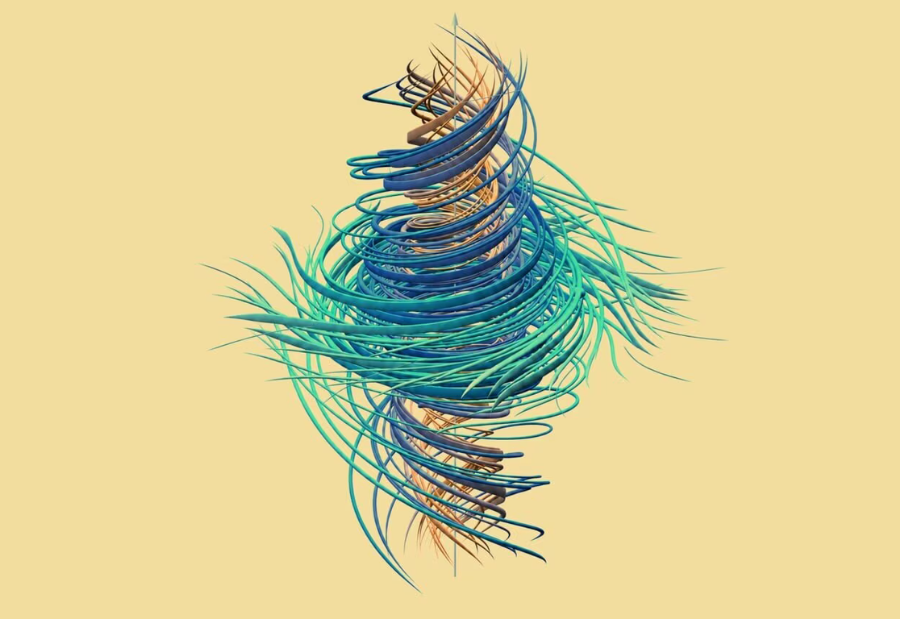
A major claim from OpenAI has put artificial intelligence and advanced mathematics in focus after the company said an internal AI system generated a solution to the 90-year-old 3D Navier–Stokes problem.
OpenAI said the system took 88 hours and involved 10,000 concurrent agents. The company does not plan to seek the official $1 million Millennium Prize, saying the result is intended to demonstrate the capabilities of its AI systems. However, mathematicians have already raised questions about the claim.
OpenAI’s AI-generated proof
In a blog post, OpenAI said it used “an internal model that is significantly more capable than GPT-6 Astra” to work on the problem. The Navier–Stokes equations use Newton’s second law of motion to describe how fluids move.
According to OpenAI, its internal AI model produced a proof showing that 3D Navier–Stokes equations can develop a singularity within finite time.
“The fluid has a smooth force applied to it, and its energy remains finite throughout the entire dynamics, from rest to the formation of the singularity. This resolves the Navier–Stokes Millennium Prize problem by establishing statement “C” (and also “D”) in the official Millennium Prize formulation,” OpenAI said.
The company used around 10,000 agents and millions of dollars in computing power. The multi-agent system generated the solution in about 88 hours, while Lean formalisation and verification took another 17 hours using GPT-6 Astra.
Across all attempted problems, the agents exchanged 4.9 million messages and used around 300 billion output tokens. For the Navier–Stokes problem alone, they sent 2.7 million messages and used around 130 billion output tokens.
OpenAI said it does not intend to claim the $1 million Millennium Prize. “Our goal in releasing this result is to report on the substantial progress of our AI models”, said OpenAI.
Mathematicians question the claim
New York University mathematician Tristan Buckmaster and Anthropic researcher Levent Alpöge, who have worked on related fluid dynamics problems, questioned whether OpenAI built on their research or accessed private Codex data.
OpenAI denied using private user data or searching unreleased research. In an X post, it said its researchers and AI agents did not access Alpöge and Buckmaster’s work before its public release.
“While unlikely, we cannot rule out that de-identified data derived from their usage of our products helped improve our models”, it said.
OpenAI added that the proofs differ significantly and that even the precise results proved are different in the Euler case.
Also read: Viksit Workforce for a Viksit Bharat
Do Follow: The Mainstream LinkedIn | The Mainstream Facebook | The Mainstream Youtube | The Mainstream Twitter
About us:
The Mainstream is a premier platform delivering the latest updates and informed perspectives across the technology business and cyber landscape. Built on research-driven, thought leadership and original intellectual property, The Mainstream also curates summits & conferences that convene decision makers to explore how technology reshapes industries and leadership. With a growing presence in India and globally across the Middle East, Africa, ASEAN, the USA, the UK and Australia, The Mainstream carries a vision to bring the latest happenings and insights to 8.2 billion people and to place technology at the centre of conversation for leaders navigating the future.