


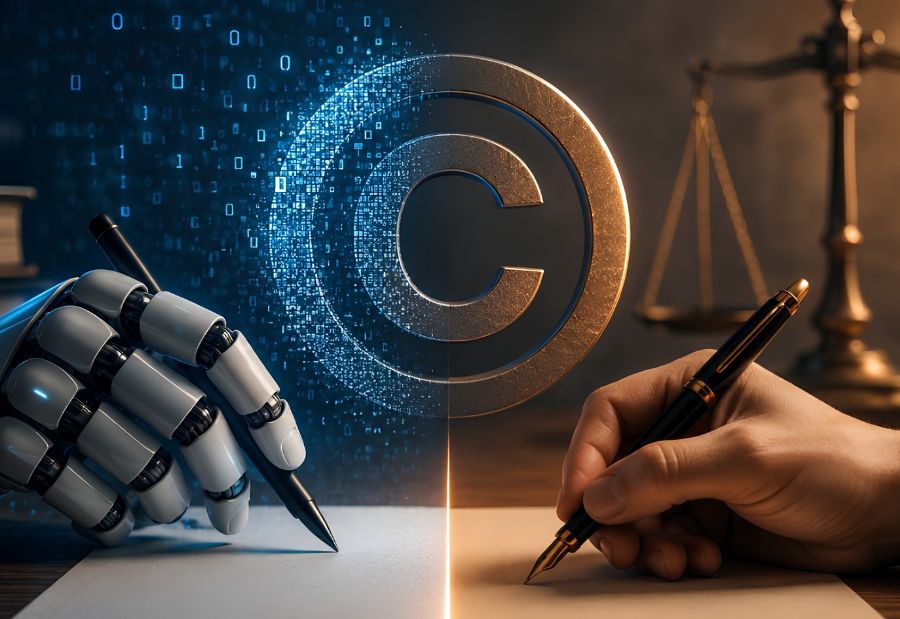
As AI becomes more autonomous, India’s copyright framework still places legal authorship firmly with humans.
An artificial intelligence system can produce an original piece of creative work, but it cannot currently claim authorship of that work under Indian copyright law. That distinction has emerged from a recent decision by India’s Copyright Office involving an artwork generated by an AI system.
The decision concerns A Recent Entrance to Paradise, an artwork created by DABUS, an AI system developed by US computer scientist Stephen Thaler. Thaler had sought copyright registration in India while naming DABUS as the author of the work.
The Copyright Office ultimately declined the application, not on the ground that the artwork was incapable of being original, but because the proposed author, DABUS, could not be recognised as a legal author under the existing statutory framework. The question was not simply whether AI created the artwork The case puts a more fundamental question at the centre of India’s rapidly evolving AI debate: when a machine produces creative output, who, in law, is responsible for creating it?
The Copyright Act, 1957, contains a specific provision for computer-generated works. Section 2(d)(vi) identifies the author of a computer-generated artistic work as the person who causes the work to be created.
The Copyright Office’s decision turns on that word: person.
DABUS, despite its ability to autonomously generate the artwork, does not have the legal status required to be treated as an author. The Office therefore did not accept the premise that the AI system itself could occupy the position of author and subsequently pass copyright ownership to Thaler.
Originality and authorship are two different questions One of the more significant aspects of the decision is that the Office did not treat AI involvement as automatically making a work ineligible for copyright. The artwork was considered against the requirement of originality, rather than being dismissed solely because it had been generated computationally.
This creates an important distinction for the technology and creative industries.
A work can potentially satisfy the requirement of originality even when AI has played a role in producing it. That, however, does not mean the AI system acquires copyright or becomes the legal author. In other words, the question of whether a work is original is separate from the question of who can legally be its author.
The decision also points towards a larger question surrounding ownership. If an AI system cannot legally qualify as the author, the question of how copyright ownership would arise from an entirely autonomous AI-generated work becomes considerably more complicated.
Parliament, not administrative interpretation The Copyright Office has also drawn a boundary around its own role. Whether artificial intelligence should eventually receive some form of legal recognition as an author, according to the decision, is ultimately a matter for the legislature. Such a change would require a policy and legislative decision rather than an administrative reinterpretation of the existing Copyright Act.
The decision comes at a time when businesses are using generative AI across advertising, publishing, design, filmmaking, software development and content production. For companies, the ruling raises an important practical consideration: simply using an AI system does not settle the question of copyright ownership.
The extent of human involvement, the nature of the instructions provided, the selection and modification of outputs, and who can legally be considered to have caused the work to be created could become increasingly important in determining rights over AI-assisted creative output. The DABUS case therefore does not close the door on copyright protection for works created with AI. Instead, it draws a line around the legal status of the machine itself. For now, India’s position is clear: AI may be capable of creating original expression, but under the current law, it cannot be the legal author of that work.
The larger question, however, remains open: as machines become more autonomous, will copyright law continue to place authorship exclusively in human hands, or will lawmakers eventually redraw the boundary?
Also read: Viksit Workforce for a Viksit Bharat
Do Follow: The Mainstream LinkedIn | The Mainstream Facebook | The Mainstream Youtube | The Mainstream Twitter
About us:
The Mainstream is a premier platform delivering the latest updates and informed perspectives across the technology business and cyber landscape. Built on research-driven, thought leadership and original intellectual property, The Mainstream also curates summits & conferences that convene decision makers to explore how technology reshapes industries and leadership. With a growing presence in India and globally across the Middle East, Africa, ASEAN, the USA, the UK and Australia, The Mainstream carries a vision to bring the latest happenings and insights to 8.2 billion people and to place technology at the centre of conversation for leaders navigating the future.