


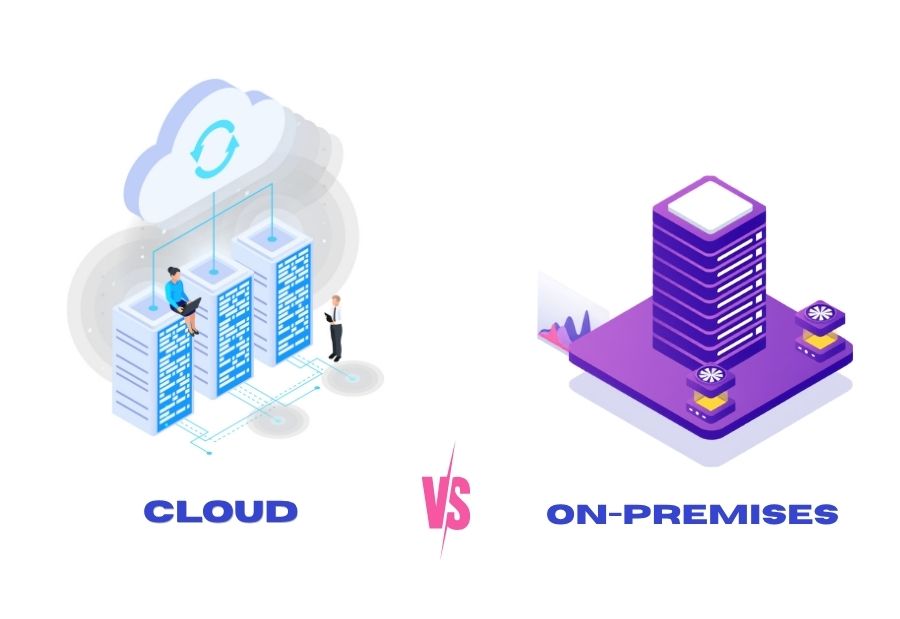
Cloud vs on-premises infrastructure is an important decision for enterprises planning their technology strategy. Cloud platforms offer flexibility, faster deployment and easier scaling, while on-premises infrastructure gives organizations greater control over their systems and data. The right choice depends on business needs, security requirements, workload types, budget and long-term technology goals.
Cloud and On-Premises: The basic difference
Cloud infrastructure runs computing resources through a service provider. Businesses can access servers, storage, applications and other resources without owning and maintaining all the underlying hardware.
On-premises infrastructure, in contrast, is hosted within an organization’s own facilities. The business is responsible for purchasing equipment, managing systems, maintaining hardware and handling upgrades.
Neither model is automatically better. The decision should be based on what the enterprise needs from its technology environment.
Cloud Infrastructure: Where it has an advantage
Cloud computing has become popular because enterprises can access technology resources without making large upfront investments in physical infrastructure.
One of its biggest advantages is scalability. Businesses can increase or reduce resources as demand changes. This can be particularly useful for organizations dealing with seasonal demand, expanding digital services, or growing AI workloads.
Cloud platforms can also help technology teams deploy new applications faster. Infrastructure can be provisioned without waiting for physical equipment to be purchased, installed and configured.
Other benefits include:
- Flexible resource allocation
- Faster deployment
- Access to managed services
- Easier support for distributed teams
- Reduced dependence on physical data centre operations
However, cloud adoption also requires careful management. Uncontrolled resource usage can increase costs, while poor configurations can create security and compliance concerns.
On-Premises Infrastructure: where it still makes sense
On-premises infrastructure remains relevant for enterprises that require greater control over their technology environment.
Organizations with sensitive workloads may prefer to keep certain systems within their own facilities. Some businesses may also have legacy applications that are difficult or expensive to move to the cloud.
On-premises environments can provide greater control over hardware, configurations, network architecture and data location. However, that control comes with responsibility.
Enterprises must manage hardware upgrades, maintenance, cooling, power, security, backups and system availability. Scaling can also take longer because additional physical resources may need to be purchased and installed.
Cloud vs On-Premises Infrastructure: Key factors to compare
There is no universal answer to the cloud vs on-premises infrastructure debate. Enterprises should evaluate several factors before making a decision.
Cost: Cloud generally shifts spending toward ongoing usage, while on-premises infrastructure involves greater upfront investment and continuing maintenance costs.
Scalability: Cloud environments can usually scale resources more quickly. On-premises systems may require additional hardware.
Control: On-premises infrastructure provides direct control over physical systems, while cloud environments depend on the provider’s infrastructure.
Security: Both approaches can be secure when properly designed and managed. Security depends heavily on configuration, access controls, monitoring and operational practices.
Compliance: Organizations should consider data location, industry and regulatory requirements when selecting an infrastructure model.
Why hybrid infrastructure is gaining attention
For many enterprises, the choice does not have to be entirely cloud or entirely on-premises.
A hybrid infrastructure combines both approaches. Businesses can keep specific workloads on their own infrastructure while using cloud services for applications that need flexibility and scalability.
For example, an organization could retain sensitive legacy systems on-premises while using cloud infrastructure for analytics, collaboration, application development, or selected AI workloads.
This model can provide flexibility while allowing businesses to maintain control over workloads that have specific requirements.
What should enterprise technology leaders choose?
CIOs should avoid selecting infrastructure based only on industry trends. Instead, they should assess each workload individually.
Questions around data sensitivity, application dependencies, performance, scalability, cost, security, compliance and future growth should guide the decision.
AI adoption is also changing infrastructure planning. AI workloads may require significant computing capacity, making cloud resources attractive for some organizations while dedicated infrastructure may make sense for others with predictable, long-term requirements.
The Mainstream covers cloud computing, AI, cybersecurity, enterprise technology and digital transformation to help technology leaders understand these evolving infrastructure decisions.
Conclusion
The cloud vs on-premises infrastructure decision depends on the enterprise, its workloads and its strategic priorities. Cloud offers flexibility and scalability, while on-premises infrastructure provides greater direct control. For many businesses, a hybrid approach may provide the most practical balance.
The best infrastructure strategy is not about choosing the most popular option. It is about building an environment that is secure, scalable, cost-conscious and aligned with long-term business goals.