


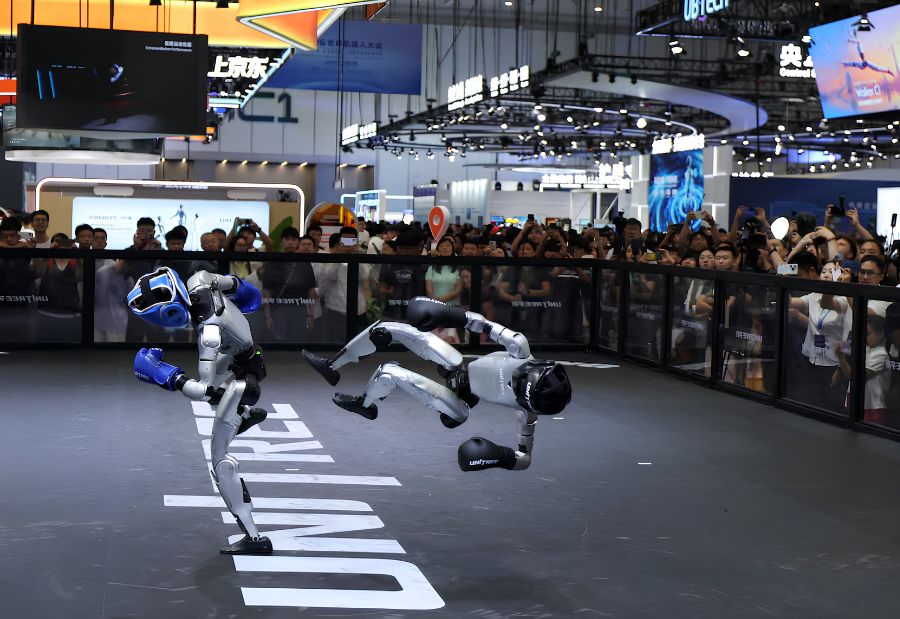
The humanoid robotics industry may be approaching a major turning point, as advances in AI models bring machines closer to handling everyday tasks with limited human instruction. Unitree founder and CEO Wang Xingxing said the sector is moving towards a “ChatGPT moment” for embodied intelligence.
His comments came after Unitree’s strong debut on China’s Shanghai stock market highlighted growing investor interest in humanoid robots and Beijing’s ambition to lead the next stage of AI-powered machines.
Unitree’s shares fell 11% on Thursday, a day after surging nearly 6 times during their market debut. The company is one of China’s best-known humanoid robot makers and has strong backing from the country’s growing robotics ecosystem.
“We are marching towards a ‘ChatGPT moment’ in embodied intelligence,” Wang said at a major robot conference in Beijing.
ChatGPT’s launch in late 2022 triggered widespread adoption of generative AI. Robotics has yet to experience a similar breakthrough in world models, which help physical AI systems understand and operate in real-world environments.
Wang said the industry is moving towards a stage where robots could enter unfamiliar environments and complete most tasks using simple voice or text instructions.
“We hope that in the future, we can see a robot be introduced into an unfamiliar household and it can achieve approximately 80% of tasks successfully through voice or text commands,” he said.
He described this as “an important tipping point for the robot industry to usher in explosive growth.” However, Wang said a major software breakthrough could arrive within 2–3 years in an optimistic scenario, or within 5–10 years at the latest.
Robotics consultancy Stieler said Wang remained cautious about the industry’s current capabilities despite the enthusiasm surrounding the World Robot Conference and Unitree’s IPO.
Unitree is the world’s largest producer of robot dogs and the 2nd-largest humanoid robot maker by shipments. The company became known for choreographed robot performances and is increasingly deploying machines in industrial environments. Its IPO prospectus shows that universities and research institutions make up most of its customers.
Galbot founder Wang He expects the sector’s “ChatGPT moment” by 2028, defining it as the point when robots can complete around 70%–80% of everyday tasks without specialised training.
Unitree’s Wang said world models currently receive the company’s largest investment in capital and manpower. He also acknowledged that the company is “lagging behind” in real-world applications of physical AI and said humanoids are not yet capable enough for mass deployment.
China delivered more than 40,000 humanoid robots in the 1st half of this year and accounted for 97% of global humanoid shipments, according to a Chinese industry report.
Beijing sees robotics as a potential way to replace human labour in repetitive, dangerous and low-value work as its workforce shrinks. However, humanoids remain less efficient than human workers in most applications.
The technology has also become part of the wider US-China technology rivalry. Last month, the US Federal Communications Commission banned future imports of foreign-made humanoid and quadruped robots over national security concerns.
Several companies at the Beijing conference said they were looking to expand internationally.
Also read: Viksit Workforce for a Viksit Bharat
Do Follow: The Mainstream LinkedIn | The Mainstream Facebook | The Mainstream Youtube | The Mainstream Twitter
About us:
The Mainstream is a premier platform delivering the latest updates and informed perspectives across the technology business and cyber landscape. Built on research-driven, thought leadership and original intellectual property, The Mainstream also curates summits & conferences that convene decision makers to explore how technology reshapes industries and leadership. With a growing presence in India and globally across the Middle East, Africa, ASEAN, the USA, the UK and Australia, The Mainstream carries a vision to bring the latest happenings and insights to 8.2 billion people and to place technology at the centre of conversation for leaders navigating the future.