


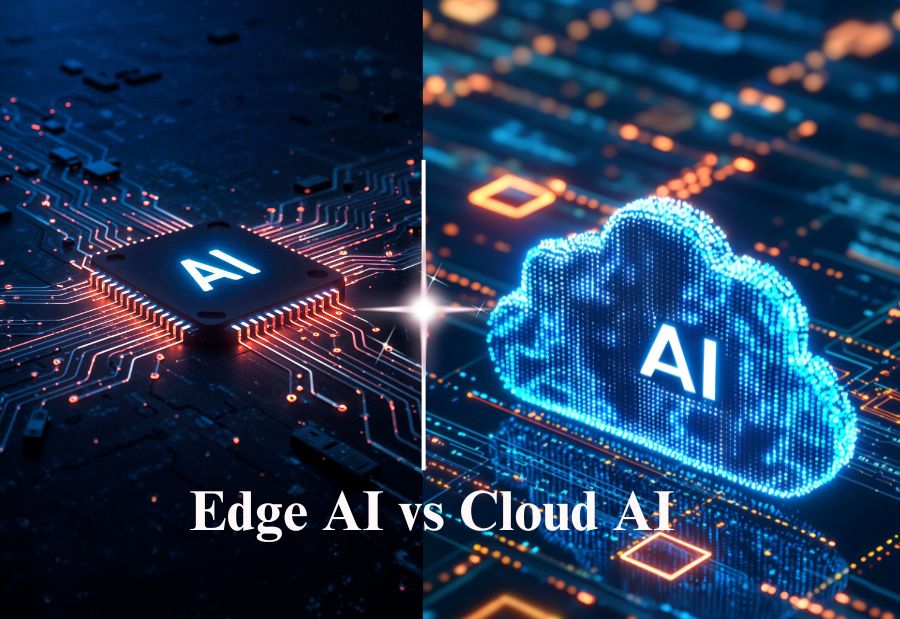
Artificial intelligence is helping businesses improve efficiency, automate routine work and make faster decisions. As AI adoption continues to grow, enterprise leaders are faced with an important question: should they process AI workloads at the edge or in the cloud?
The discussion around edge AI vs cloud AI is not about choosing one technology over the other. Instead, it is about understanding which approach best supports specific business goals. Each strategy offers unique advantages and the right choice depends on factors such as speed, scalability, security and operational requirements.
Understanding these differences helps organizations build AI strategies that deliver long-term value.
Understanding edge AI and cloud AI
Edge AI refers to running AI applications directly on devices or near the location where data is generated. This allows information to be processed locally without always sending it to a central data center or cloud platform.
Cloud AI, on the other hand, processes data in cloud environments using powerful computing infrastructure. This approach gives businesses access to advanced AI capabilities while reducing the need for high-performance hardware at every location.
Both approaches support enterprise innovation, but they solve different business challenges.
When edge AI makes more sense
Edge AI is well-suited for situations where quick decision-making is essential.
Manufacturing facilities, connected vehicles, healthcare devices and retail systems often require immediate responses. Processing data closer to the source reduces delays and allows systems to continue operating even if internet connectivity is limited.
Edge AI can also help organizations manage sensitive information locally, making it useful for environments with strict privacy or regulatory requirements.
Why do many businesses prefer cloud AI
Cloud AI offers flexibility and scalability for organizations managing large amounts of data across multiple locations.
Businesses can train complex AI models, analyse information from different systems and deploy new AI applications without investing heavily in local computing infrastructure.
Cloud-based AI also makes collaboration easier because teams in different locations can access the same models and data securely through centralized platforms.
For enterprises with rapidly growing AI initiatives, cloud environments often simplify expansion and ongoing management.
Comparing the two approaches
The choice between edge AI vs cloud AI depends on business priorities rather than technology trends.
For example:
- Edge AI is ideal for real-time decision-making, local data processing and environments where low latency is important.
- Cloud AI is better suited for large-scale analytics, model training, centralized management and supporting distributed business operations.
Many organizations discover that combining both approaches provides the greatest flexibility.
A hybrid strategy is becoming more common.
Instead of choosing only one option, enterprises are increasingly adopting hybrid AI strategies.
In this model, Edge AI handles immediate tasks close to the user or device, while Cloud AI performs deeper analysis, stores large datasets and continuously improves AI models.
This balanced approach allows businesses to benefit from both speed and scalability without compromising performance or operational efficiency.
As AI technologies continue to evolve, hybrid architectures are becoming an increasingly practical choice for enterprise environments.
The Mainstream’s perspective on enterprise AI
The Mainstream is a global tech media platform focused on enterprise and emerging technology, AI, digital transformation, cybersecurity, governance policy, GCC, Digital Natives, CX, BFSI and FinTech.
Through expert insights, leadership interviews, technology news and industry events, The Mainstream helps enterprise leaders understand emerging AI trends and evaluate technologies that support business growth. Connecting technology with real-world business applications, it enables informed decision-making across industries.
Conclusion
The debate around edge AI vs cloud AI is not about finding a universal winner. It is about selecting the right approach based on business needs, operational priorities and long-term goals.
Edge AI offers faster local processing and supports real-time applications, while Cloud AI provides scalability, flexibility and advanced computing capabilities. For many enterprises, combining both technologies creates a stronger and more adaptable AI strategy.
As organizations continue expanding their AI initiatives, understanding where and how AI should operate will become just as important as the technology itself. Businesses that choose the right strategy today will be better prepared to innovate, improve efficiency and remain competitive in the years ahead.