


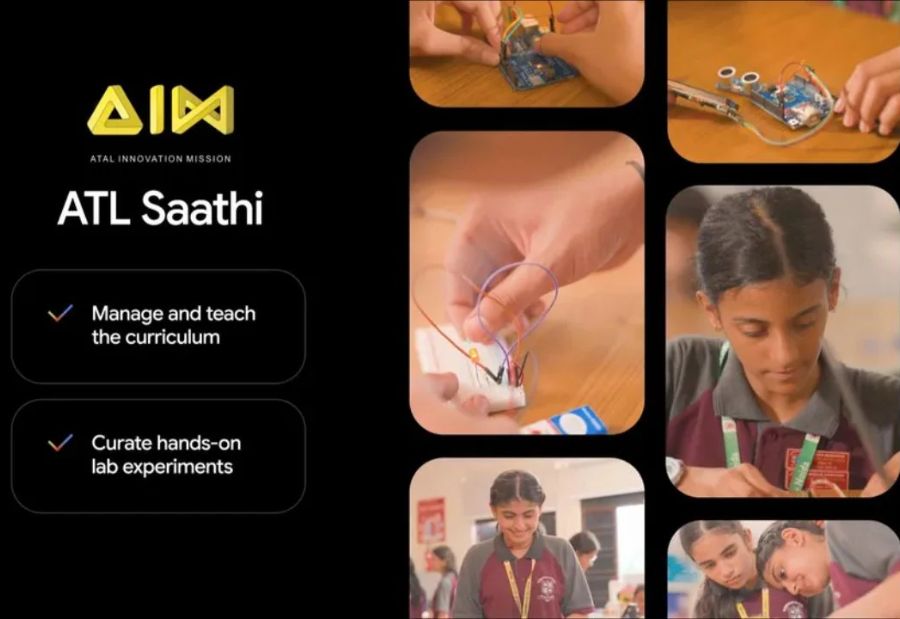
Google has introduced ATL Saathi, a Gemini-powered web application designed to help Indian teachers create hands-on learning experiences for students. The announcement was made during Google I/O Connect India 2026 in Bengaluru, alongside a series of new AI, cloud, education, and cybersecurity initiatives for India.
Developed by Google DeepMind India, ATL Saathi is trained on the curriculum of Atal Tinkering Labs under NITI Aayog’s Atal Innovation Mission (AIM). The application will be rolled out to 100 schools this year, with a long-term goal of expanding to 10,000 schools across the country.
Google also announced new tools and partnerships aimed at helping Indian developers, startups, and enterprises build AI solutions while meeting local data localisation requirements. The company said it paid out over ₹5.3 lakh crore to developers in the Google Play and Android ecosystem in India in 2024, marking a 28% increase from the previous year. Research also found that 91% of surveyed Google Play developers using Google AI reported revenue benefits, while 76% of adults expressed interest in using AI tools for “vibe coding.”
“As we drive the shift into the agentic era, where AI moves from answering queries to securely executing tasks, our focus is on providing the underlying infrastructure and guardrails the ecosystem needs to scale safely,” said Preeti Lobana, Country Manager, Google India.
“The ultimate metric of AI progress isn’t just model parameters, but also in the positive transformation it enables. India is championing this as it adopts AI across every tier of the economy,” said Dr. Manish Gupta, Senior Director for India and APAC at Google DeepMind.
The event brought together more than 1,500 developers and featured AI innovations from startups including Adya.AI, VideoSDK, Sivi, Superjoin, Knit, PolicyBazaar, Emergent, and RedBus.
Among the key announcements, Google introduced Sec-Gemini v3, its AI-powered cybersecurity agent, to trusted government and enterprise testers, including Flipkart. The company also made Gemini 3.5 Flash available to Indian enterprises and enabled organizations to run Gemini through Google Distributed Cloud within Indian data centres to support data localisation.
Google further expanded Gemini Live to support 25 Indian languages and dialects, including Sanskrit, Bhojpuri, and Maithili. In healthcare, researchers at AIIMS Delhi are using Google’s MedGemma models to develop India-specific AI solutions for leprosy and sexual and reproductive health. The company also open-sourced CAPSEM, a secure runtime environment for AI agents, and introduced new security standards to strengthen AI-powered digital transactions and enterprise protection.
Additionally, researchers at IIT Delhi and IIT Madras are collaborating with Google on agentic AI safety, including early threat detection and the development of next-generation “Guardian Agents.”
Also read: Viksit Workforce for a Viksit Bharat
Do Follow: The Mainstream LinkedIn | The Mainstream Facebook | The Mainstream Youtube | The Mainstream Twitter
About us:
The Mainstream is a premier platform delivering the latest updates and informed perspectives across the technology business and cyber landscape. Built on research-driven, thought leadership and original intellectual property, The Mainstream also curates summits & conferences that convene decision makers to explore how technology reshapes industries and leadership. With a growing presence in India and globally across the Middle East, Africa, ASEAN, the USA, the UK and Australia, The Mainstream carries a vision to bring the latest happenings and insights to 8.2 billion people and to place technology at the centre of conversation for leaders navigating the future.