


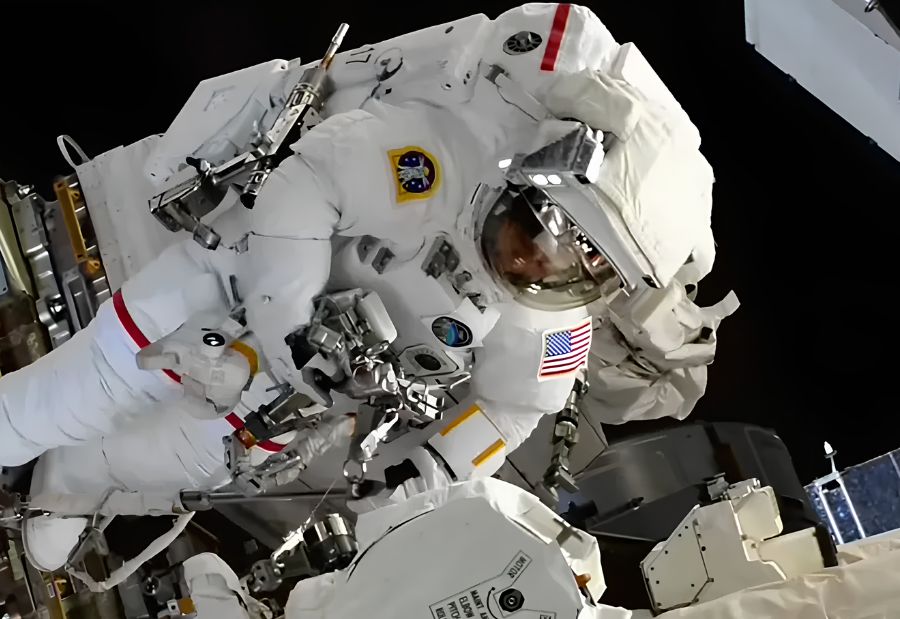
A day after completing a successful spacewalk, Expedition 74 astronauts followed a lighter schedule aboard the International Space Station (ISS), balancing recovery, spacesuit maintenance, and scientific research. Meanwhile, the station’s Roscosmos crew carried out experiments focused on cardiovascular health, teamwork, and laboratory maintenance.
NASA flight engineers Chris Williams and Jessica Meir wrapped up their 2nd spacewalk together on Tuesday, successfully replacing a malfunctioning wrist joint on the Canadarm2 robotic arm. The spacewalk lasted 7 hours and 20 minutes, marking the 4th repair performed on Canadarm2 since it was installed on April 26, 2001. Initial assessments by ground controllers confirmed the robotic arm is functioning as expected, with additional testing and verification planned over the coming days.
Following the demanding operation, Williams and Meir spent Wednesday resting before inspecting and photographing their spacesuit gloves and refilling the suits’ water tanks, which help regulate temperature during spacewalks.
NASA flight engineer Jack Hathaway and ESA (European Space Agency) flight engineer Sophie Adenot, who supported Tuesday’s spacewalk from inside the station, also had a lighter schedule. Later, all 4 astronauts participated in a post-spacewalk conference with mission controllers to review the robotics repair mission.
Elsewhere on the station, Roscosmos commander Sergey Kud-Sverchkov and flight engineer Sergei Mikaev carried out research to study how long-duration spaceflight affects mental performance and the human circulatory system. The pair completed computer-based coordination and decision-making exercises designed to understand how teamwork, concentration, and cognitive performance change in microgravity.
The two cosmonauts also participated in cardiovascular studies by wearing arm, wrist, and finger cuffs to monitor blood pressure. They later attached light-based sensors to their forehead, fingers, and toes to examine blood flow through the skin’s microcirculatory system. The research is expected to improve the early detection of circulation-related health issues during space missions while contributing to advanced medical technologies on Earth.
Meanwhile, Roscosmos flight engineer Andrey Fedyaev spent much of the day cleaning smoke detectors inside the Nauka science module. He also downloaded and reviewed data collected by radiation detectors worn by Williams and Meir during Tuesday’s spacewalk.
Also read: Viksit Workforce for a Viksit Bharat
Do Follow: The Mainstream LinkedIn | The Mainstream Facebook | The Mainstream Youtube | The Mainstream Twitter
About us:
The Mainstream is a premier platform delivering the latest updates and informed perspectives across the technology business and cyber landscape. Built on research-driven, thought leadership and original intellectual property, The Mainstream also curates summits & conferences that convene decision makers to explore how technology reshapes industries and leadership. With a growing presence in India and globally across the Middle East, Africa, ASEAN, the USA, the UK and Australia, The Mainstream carries a vision to bring the latest happenings and insights to 8.2 billion people and to place technology at the centre of conversation for leaders navigating the future.