


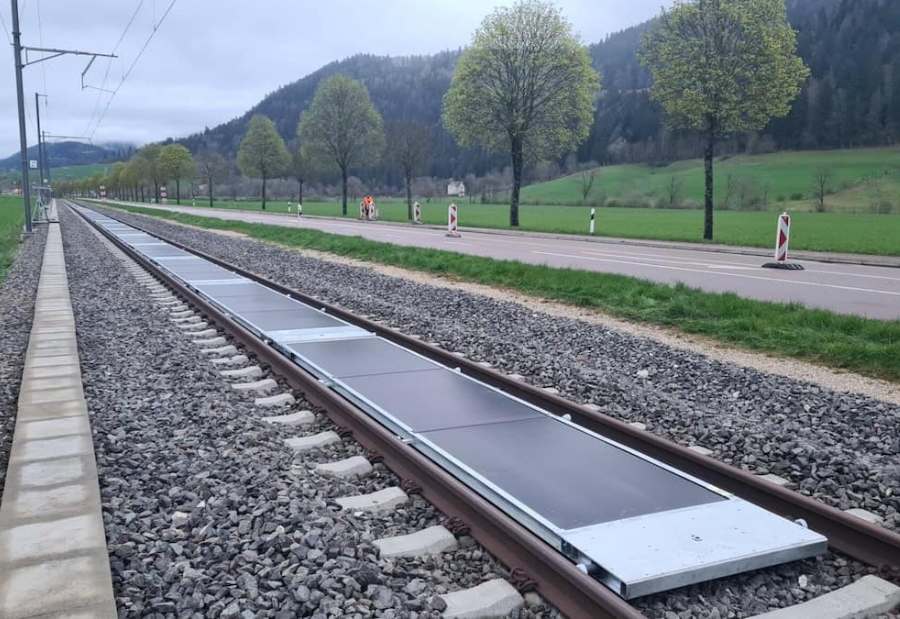
Switzerland has launched a first-of-its-kind pilot project that places solar panels directly between active railway tracks, exploring a new way to generate clean energy without using additional land.
The project, developed by Swiss startup Sun-Ways, is operating on a 100-meter section of railway near the village of Buttes in western Switzerland. The installation consists of 48 removable solar panels with a total capacity of 18 kilowatts, capable of generating approximately 16,000 kilowatt-hours of electricity annually.
What makes the project unique is that trains continue to run normally above the panels. The solar modules are installed low enough to avoid interfering with rail operations and can be removed when maintenance work is required.
Operational since April 24, 2025, the pilot will run until April 2028. During this period, researchers will evaluate energy performance, maintenance requirements, panel durability, dust accumulation, safety, glare effects, and compatibility with railway infrastructure.
The initiative is attracting international attention. Sun-Ways has signed a collaboration agreement with France’s national railway operator SNCF, which will monitor technical results and operational data from the Swiss project to assess similar possibilities in France.
The company developed a specialized installation system with railway maintenance firm Scheuchzer. The technology allows solar panels to be deployed rapidly along railway tracks, with the potential to install up to 1,000 square meters of panels per day.
However, the concept faces several technical challenges. Railway environments expose equipment to vibrations, dust, snow, metal particles, ballast movement, and pressure waves from passing trains. The panels must also avoid interfering with signalling systems, inspections, emergency operations, and driver visibility.
Swiss regulators initially rejected the proposal in 2023 due to safety concerns. Following additional testing, independent studies, and safety assessments, the project received approval to move forward.
For now, electricity generated by the pilot is being fed into the local power grid. In the future, Sun-Ways hopes the energy could help power railway infrastructure such as signals and stations, or even contribute directly to train operations.
The company estimates that installing similar systems across Switzerland’s approximately 5,000 kilometers of railway could generate around 1 terawatt-hour of electricity annually, equivalent to roughly 2% of the country’s electricity consumption.
As countries search for new locations to deploy renewable energy, the project highlights how existing infrastructure could become an important source of clean power generation without placing additional pressure on farmland or natural landscapes.
Also read: Viksit Workforce for a Viksit Bharat
Do Follow: The Mainstream LinkedIn | The Mainstream Facebook | The Mainstream Youtube | The Mainstream Twitter
About us:
The Mainstream is a premier platform delivering the latest updates and informed perspectives across the technology business and cyber landscape. Built on research-driven, thought leadership and original intellectual property, The Mainstream also curates summits & conferences that convene decision makers to explore how technology reshapes industries and leadership. With a growing presence in India and globally across the Middle East, Africa, ASEAN, the USA, the UK and Australia, The Mainstream carries a vision to bring the latest happenings and insights to 8.2 billion people and to place technology at the centre of conversation for leaders navigating the future.