


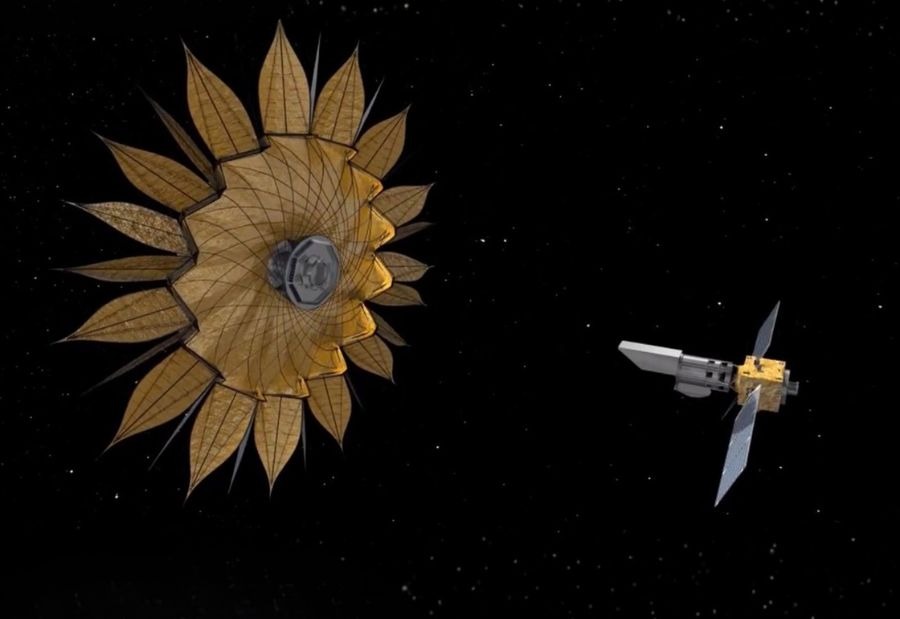
Scientists have developed a new ultra-black coating that could significantly improve the search for life beyond our solar system. The coating is extremely thin, durable, and highly effective at absorbing light, making it a strong candidate for future starshade missions designed to image distant exoplanets.
One of the biggest challenges in observing exoplanets is the overwhelming brightness of nearby stars. The light from a star can be billions of times brighter than the faint light reflected by surrounding planets, making direct imaging extremely difficult. Additional light scattering from spacecraft surfaces further increases this interference.
To solve this problem, researchers are developing starshades — giant flower-shaped spacecraft positioned between a telescope and a distant star. These structures block starlight while allowing faint light from orbiting planets to reach the telescope. However, even tiny amounts of scattered sunlight from the starshade itself can affect image quality.
Over the years, NASA engineers tested several solutions, including razor-thin metal edges and black coatings. Existing coatings were too thick and ended up increasing light scatter instead of reducing it.
A breakthrough came from ZeCoat Corporation founder David Sheikh, who developed a unique ultra-black coating using an advanced physical vapor deposition process. The coating uses nanoscale metal and glass layers that trap and absorb incoming light. Researchers found the coating to be nearly 100 times thinner than earlier alternatives.
In 2020, NASA’s Exoplanet Exploration Program at Jet Propulsion Laboratory tested the coating on prototype starshade edges. The tests showed the coating reduced reflected light by nearly 20 times, improving the possibility of directly imaging exoplanets.
Supported by a 2021 NASA SBIR contract, ZeCoat later developed a roll-to-roll coating process capable of covering large polyimide films with the same ultra-black finish. These coated membranes could eventually form the central disk and petals of future starshades.
Beyond space exploration, the coating could also support military, commercial, and scientific applications, including reducing satellite visibility and improving smartphone camera performance.
Also read: Viksit Workforce for a Viksit Bharat
Do Follow: The Mainstream LinkedIn | The Mainstream Facebook | The Mainstream Youtube | The Mainstream Twitter
About us:
The Mainstream is a premier platform delivering the latest updates and informed perspectives across the technology business and cyber landscape. Built on research-driven, thought leadership and original intellectual property, The Mainstream also curates summits & conferences that convene decision makers to explore how technology reshapes industries and leadership. With a growing presence in India and globally across the Middle East, Africa, ASEAN, the USA, the UK and Australia, The Mainstream carries a vision to bring the latest happenings and insights to 8.2 billion people and to place technology at the centre of conversation for leaders navigating the future.