


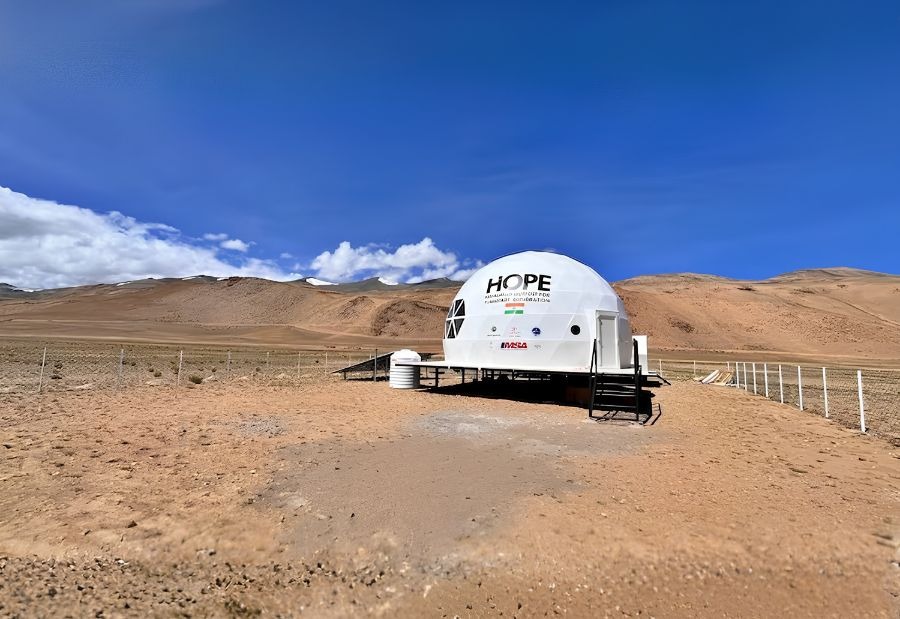
India is strengthening its human spaceflight preparation efforts with new upgrades planned for the Hope Habitat in Ladakh, a remote analogue station designed to simulate the harsh conditions of space missions.
The habitat, located in the Tso Kar valley of Ladakh and developed by space research company Protoplanet, is being expanded in collaboration with ISRO’s Human Space Flight Centre to support future astronaut training linked to the Gaganyaan programme.
The project aims to help astronauts prepare for the physical and psychological challenges of long-duration space missions by recreating conditions similar to those encountered in space.
According to Dr. Siddharth Pandey, founder of Protoplanet, the initiative gained momentum after the successful Hope analogue mission conducted in 2025. The programme later evolved into a specialized training exercise involving ISRO engineers and astronauts to study teamwork, decision-making, stress management, and isolation handling in extreme environments.
Ladakh was selected for the mission because its environment closely mirrors several spaceflight stressors, including low oxygen levels, low atmospheric pressure, freezing temperatures, sharp thermal variations, and geographic isolation. Researchers believe these conditions can provide valuable insights into human performance and group behavior during future space missions.
Protoplanet was recently involved in a simulation mission featuring all 4 designated Gaganyaan astronauts, giving researchers a rare opportunity to observe actual astronaut crews instead of only analogue participants.
The upcoming upgrades will focus on improving communication systems, power infrastructure, and scientific data monitoring capabilities inside the habitat. The station will also feature surveillance systems, cameras, and wearable biometric devices to study astronauts’ physiological and psychological responses during extended isolation periods.
Psychologists from the Institute of Aerospace Medicine in Bengaluru are also expected to participate in future missions at the facility.
Protoplanet plans to significantly expand the Hope Habitat over the next 2 years, allowing more personnel to stay at the station while centralizing scientific and behavioral data collection. Some upgrades are expected to be completed during the current summer season in Ladakh, with additional work continuing next year.
Discussions are also underway with ISRO to make analogue missions a regular part of astronaut preparation for future Gaganyaan and human spaceflight missions.
Also read: Viksit Workforce for a Viksit Bharat
Do Follow: The Mainstream LinkedIn | The Mainstream Facebook | The Mainstream Youtube | The Mainstream Twitter
About us:
The Mainstream is a premier platform delivering the latest updates and informed perspectives across the technology business and cyber landscape. Built on research-driven, thought leadership and original intellectual property, The Mainstream also curates summits & conferences that convene decision makers to explore how technology reshapes industries and leadership. With a growing presence in India and globally across the Middle East, Africa, ASEAN, the USA, the UK and Australia, The Mainstream carries a vision to bring the latest happenings and insights to 8.2 billion people and to place technology at the centre of conversation for leaders navigating the future.