


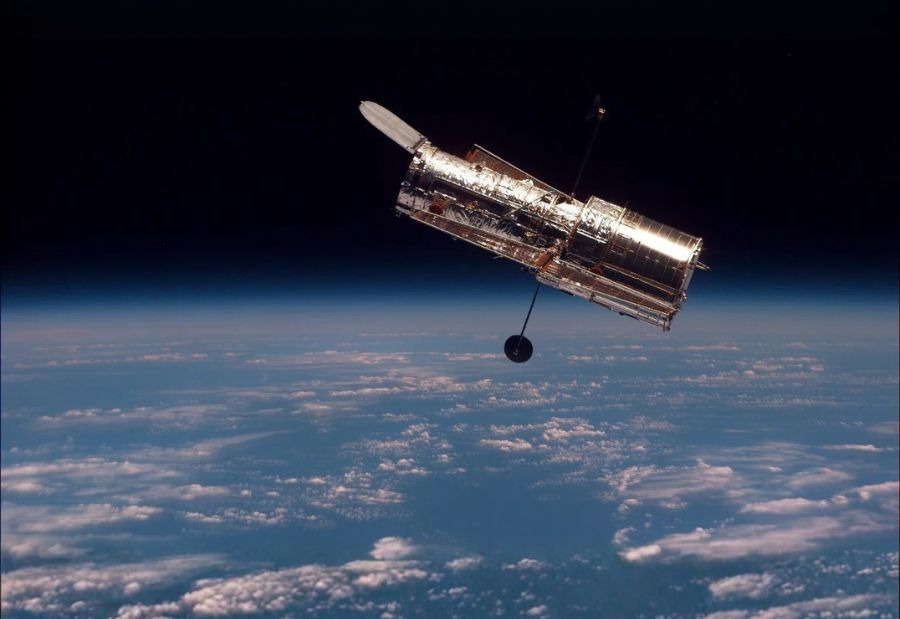
NASA’s Hubble Space Telescope is helping prepare for the upcoming Nancy Grace Roman Space Telescope mission by conducting a major survey of the Milky Way’s galactic bulge, the dense region surrounding the center of the galaxy.
The new Hubble survey is designed to support Roman’s future Galactic Bulge Time-Domain Survey, which will study millions of stars and search for thousands of new exoplanets, rogue planets, neutron stars, and black holes. NASA is currently targeting as early as September 2026 for the launch of the Roman Space Telescope.
Researchers are using Hubble to capture detailed observations of the same regions Roman will later monitor. By comparing older Hubble data with future Roman observations, astronomers expect to better understand stars, planets, and gravitational lensing events occurring near the center of the Milky Way.
“A top priority of our Hubble survey is to cover as much sky area as possible,” said Sean Terry, project lead and assistant research scientist from the University of Maryland and NASA’s Goddard Space Flight Center.
The findings were published on May 11, 2026, in the Astrophysical Journal.
Roman’s Galactic Bulge Time-Domain Survey will consist of 6 observing seasons of 72 days each, during which the telescope will capture images every 12 minutes across approximately 1.7 square degrees of the galactic bulge. The survey is specifically optimized to detect microlensing events, where light from distant stars is bent by the gravity of objects passing between the star and Earth.
Scientists believe this technique will help discover hundreds of “rogue planets” that drift freely through space after being ejected from planetary systems. It could also help identify isolated neutron stars and Sun-sized black holes previously hidden within the galaxy.
“The great thing about microlensing is that we’ll be able to do a complete census of objects as small as Mars,” said co-author Jay Anderson of the Space Telescope Science Institute.
The Hubble observations also aim to create a detailed catalog of stars within the galactic bulge. Researchers estimate Hubble’s survey could identify 20 million to 30 million point sources, while Roman could eventually expand the catalog to nearly 300 million stars.
Beyond exoplanet discovery, the survey will help scientists map regions filled with dust and gas that block light, improving future observations of the Milky Way’s core.
NASA stated that the Roman mission is expected to deliver some of the deepest and most detailed images ever captured of the night sky, further advancing the study of planets, stars, and the structure of the universe.
Also read: Viksit Workforce for a Viksit Bharat
Do Follow: The Mainstream LinkedIn | The Mainstream Facebook | The Mainstream Youtube | The Mainstream Twitter
About us:
The Mainstream is a premier platform delivering the latest updates and informed perspectives across the technology business and cyber landscape. Built on research-driven, thought leadership and original intellectual property, The Mainstream also curates summits & conferences that convene decision makers to explore how technology reshapes industries and leadership. With a growing presence in India and globally across the Middle East, Africa, ASEAN, the USA, the UK and Australia, The Mainstream carries a vision to bring the latest happenings and insights to 8.2 billion people and to place technology at the centre of conversation for leaders navigating the future.