


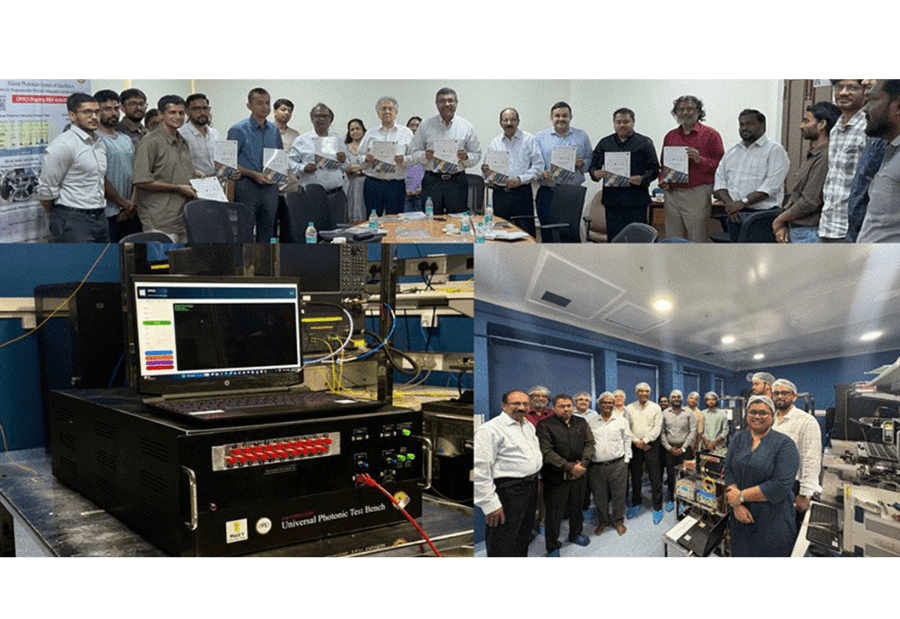
In a significant move towards strengthening its high-tech ecosystem, India has introduced indigenously developed Silicon Photonics solutions at the Indian Institute of Technology Madras in Chennai.
The initiative is aimed at boosting the country’s semiconductor capabilities and supporting its vision of technology self-reliance. The launch took place under the leadership of S. Krishnan, Secretary at the Ministry of Electronics and Information Technology (MeitY).
Two key innovations were unveiled during the event — the Silicon Photonics Process Design Kit (PDK) and the Universal Programmable Photonic Integrated Circuit (PPIC) Test Engine. These technologies have been developed at the MeitY-supported Centre of Excellence (CoE-CPPICS) at IIT Madras.
Silicon Photonics is an advanced technology that combines optical and electronic components on a single chip. It enables faster data transfer, better communication systems, and improved computing performance. Officials believe this development will help India compete globally in this domain.
The solutions have been designed as a shared national platform to support research and development across academic institutions, industries, startups, and defence organisations. This will allow students and researchers to work on advanced technologies and drive innovation.
The PDK includes more than 50 validated components for designing photonic circuits. The PPIC Test Engine serves as an automated platform to test and analyse photonic and optoelectronic modules.
At the event, Amitesh Sinha, CEO of the India Semiconductor Mission, highlighted that the technology has applications in both classical and quantum domains. Further advancements are expected under the proposed ISM 2.0 initiative.
In the next phase, multi-project wafer (MPW) fabrication will begin from the third quarter of the current financial year. This stage will involve manufacturing, testing, packaging, and module characterisation, helping build a complete ecosystem.
The initiative is also expected to create new opportunities in education and employment. Students and young professionals will gain exposure to advanced engineering and research, preparing them for global competition.
Overall, this development marks a key milestone in India’s journey towards self-reliance in semiconductors and high-tech innovation.
Also read: Viksit Workforce for a Viksit Bharat
Do Follow: The Mainstream LinkedIn | The Mainstream Facebook | The Mainstream Youtube | The Mainstream Twitter
About us:
The Mainstream is a premier platform delivering the latest updates and informed perspectives across the technology business and cyber landscape. Built on research-driven, thought leadership and original intellectual property, The Mainstream also curates summits & conferences that convene decision makers to explore how technology reshapes industries and leadership. With a growing presence in India and globally across the Middle East, Africa, ASEAN, the USA, the UK and Australia, The Mainstream carries a vision to bring the latest happenings and insights to 8.2 billion people and to place technology at the centre of conversation for leaders navigating the future.