


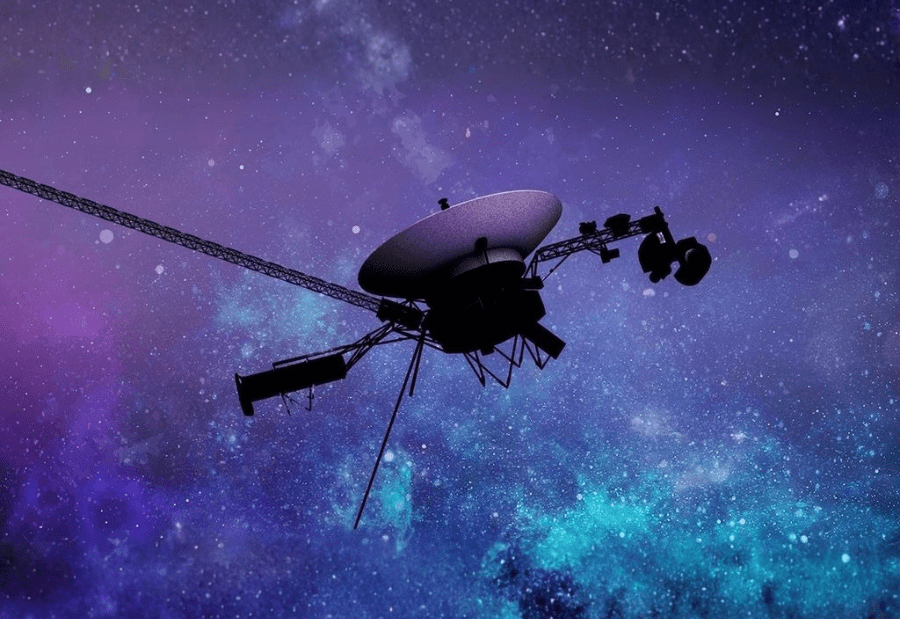
In a critical move to keep one of humanity’s most iconic spacecraft alive, NASA has shut down a key science instrument aboard Voyager 1 as it continues its journey beyond the solar system.
On April 17, engineers at NASA’s Jet Propulsion Laboratory turned off the Low-energy Charged Particles (LECP) instrument to conserve power. The spacecraft, launched in 1977, has been operating for nearly 49 years and is now running on extremely limited energy.
The LECP instrument has played a vital role in studying ions, electrons, and cosmic rays, helping scientists understand the structure of the interstellar medium. Along with Voyager 2, it remains among the only spacecraft capable of sending such data from deep space.
Voyager 1 is powered by a radioisotope thermoelectric generator, which converts heat from decaying plutonium into electricity. However, the system loses about 4 watts of power each year, forcing engineers to make difficult decisions to keep the mission alive.
During a routine maneuver in February, the spacecraft experienced an unexpected drop in power. Engineers acted quickly to avoid triggering its automatic fault protection system, which could have shut down systems unpredictably.
“While shutting down a science instrument is not anybody’s preference, it is the best option available,” said Kareem Badaruddin. “Voyager 1 still has two remaining operating science instruments… sending back data from a region of space no other human-made craft has ever explored.”
The decision to switch off LECP was part of a long-term plan. Out of 10 original instruments, 7 have already been shut down to conserve power. A small motor within the LECP will remain active, using just 0.5 watts, keeping open the possibility of reactivating the instrument in the future.
The shutdown process itself takes over 23 hours for commands to reach Voyager 1, followed by more than 3 hours for execution, due to its distance of over 15 billion miles (25 billion km) from Earth.
Engineers estimate this step will extend the spacecraft’s life by about 1 year. Meanwhile, teams are preparing a more advanced energy-saving strategy known as the “Big Bang,” which involves replacing higher-power systems with lower-energy alternatives.
This upgrade will first be tested on Voyager 2 in mid-2026. If successful, it could be applied to Voyager 1 later, potentially extending the mission even further—and possibly allowing some instruments to be restarted.
Despite its age, Voyager 1 continues to send back invaluable data, offering a rare glimpse into a region of space no other spacecraft has reached.
Also read: Viksit Workforce for a Viksit Bharat
Do Follow: The Mainstream LinkedIn | The Mainstream Facebook | The Mainstream Youtube | The Mainstream Twitter
About us:
The Mainstream is a premier platform delivering the latest updates and informed perspectives across the technology business and cyber landscape. Built on research-driven, thought leadership and original intellectual property, The Mainstream also curates summits & conferences that convene decision makers to explore how technology reshapes industries and leadership. With a growing presence in India and globally across the Middle East, Africa, ASEAN, the USA, the UK and Australia, The Mainstream carries a vision to bring the latest happenings and insights to 8.2 billion people and to place technology at the centre of conversation for leaders navigating the future.