


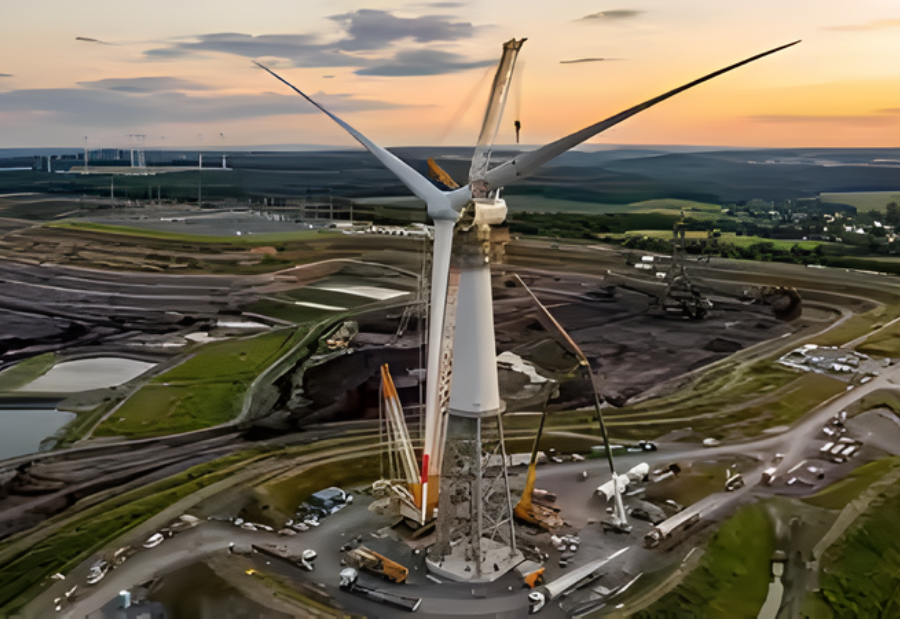
Germany is advancing its clean energy transition with the construction of a 364 m wind turbine, set to become the tallest in the world and a symbol of its shift away from fossil fuels.
The project is being developed at a former coal mining site, reflecting a broader move to repurpose carbon-intensive infrastructure into renewable energy assets. By placing the turbine at such height, it can access stronger and more consistent winds, enabling higher electricity generation and improved grid stability.
Engineering this structure requires advanced design to withstand turbulence and structural loads. According to technical evaluations prepared for the Federal Ministry for Economic Affairs and Climate Action, taller turbines can reach “low-level jets” — fast, stable wind streams found at higher altitudes. This increases the turbine’s capacity factor, allowing it to generate power even when surface winds are weak.
The choice of a former coal mine also offers strategic advantages. As per insights from the International Renewable Energy Agency (IRENA), brownfield sites already have grid infrastructure such as transmission lines and substations. This reduces the need for new installations and lowers environmental impact, while supporting economic redevelopment in mining regions.
To operate safely at such scale, the turbine will use advanced materials. Studies by the National Renewable Energy Laboratory (NREL) show that blade weight becomes a limiting factor as turbines grow larger. To address this, the project will use carbon-fibre-reinforced polymer blades, offering a better strength-to-weight ratio than traditional fibreglass. This allows higher energy capture without adding excessive mechanical stress.
The project also highlights efficiency gains in land use. According to modelling referenced by the European Environment Agency (EEA), one ultra-tall turbine can potentially replace multiple smaller units. These turbines could generate up to 2 times the energy of conventional designs, reducing the need for large-scale land expansion.
Overall, the initiative demonstrates how legacy industrial sites can be transformed into high-impact renewable energy hubs, supporting both sustainability goals and long-term energy needs.
Also read: Viksit Workforce for a Viksit Bharat
Do Follow: The Mainstream LinkedIn | The Mainstream Facebook | The Mainstream Youtube | The Mainstream Twitter
About us:
The Mainstream is a premier platform delivering the latest updates and informed perspectives across the technology business and cyber landscape. Built on research-driven, thought leadership and original intellectual property, The Mainstream also curates summits & conferences that convene decision makers to explore how technology reshapes industries and leadership. With a growing presence in India and globally across the Middle East, Africa, ASEAN, the USA, the UK and Australia, The Mainstream carries a vision to bring the latest happenings and insights to 8.2 billion people and to place technology at the centre of conversation for leaders navigating the future.