


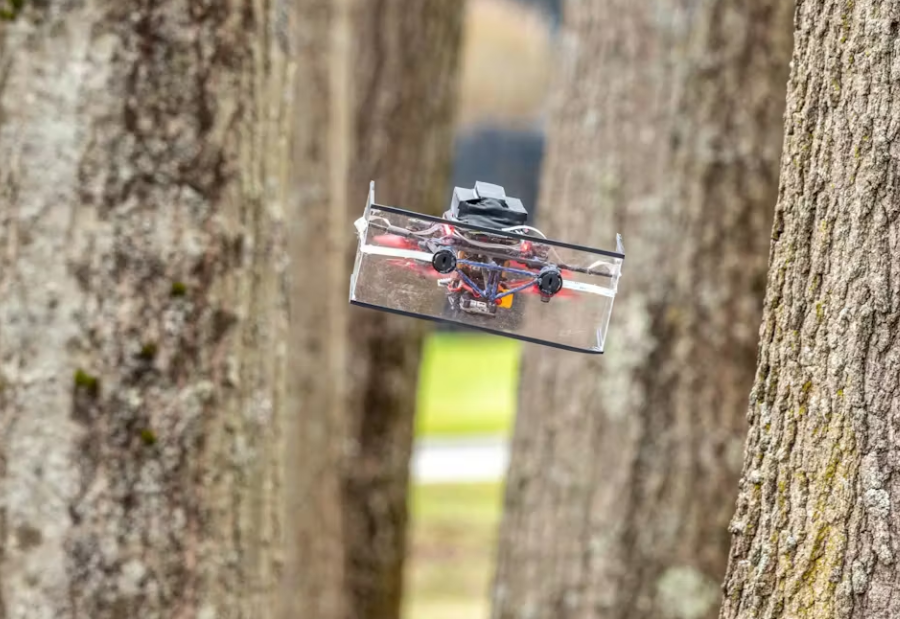
Researchers have developed a new ultrasound-based perception system that allows small aerial robots to navigate in low-visibility environments, drawing inspiration from how bats use echolocation.
Traditional drone navigation relies on cameras and lidar, which often fail in conditions such as smoke, fog, dust, snow, or complete darkness. To overcome this, scientists designed a lightweight sonar system that uses sound waves instead of light, enabling drones to detect obstacles even in challenging environments.
The system mimics how bats emit sound and interpret echoes to understand their surroundings. However, applying this to drones posed a major challenge due to noise from propellers, which can interfere with detecting weak echo signals.
To solve this, researchers introduced 2 key innovations. First, an acoustic shield inspired by bat ear cartilage reduces propeller noise around the sensors. Second, a neural network called Saranga processes and recovers weak echo signals from noisy data, similar to how bats interpret sound.
Together, these technologies allow drones to map their surroundings in 3D and navigate safely using very low power.
The development is especially useful for search and rescue operations, where drones often operate in environments with poor visibility, such as collapsed buildings, forest fires, caves, or dusty outdoor areas. In such conditions, traditional sensors become unreliable, while ultrasound-based sensing continues to function effectively.
The new system also opens possibilities for other applications, including anti-poaching efforts, cave exploration, and environmental monitoring. Researchers say it could lead to swarms of small, low-cost drones working together in hazardous environments, similar to how bats move in groups.
Compared to existing technologies, this approach significantly reduces resource requirements—cutting power usage by up to 1,000 times, weight by 10 times, and cost by 100 times.
While radar can work in low-visibility conditions, it is too power-intensive for small drones. Earlier research explored ultrasound mainly for ground robots, but this breakthrough successfully adapts it for aerial use.
Researchers are now working to improve flight speed, sensing range, and system size, while exploring combinations with other sensing technologies.
The innovation marks a step toward building reliable, energy-efficient drones capable of operating in dynamic and high-risk environments where human access is limited.
Also read: Viksit Workforce for a Viksit Bharat
Do Follow: The Mainstream LinkedIn | The Mainstream Facebook | The Mainstream Youtube | The Mainstream Twitter
About us:
The Mainstream is a premier platform delivering the latest updates and informed perspectives across the technology business and cyber landscape. Built on research-driven, thought leadership and original intellectual property, The Mainstream also curates summits & conferences that convene decision makers to explore how technology reshapes industries and leadership. With a growing presence in India and globally across the Middle East, Africa, ASEAN, the USA, the UK and Australia, The Mainstream carries a vision to bring the latest happenings and insights to 8.2 billion people and to place technology at the centre of conversation for leaders navigating the future.