


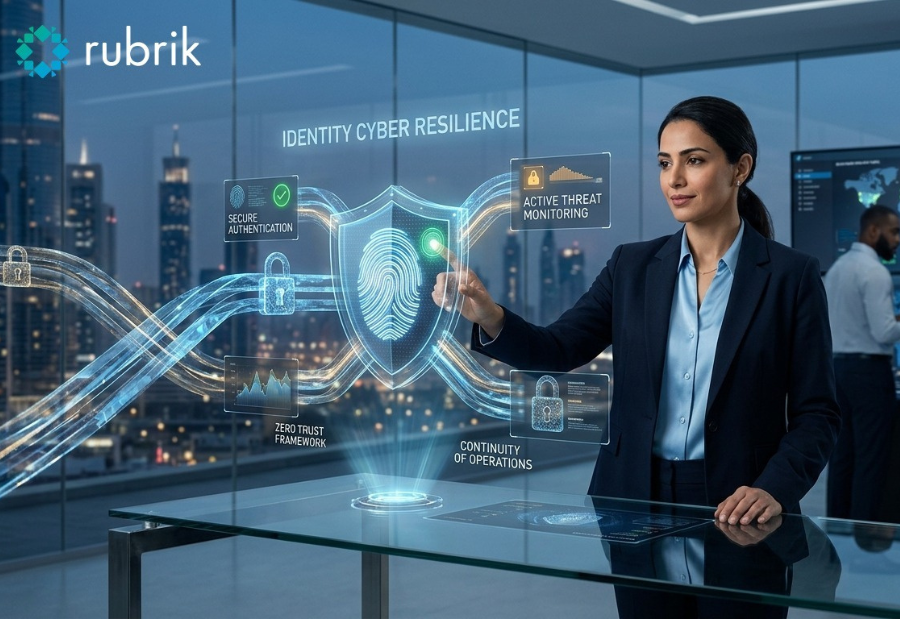
At GCC Converge Summit 2026, one theme stood out across discussions with security and technology leaders: cyber resilience strategies must now extend beyond data protection to securing the Identity Control Plane. This perspective is highlighted in an article by Rubrik, authored by Mr. Rahul Goyal.
Modern cyberattacks are no longer limited to encrypting files or exfiltrating sensitive data. They increasingly target identity systems such as Active Directory and Microsoft Entra ID. Once identity is compromised, attackers gain privileged access across infrastructure, applications, backups, and cloud environments. At that point, the entire enterprise is exposed.
This is why the conversation must evolve from traditional Identity Management to Identity Cyber Resilience. At Rubrik, we believe identity is not just an authentication layer. It is the foundation of operational continuity.
The Strategic Shift: From Identity Management to Identity Resilience
Identity management focuses on provisioning, authentication, and governance. While essential, these are largely preventive controls.
However, credential compromise is no longer a rare event. Phishing, token theft, privilege escalation, and lateral movement are persistent realities. The true differentiator today is not whether an organisation can prevent every breach, but whether it can detect, respond, and recover when identity is compromised.
Identity resilience ensures that even if attackers obtain credentials, the organisation retains control. We frame this through three core pillars: Visibility and Posture, Immutable Detection, and Orchestrated Recovery.
Pillar 1: Visibility and Posture
The Before
You cannot protect what you cannot see.
Most enterprises operate with thousands of identities spanning employees, contractors, service accounts, APIs, and machine identities. Over time, this creates:
- Dormant or ghost accounts
- Over-privileged users
- Excessive administrative rights
- Misconfigured group memberships
These exposures often provide the initial foothold for attackers.
Rubrik enables comprehensive mapping of both human and non-human identities, uncovering hidden privilege paths and risky configurations before they are exploited. By identifying over-privileged accounts and stale access points, organizations can reduce their attack surface proactively.
Resilience begins with clarity into identity posture.
Pillar 2: Immutable Detection
The During
Attackers who compromise identity rarely stop at access. They escalate privileges and attempt to erase evidence by deleting or manipulating system logs.
Traditional detection tools rely heavily on native logs, which can be altered during an attack.
Rubrik provides independent, immutable time-series monitoring of identity changes. This ensures that even if server logs are wiped, organizations retain a tamper-proof record of:
- Unauthorized privilege escalations, such as a guest account becoming an administrator
- Suspicious group membership modifications
- Changes to critical policies or configurations
Immutable detection ensures visibility remains intact during active compromise.
Pillar 3: Orchestrated Recovery
The After
Identity recovery has historically been manual, complex, and time-intensive. Active Directory restoration can require forest rebuilds, prolonged downtime, and significant operational disruption.
Rubrik transforms this process through automation and structured recovery workflows.
Organisations can perform:
- Surgical rollbacks to restore a single attribute, object, or policy without disrupting the entire environment
- Full forest recovery when required
- Validation within a secure Clean Room environment before reintegration into production
This structured framework reduces recovery time, minimizes human error, and prevents reinfection. Resilience is ultimately proven in recovery.
Industry Impact and Practical Value
Identity resilience has a measurable impact across sectors.
In healthcare, it prevents prolonged Code Dark scenarios by restoring identity access to critical systems in hours rather than weeks.
In financial services, it supports stringent compliance mandates such as DORA and SEC requirements by maintaining an immutable audit trail of identity changes that cannot be altered by attackers.
In public sector and hybrid enterprise environments, it secures complex on-premises and cloud infrastructures through a unified resilience plane.
The Safety Net
Preventive controls such as MFA and firewalls remain critical. They secure the front door.
But what happens when attackers steal the keys?
Rubrik serves as the vault. It provides the safety net that ensures business continuity even when credentials are compromised. By combining visibility, immutable detection, and orchestrated recovery, organisations can operate with confidence in an era where identity attacks are inevitable.
As highlighted through conversations at GCC Converge Summit 2026, cyber resilience is no longer solely about stopping attacks. It is about ensuring the business can stand back up securely and swiftly when identity is targeted.
Because in today’s threat landscape, resilience is the ultimate competitive advantage.
Also read: Viksit Workforce for a Viksit Bharat
Do Follow: The Mainstream LinkedIn | The Mainstream Facebook | The Mainstream Youtube | The Mainstream Twitter
About us:
The Mainstream is a premier platform delivering the latest updates and informed perspectives across the technology business and cyber landscape. Built on research-driven, thought leadership and original intellectual property, The Mainstream also curates summits & conferences that convene decision makers to explore how technology reshapes industries and leadership. With a growing presence in India and globally across the Middle East, Africa, ASEAN, the USA, the UK and Australia, The Mainstream carries a vision to bring the latest happenings and insights to 8.2 billion people and to place technology at the centre of conversation for leaders navigating the future.