


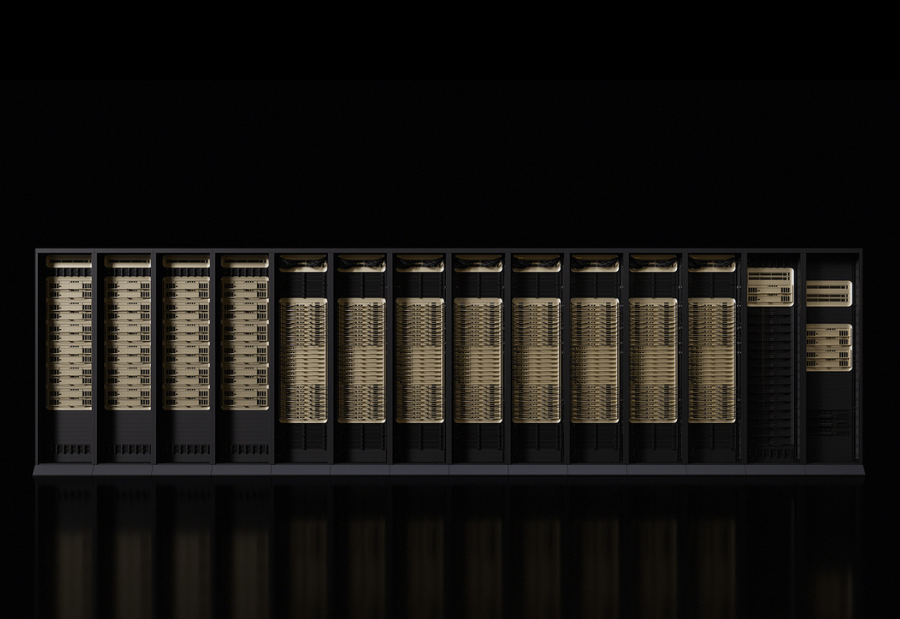
Nvidia opened CES 2026 with a series of major artificial intelligence announcements. The biggest reveal was Vera Rubin, the company new AI platform that will replace Blackwell. Alongside this, Nvidia also launched six new chipsets, a supercomputer based on the new architecture, and several open source AI models. The company also shared updates in the physical AI space. All these announcements were made during CEO Jensen Huang keynote session.
During his address, Huang introduced the Vera Rubin platform. Like Blackwell, this new architecture will become the base for future chipsets designed for AI workloads, enterprise systems, and supercomputers. The platform is named after American astronomer Vera Florence Cooper Rubin, who is known for her work on galaxy rotation curves that helped prove the existence of dark matter.
“Rubin arrives at exactly the right moment, as AI computing demand for both training and inference is going through the roof. With our annual cadence of delivering a new generation of AI supercomputers and extreme codesign across six new chips Rubin takes a giant leap toward the next frontier of AI,” said Huang.
Nvidia explained that Vera Rubin is built on the idea of extreme codesign. This means all its parts are designed together to move data faster, lower costs, and improve efficiency. The company also revealed six chipset families that will be part of rack scale systems called Vera Rubin NVL servers. These include the Nvidia Vera CPU, Rubin GPU, NVLink 6 Switch, ConnectX 9 SuperNIC, BlueField 4 DPU, and Spectrum 6 Ethernet Switch.
According to Nvidia, the new architecture will boost agentic AI, advanced reasoning, and large scale mixture of experts model inference. It is said to offer up to ten times lower cost and use up to four times fewer GPUs compared to Blackwell.
Nvidia also named several companies expected to adopt Vera Rubin based chipsets soon. These include Amazon Web Services, Anthropic, Dell Technologies, Google, HPE, Lenovo, Meta, Microsoft, OpenAI, Oracle, Perplexity, Thinking Machines Lab, and xAI.
Along with the new platform, Nvidia expanded its open source offerings. The company introduced the Alpamayo family, which includes reasoning focused models and tools for safer autonomous vehicle development. Huang described this as a “ChatGPT moment for physical AI,” where machines can understand, reason, and act in the real world. Nvidia also opened access to its Nemotron, Cosmos, Isaac GR00T, and Clara platforms.
Also read: Viksit Workforce for a Viksit Bharat
Do Follow: The Mainstream formerly known as CIO News LinkedIn Account | The Mainstream formerly known as CIO News Facebook | The Mainstream formerly known as CIO News Youtube | The Mainstream formerly known as CIO News Twitter
About us:
The Mainstream is a premier platform delivering the latest updates and informed perspectives across the technology business and cyber landscape. Built on research-driven, thought leadership and original intellectual property, The Mainstream also curates summits & conferences that convene decision makers to explore how technology reshapes industries and leadership. With a growing presence in India and globally across the Middle East, Africa, ASEAN, the USA, the UK and Australia, The Mainstream carries a vision to bring the latest happenings and insights to 8.2 billion people and to place technology at the centre of conversation for leaders navigating the future.