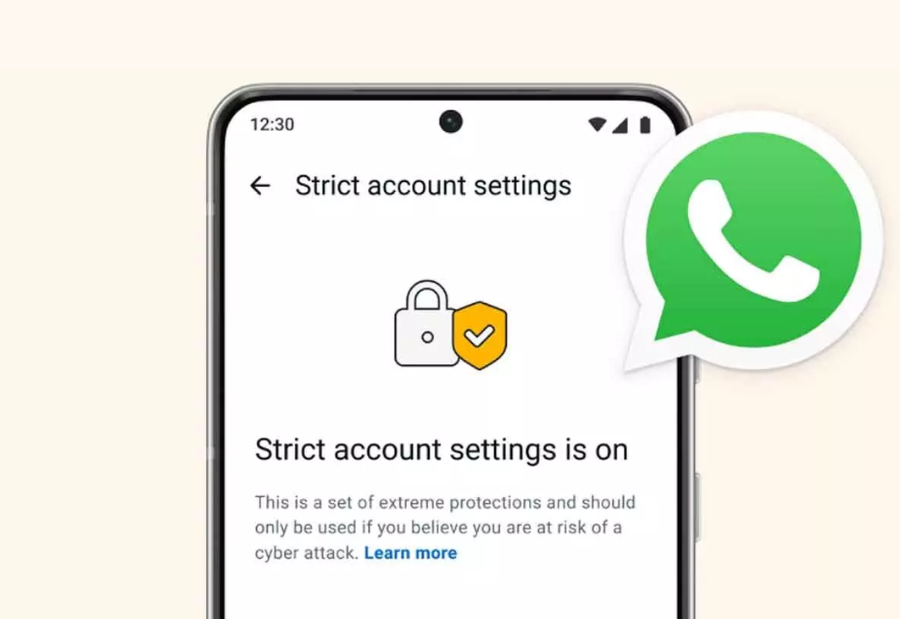
With digital threats becoming more targeted and complex, WhatsApp has rolled out a new security feature aimed at users who face higher risks online. The feature, called ‘Strict Account Settings’, is designed to add stronger protections beyond the app’s standard security options.
WhatsApp said the new setting is meant for a small group of users such as journalists, activists, and public-facing individuals who are more likely to be targeted by cyberattacks. The feature applies tighter controls on how an account works, including limits on messages, calls, and file sharing from unknown users. It is being released gradually and can be turned on from the app’s settings menu.
According to WhatsApp, Strict Account Settings works like a lockdown mode. While all WhatsApp messages are already protected with end-to-end encryption, this feature adds another layer by reducing how an account can interact with people who are not in the user’s contacts.
Once enabled, several settings are automatically locked to their most restrictive levels. One major change is that attachments and media sent by unknown contacts may be blocked. This helps reduce the risk of harmful files that are often disguised as normal images, videos, or documents. WhatsApp noted that many advanced attacks depend on tricking users into opening such files, and limiting this access can block a common attack path.
Behind the scenes, the company said attackers continue to look for weaknesses in how media files are handled, even when encryption is in place. In some cases, malware can be hidden inside images or videos and used to exploit flaws in apps or operating systems.
To counter this, WhatsApp has been changing how media is processed internally. A key step has been increased use of the Rust programming language, which is designed to reduce memory-related security flaws. Meta said this lowers the chances of bugs that attackers often exploit. The company also reviews past security incidents to improve protections, including stricter controls around media handling and account settings.
Lockdown-style security features are not meant for everyday use. They focus on maximum protection over convenience by limiting contacts, blocking files and links, turning off risky features, and reducing usability to improve safety.
Similar features already exist on other platforms. In 2022, Apple introduced Lockdown Mode on iPhone and macOS. In 2025, Alphabet launched Advanced Protection Mode on Android, which also limits certain features to improve security.
Also read: Viksit Workforce for a Viksit Bharat
Do Follow: The Mainstream formerly known as CIO News LinkedIn Account | The Mainstream formerly known as CIO News Facebook | The Mainstream formerly known as CIO News Youtube | The Mainstream formerly known as CIO News Twitter
About us:
The Mainstream is a premier platform delivering the latest updates and informed perspectives across the technology business and cyber landscape. Built on research-driven, thought leadership and original intellectual property, The Mainstream also curates summits & conferences that convene decision makers to explore how technology reshapes industries and leadership. With a growing presence in India and globally across the Middle East, Africa, ASEAN, the USA, the UK and Australia, The Mainstream carries a vision to bring the latest happenings and insights to 8.2 billion people and to place technology at the centre of conversation for leaders navigating the future.