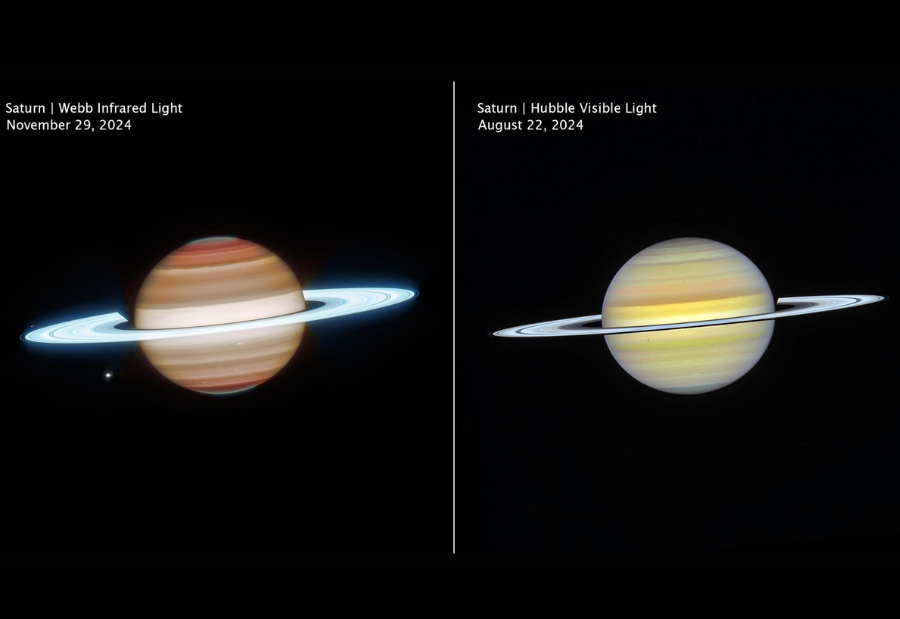
A new set of observations has brought Saturn into sharper focus, as two of NASA’s most powerful space telescopes work together to uncover the planet’s complex atmospheric structure.
NASA’s James Webb Space Telescope and Hubble Space Telescope have captured new images of Saturn using different wavelengths of light. While Hubble highlights subtle color variations across the planet, Webb’s infrared capabilities reveal clouds and chemical structures at multiple depths, from deep atmospheric layers to the upper haze.
Together, these observations allow scientists to examine Saturn’s atmosphere like layered sections, offering a more complete 3D understanding. The findings also build on earlier insights from the Cassini orbiter.
The Hubble image was captured in August 2024 as part of the OPAL (Outer Planet Atmospheres Legacy) program, while Webb’s image followed a few months later under Director’s Discretionary Time.
The images highlight several dynamic atmospheric features. Webb reveals a long-lived jet stream called the “ribbon wave” across the northern mid-latitudes. Just below it lies a remnant from the “Great Springtime Storm” of 2010 to 2012. Multiple storms are also visible in Saturn’s southern hemisphere, shaped by strong winds and atmospheric waves.
Saturn’s iconic hexagon-shaped jet stream at the north pole, first discovered by Voyager spacecraft, is faintly visible in both images. This persistent structure remains one of the most intriguing weather patterns in the solar system. Scientists note that these may be the last clear views of the hexagon until the 2040s, as the region will enter a 15-year winter darkness.
Webb’s infrared data also shows Saturn’s poles in a grey-green tone at wavelengths around 4.3 microns. This could be due to high-altitude aerosols or auroral activity caused by interactions with the planet’s magnetic field. Previous observations from Hubble and Webb have also studied auroras on Saturn, Jupiter, Uranus, and Neptune.
Saturn’s rings appear extremely bright in Webb’s image due to reflective water ice. Subtle differences are visible between the two telescopes, including features in the B ring and the thin, sharply defined F ring.
The observations, taken 14 weeks apart in 2024, show Saturn transitioning toward its 2025 equinox. As seasonal changes continue, scientists expect improved views of the southern hemisphere in the coming years.
Hubble’s long-term monitoring programs like OPAL have tracked Saturn’s atmospheric evolution for decades. Webb now enhances this research with advanced infrared capabilities, enabling deeper analysis of the planet’s dynamic systems.
The James Webb Space Telescope is a leading space observatory studying distant worlds and cosmic origins. The Hubble Space Telescope, operating for over 30 years, continues to deliver discoveries that shape our understanding of the universe.
Also read: Viksit Workforce for a Viksit Bharat
Do Follow: The Mainstream LinkedIn | The Mainstream Facebook | The Mainstream Youtube | The Mainstream Twitter
About us:
The Mainstream is a premier platform delivering the latest updates and informed perspectives across the technology business and cyber landscape. Built on research-driven, thought leadership and original intellectual property, The Mainstream also curates summits & conferences that convene decision makers to explore how technology reshapes industries and leadership. With a growing presence in India and globally across the Middle East, Africa, ASEAN, the USA, the UK and Australia, The Mainstream carries a vision to bring the latest happenings and insights to 8.2 billion people and to place technology at the centre of conversation for leaders navigating the future.