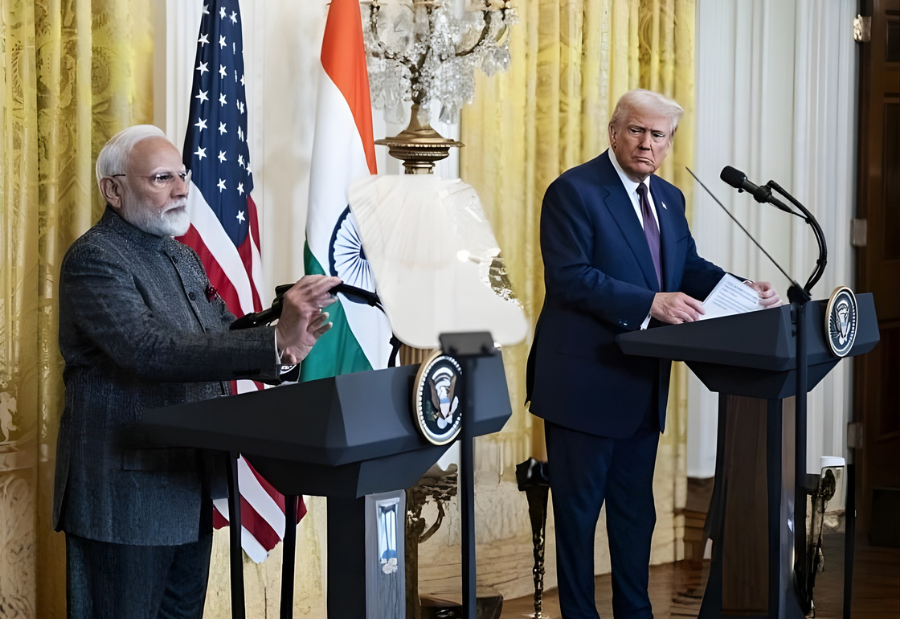
Donald Trump said on Sunday (January 4, 2026) that India had reduced its oil imports from Russia in recent months to “make him happy” and to help move forward an India–U.S. trade deal. He also warned that additional tariffs could “come quickly” if India continues purchasing Russian oil.
Backing the claim, U.S. Senator Lindsey Graham said India’s Ambassador to the U.S., Vinay Kwatra, had highlighted the reduction in Russian oil imports during a meeting in December 2025. According to Mr. Graham, the ambassador asked him to speak to Mr. Trump about easing a 25% penalty tariff imposed by the U.S., in addition to existing 25% reciprocal tariffs.
While Mr. Graham did not specify the exact date, Mr. Kwatra had hosted a bipartisan U.S. Senate delegation on December 2 at the Indian Embassy in Washington. The delegation included Mr. Graham and Senator Richard Blumenthal. Both lawmakers are leading co-sponsors of a Russia sanctions bill that proposes tariffs of up to 500% on countries that continue to buy oil or uranium from Russia.
“PM Modi wants to make me happy”: India cut Russian oil imports to reduce tariffs, says Trump.
India’s Ministry of External Affairs did not respond to requests for comment on the statements made by the U.S. leaders. The remarks were made during a press interaction on board Mr. Trump’s plane, attended by U.S. Commerce Secretary Howard Lutnick. In the past, the Ministry has described unilateral U.S. sanctions as “double standards”, noting that the U.S. itself purchases Russian oil, uranium, and critical minerals.
Mr. Trump has made similar claims since October 2025, saying India had promised to cut Russian oil imports “completely”. As reported earlier by a newspaper, Indian refiners reduced Russian oil imports between June and October, but imports from Russia and the U.S. rose to 7-month highs in November. Commerce ministry sources cited in the report said trade talks with the U.S. had still not progressed, reflecting some “frustration” in New Delhi.
During the press conference, Mr. Trump said he expected the Russia Sanctions Act to be passed soon and asked Mr. Graham to explain what he called a “great legislation”. Mr. Graham said U.S. tariffs had helped push several trade deals by applying pressure on the European Union and other countries.
“I was at the Indian ambassador’s house about a month ago and all he wanted to talk about is how they’re buying less Russian oil. Would you tell the president to relieve the tariff? This stuff works,” Mr. Graham said.
“They [India] wanted to make me happy,” Mr. Trump added. “Basically he wanted to- [Prime Minister] Modi’s a very good man. He’s a good guy. He knew I was unhappy and it was important to make me happy. They do trade and we can raise tariffs on them very quickly and it would be bad for them.”
The sanctions bill, with 85 co-sponsors in the Senate and more than 150 in the House of Representatives, mandates tariffs of at least 500% on imports from countries trading Russian-origin oil or uranium.
Also read: Viksit Workforce for a Viksit Bharat
Do Follow: The Mainstream formerly known as CIO News LinkedIn Account | The Mainstream formerly known as CIO News Facebook | The Mainstream formerly known as CIO News Youtube | The Mainstream formerly known as CIO News Twitter
About us:
The Mainstream is a premier platform delivering the latest updates and informed perspectives across the technology business and cyber landscape. Built on research-driven, thought leadership and original intellectual property, The Mainstream also curates summits & conferences that convene decision makers to explore how technology reshapes industries and leadership. With a growing presence in India and globally across the Middle East, Africa, ASEAN, the USA, the UK and Australia, The Mainstream carries a vision to bring the latest happenings and insights to 8.2 billion people and to place technology at the centre of conversation for leaders navigating the future.