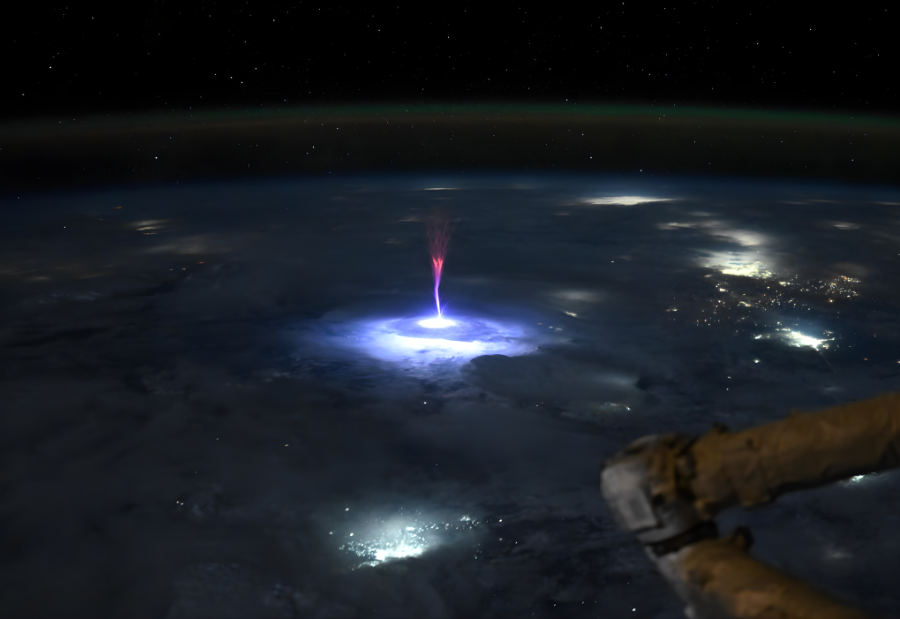
NASA astronauts aboard the International Space Station (ISS) have captured remarkable images of rare electrical events that occur high above Earth’s thunderstorms. These spectacular phenomena appear far above typical lightning storms and reveal a hidden layer of atmospheric activity rarely visible from the ground.
While people on Earth usually see thunder and lightning during storms, other colorful electrical events occur much higher in the atmosphere, reaching up to 55 miles above the surface. These brief phenomena include blue jets, red sprites, violet halos and ultraviolet rings. Scientists collectively call them transient luminous events (TLEs).
For many years, these events were difficult to study. They were mostly known through pilot reports or occasional photographs. The ISS has changed this by providing a clear observation point above storm systems. From orbit, specialized cameras and sensors can record these short-lived flashes in detail.
A major instrument supporting this research is the Atmosphere–Space Interactions Monitor (ASIM), developed by the European Space Agency. Installed on the ISS in 2018, ASIM continuously monitors Earth’s atmosphere to detect lightning-like discharges and other electrical activity.
The instrument uses high-speed cameras and photometers capable of detecting flashes smaller than a fingernail and lasting less than a heartbeat. Scientists have already discovered that certain lightning-like discharges at the tops of thunderclouds can send electromagnetic energy into the ionosphere. This process can create massive ultraviolet rings known as ELVES.
These rings can extend hundreds of miles across the sky and may increase electrical charge in the ionosphere, sometimes affecting long-distance radio communication.
ASIM has also detected extremely short corona discharges in storm clouds. These bursts are so brief that ground-based equipment often fails to detect them. By studying these events, scientists are learning how lightning forms and how electrical energy builds in the upper parts of storm clouds.
Other rare phenomena include red sprites and blue jets. Red sprites appear in the mesosphere and resemble upside-down jellyfish that last for only about 10 milliseconds. Blue jets shoot upward from cloud tops toward the stratosphere. Because these events occur very quickly and at high altitudes, they were difficult to capture before space-based monitoring.
Using ASIM observations combined with ground instruments, researchers have measured the altitude of a blue jet and confirmed that these electrical bursts extend beyond the typical weather layer of Earth’s atmosphere.
Another ISS observation platform is the Cupola, the station’s seven-window viewing dome. Through the European Space Agency’s Thor-Davis experiment, astronauts use high-speed cameras capable of recording storms at up to 100,000 frames per second. These slow-motion recordings reveal complex lightning patterns that were previously unknown.
Some lightning events also produce terrestrial gamma-ray flashes. These bursts of radiation can briefly expose aircraft to energy levels similar to a chest X-ray.
To study these events, the Japan Aerospace Exploration Agency launched the Light-1 CubeSat from the ISS. About the size of a loaf of bread, the satellite carries sensors designed to detect high-energy radiation from storms.
By combining data from Light-1 with global lightning networks, scientists aim to build a 3D map of where gamma-ray flashes occur most frequently.
Although these atmospheric events may seem unusual, they can influence radio communications, aviation safety and atmospheric chemistry. They also play a role in moving chemicals such as nitrogen oxides between atmospheric layers, which can affect ozone and climate systems.
With the ISS expected to operate through the decade, instruments like ASIM will continue collecting data on these mysterious lightning events. Future missions may deploy faster detectors and additional CubeSats to provide real-time monitoring of powerful atmospheric flashes.
By observing storms from space, scientists are gaining new insights into how lightning behaves and how electrical activity reaches the edge of space.
Also read: Viksit Workforce for a Viksit Bharat
Do Follow: The Mainstream LinkedIn | The Mainstream Facebook | The Mainstream Youtube | The Mainstream Twitter
About us:
The Mainstream is a premier platform delivering the latest updates and informed perspectives across the technology business and cyber landscape. Built on research-driven, thought leadership and original intellectual property, The Mainstream also curates summits & conferences that convene decision makers to explore how technology reshapes industries and leadership. With a growing presence in India and globally across the Middle East, Africa, ASEAN, the USA, the UK and Australia, The Mainstream carries a vision to bring the latest happenings and insights to 8.2 billion people and to place technology at the centre of conversation for leaders navigating the future.