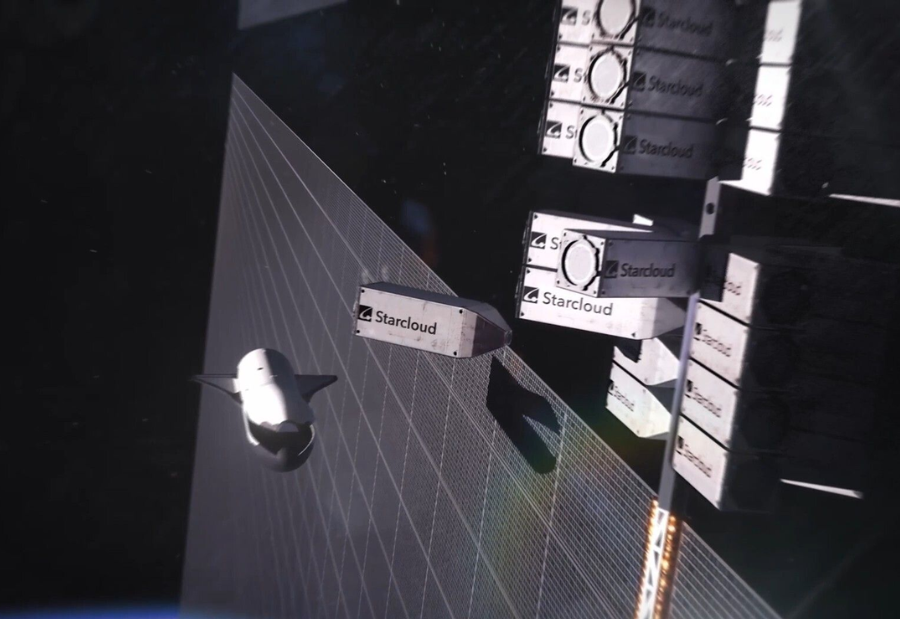
Starcloud has achieved a major milestone by successfully training and running large language models in space, marking a new chapter for high performance computing. The company’s Starcloud 1 satellite, which carries an NVIDIA H100 GPU, trained Andrej Karpathy’s nano GPT on Shakespeare and also performed inference on Google DeepMind’s Gemma model. Founder Philip Johnston called this achievement “the first LLM in space” and described it as an important step toward using “the near limitless energy of our Sun.”
Starcloud said this breakthrough supports its vision of building orbital compute systems that can serve as cleaner and more scalable alternatives to Earth based data centres. Starcloud, which has support from NVIDIA and is a graduate of Y Combinator and Google for Startups, believes that running AI systems in orbit can reduce the energy and environmental load created by traditional data infrastructure. Its long term plan includes creating a 5 gigawatt solar powered orbital data centre stretching 4 kilometres, which it says will be cheaper, more compact and far more sustainable than similar installations on the ground.
The engineering challenge behind this success was significant. The team had to enable NVIDIA’s advanced GPU to work in the harsh conditions of low Earth orbit. CTO Adi Oltean said it took “a lot of innovation and hard work,” pointing to the technical difficulty of managing thermal conditions, protecting hardware from radiation and ensuring stable power supply from satellite solar arrays.
Starcloud’s progress comes at a time when major technology companies are also increasing their focus on orbital computing. Google is working on Project Suncatcher, and CEO Sundar Pichai has described it as a “moonshot” aimed at enabling large scale AI workloads off planet. Elon Musk has also outlined ambitious plans, saying that upcoming Starlink V3 satellites will offer the “lowest cost AI compute within five years.” He added that Starship launches could deploy up to 500 gigawatts of solar powered AI satellites every year, creating an orbital compute network that could surpass the entire US economy’s electricity consumption for intelligence processing in just 2 years.
With Starcloud’s technology now proven in orbit, the competition around space based AI compute is gaining momentum and suggests a future where large model training may rely on solar energy collected beyond Earth instead of limited terrestrial power sources.
Also read: Viksit Workforce for a Viksit Bharat
Do Follow: The Mainstream formerly known as CIO News LinkedIn Account | The Mainstream formerly known as CIO News Facebook | The Mainstream formerly known as CIO News Youtube | The Mainstream formerly known as CIO News Twitter
About us:
The Mainstream is a premier platform delivering the latest updates and informed perspectives across the technology business and cyber landscape. Built on research-driven, thought leadership and original intellectual property, The Mainstream also curates summits & conferences that convene decision makers to explore how technology reshapes industries and leadership. With a growing presence in India and globally across the Middle East, Africa, ASEAN, the USA, the UK and Australia, The Mainstream carries a vision to bring the latest happenings and insights to 8.2 billion people and to place technology at the centre of conversation for leaders navigating the future.