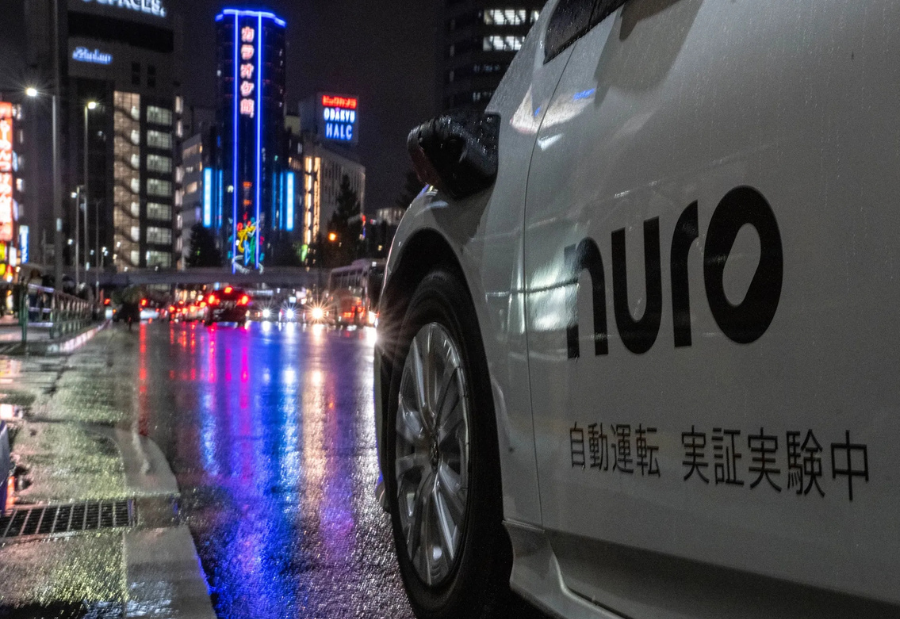
Autonomous vehicle technology is expanding beyond the United States as companies explore global markets. Nuro has started testing its self-driving software on public roads in Tokyo, marking the company’s first overseas deployment. The Silicon Valley-based startup, backed by Nvidia, Uber and SoftBank, launched the trials last month using Toyota Prius vehicles fitted with its autonomous driving system.
The test vehicles include human safety operators behind the wheel as a backup while the software runs during real-world driving conditions. Nuro said operating in Japan presents several new challenges, including driving on the left side of the road, dense urban traffic and different road signs and lane markings compared with the United States. The company, which opened its Tokyo office in August last year, has not revealed how many vehicles are currently being used for testing or when the safety drivers might be removed.
In a blog post announcing the expansion, the company indicated that the Tokyo trials could lead to further international deployments. “Our autonomous operations in Tokyo are the beginning of the compounding benefits of global deployment,” the company wrote. Nuro was founded in 2016 by former engineers from an early self-driving project at Google — Dave Ferguson and Jiajun Zhu. The startup initially focused on building low-speed delivery robots and attracted major funding, including a $940 million investment from SoftBank Vision Fund in 2019. However, rising development costs and industry consolidation pushed the company to rethink its strategy. In 2024, it stopped developing delivery robots and shifted to licensing its autonomous driving technology to automakers, ride-hailing platforms and delivery services.
The company’s system is built on an end-to-end AI foundation model designed to learn from real-world driving. Nuro calls the approach “zero-shot autonomous driving,” meaning the system can operate in new environments without prior training data. According to the company, this method allowed its software to drive on Tokyo roads without being trained on Japanese driving data. A similar AI strategy is being explored by Wayve, which recently raised $1.2 billion. Nuro says safety remains a priority. New versions of its autonomy model are first tested on closed tracks and in simulations. When vehicles move to public roads, the software initially runs in “shadow mode,” where it predicts actions but does not control the vehicle until performance is validated. The startup has also attracted continued investor interest, raising $203 million in a Series E funding round last year with support from firms including Baillie Gifford, Icehouse Ventures, Kindred Ventures, Pledge Ventures and Nvidia. Uber also participated as part of a broader agreement linked to Lucid Motors.
Also read: Viksit Workforce for a Viksit Bharat
Do Follow: The Mainstream LinkedIn | The Mainstream Facebook | The Mainstream Youtube | The Mainstream Twitter
About us:
The Mainstream is a premier platform delivering the latest updates and informed perspectives across the technology business and cyber landscape. Built on research-driven, thought leadership and original intellectual property, The Mainstream also curates summits & conferences that convene decision makers to explore how technology reshapes industries and leadership. With a growing presence in India and globally across the Middle East, Africa, ASEAN, the USA, the UK and Australia, The Mainstream carries a vision to bring the latest happenings and insights to 8.2 billion people and to place technology at the centre of conversation for leaders navigating the future.