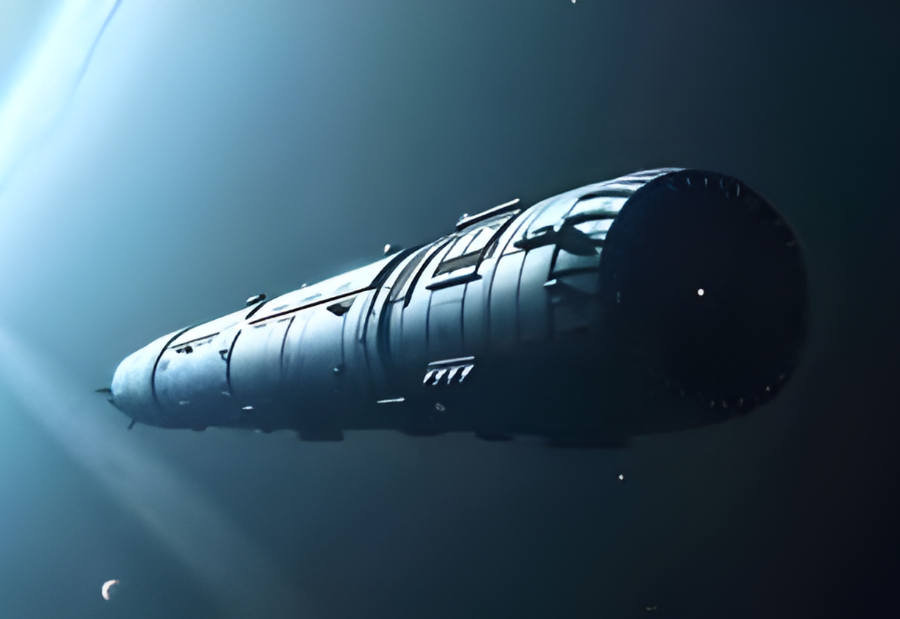
A futuristic spacecraft concept is exploring how humans might travel beyond the solar system on extremely long missions. The proposed vessel, known as Chrysalis, is envisioned as a self-sustaining space habitat capable of carrying a human population across interstellar space for centuries.
The concept was developed as part of the Project Hyperion design competition, which studies the feasibility of long-duration human space travel through generation ships. These spacecraft are designed as fully self-contained ecosystems where multiple generations of people live and work while travelling to distant star systems.
According to the design proposal, Chrysalis would be an enormous spacecraft measuring about 58 km in length and weighing more than 2.4 bn tons. The vessel is designed to carry around 1,000 people initially, though it could support a larger population over time.
The starship is envisioned as a mobile city in space. Its design includes several rotating cylindrical layers that generate artificial gravity using centrifugal force. Inside these sections would be residential areas, farms, parks, schools, hospitals and industrial facilities needed to sustain life during the journey.
Food production, water recycling and ecological systems would operate through closed-loop systems to ensure long-term survival without external supplies. The design also includes controlled environments that could maintain biodiversity through forests, agricultural zones and other ecosystems.
The spacecraft would rely on nuclear fusion for propulsion and onboard energy. The estimated journey time is about 400 years to reach the Alpha Centauri star system, located roughly 4.2 light-years from Earth. Over such a long mission, multiple generations of people would live and die aboard the ship before their descendants reach the destination.
Construction of a spacecraft of this scale would likely take place in space rather than on Earth. One proposed location is a gravitationally stable Lagrange point between Earth and the Moon.
The designers also suggested that future crew members could undergo long-term isolation training in remote environments such as Antarctica for 70–80 years to prepare for the psychological and social challenges of deep-space living.
Although the Chrysalis concept remains theoretical and depends on technologies that do not yet exist, such research helps scientists and engineers explore the practical and societal challenges of long-duration interstellar missions.
Also read: Viksit Workforce for a Viksit Bharat
Do Follow: The Mainstream LinkedIn | The Mainstream Facebook | The Mainstream Youtube | The Mainstream Twitter
About us:
The Mainstream is a premier platform delivering the latest updates and informed perspectives across the technology business and cyber landscape. Built on research-driven, thought leadership and original intellectual property, The Mainstream also curates summits & conferences that convene decision makers to explore how technology reshapes industries and leadership. With a growing presence in India and globally across the Middle East, Africa, ASEAN, the USA, the UK and Australia, The Mainstream carries a vision to bring the latest happenings and insights to 8.2 billion people and to place technology at the centre of conversation for leaders navigating the future.