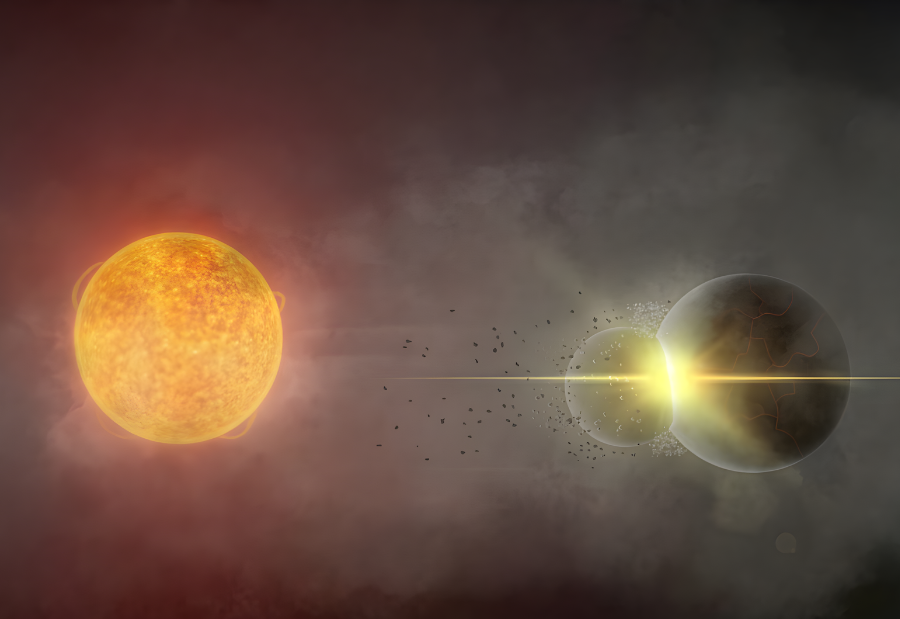
Astronomers have found signs of a dramatic collision between two planets orbiting a distant star, an event that may resemble the ancient impact believed to have formed Earth’s moon. The discovery was made after scientists noticed unusual changes in the brightness of a star located about 11,000 light-years away.
The star, known as Gaia20ehk, is normally a stable main-sequence star similar to the sun with a steady and predictable light output. However, researchers observed unusual behaviour beginning in 2016 when the star’s brightness suddenly showed three dips. By 2021, the fluctuations became even more extreme.
“The star’s light output was nice and flat, but starting in 2016, it had these three dips in brightness. And then, right around 2021, it went completely bonkers,” team leader and University of Washington researcher Anastasios Tzanidakis said in a statement. “I can’t emphasize enough that stars like our sun don’t do that. So when we saw this one, we were like ‘Hello, what’s going on here?'”
Further investigation revealed that the flickering was not caused by the star itself. Instead, large amounts of rock and dust were passing in front of it, blocking some of its light as the debris orbited the star.
Scientists concluded that the debris likely came from a collision between two planets orbiting Gaia20ehk.
“It’s incredible that various telescopes caught this impact in real time,” Tzanidakis explained. “There are only a few other planetary collisions of any kind on record, and none that bear so many similarities to the impact that created the Earth and moon. If we can observe more moments like this elsewhere in the galaxy, it will teach us lots about the formation of our world.”
Planetary systems typically form through repeated collisions and mergers of smaller bodies known as planetesimals around young stars. These chaotic impacts are common during the early stages of a solar system, but over hundreds of millions of years the system usually stabilises.
Although such collisions may occur frequently, observing them in distant star systems is extremely difficult. Astronomers must wait for debris to pass directly between the star and Earth, creating visible dimming events that can take years to unfold.
“Andy’s unique work leverages decades of data to find things that are happening slowly — astronomy stories that play out over the course of a decade,” team member James Davenport, a University of Washington scientist, said. “Not many researchers are looking for phenomena in this way, which means that all kinds of discoveries are potentially up for grabs.”
Researchers solved the mystery by analysing the star using infrared observations from multiple telescopes.
“The infrared light curve was the complete opposite of the visible light,” Tzanidakis said. “As the visible light began to flicker and dim, the infrared light spiked. Which could mean that the material blocking the star is hot — so hot that it’s glowing in the infrared.”
Scientists believe the two planets may have initially experienced several grazing impacts before a final catastrophic collision generated intense heat and large amounts of debris.
The dust cloud produced by the collision orbits Gaia20ehk at a distance of about 93 million miles, which is close to the distance between the Earth-moon system and the sun. As the debris cools over millions of years, it could eventually form an exomoon and a planet-moon system similar to our own.
Although astronomers may not witness the final outcome, discovering more events like this could help scientists understand how often moon-forming collisions occur. Because Earth’s moon is believed to have played an important role in shaping conditions for life, studying such impacts may also provide insights into the potential for life elsewhere in the Milky Way.
“How rare is the event that created the Earth and the moon? That question is fundamental to astrobiology,” Davenport said. “Right now, we don’t know how common these dynamics are. But if we catch more of these collisions, we’ll start to figure it out.”
Also read: Viksit Workforce for a Viksit Bharat
Do Follow: The Mainstream LinkedIn | The Mainstream Facebook | The Mainstream Youtube | The Mainstream Twitter
About us:
The Mainstream is a premier platform delivering the latest updates and informed perspectives across the technology business and cyber landscape. Built on research-driven, thought leadership and original intellectual property, The Mainstream also curates summits & conferences that convene decision makers to explore how technology reshapes industries and leadership. With a growing presence in India and globally across the Middle East, Africa, ASEAN, the USA, the UK and Australia, The Mainstream carries a vision to bring the latest happenings and insights to 8.2 billion people and to place technology at the centre of conversation for leaders navigating the future.