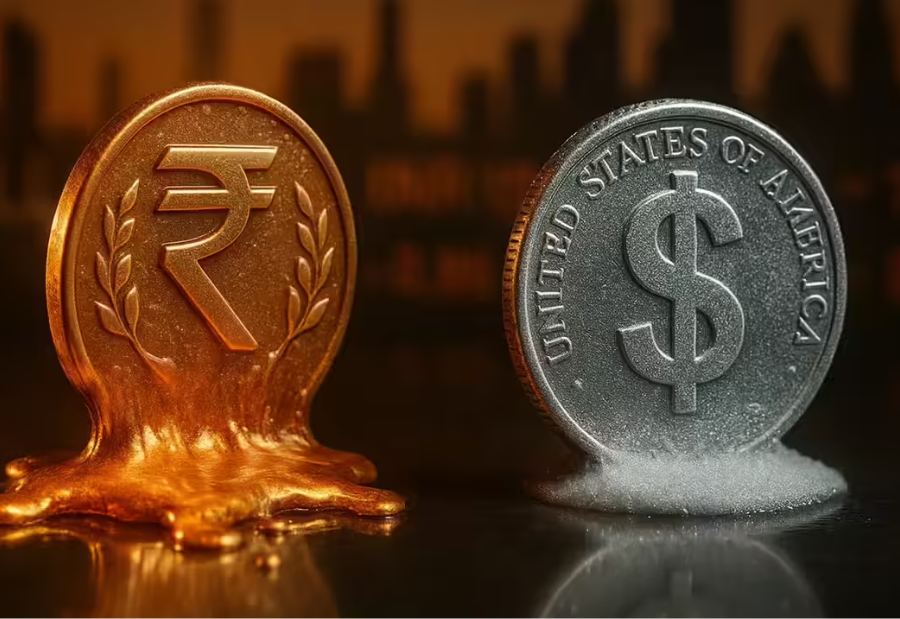
The Indian rupee ended a volatile trading session at record lows, capping its worst fiscal year performance in more than a decade amid global and domestic pressures.
The currency opened strong at 93.59 per dollar but quickly reversed course, falling to an all-time low of 95.21 before closing at 94.83. The session saw sharp swings, with the Reserve Bank of India stepping in to stabilize the market after breaching the 95 mark.
“The rupee’s moves today were hard to predict and even harder to trade. Had the RBI not stepped in past 95, the rupee’s fall could have extended deeper,” a trader at a foreign bank said.
Despite intervention, the rupee has declined 11% over the fiscal year from April to March, marking its steepest drop since 2011-12.
The fall has been driven by multiple factors, including sustained foreign investor outflows and global uncertainty linked to geopolitical tensions. Overseas investors sold more than $19 billion worth of Indian equities over the past 12 months, with March seeing record outflows as rising oil prices heightened concerns for India, a major energy importer.
Analysts caution that recent measures by the RBI, such as tightening foreign exchange position limits, may offer only temporary relief. “The bottom line is that the RBI’s cap does not change the underlying dynamics that fuelled pressure on the currency,” analysts at Barclays said.
They added that the rupee remains vulnerable to oil supply shocks, worsening balance of payments conditions, and increasing capital account pressures.
Market indicators reflected broader stress. The benchmark Nifty 50 index fell 11% in March, its steepest monthly decline since 03 2020. Meanwhile, India’s 10-year bond yield rose above 7% for the first time in 21 months.
Oil prices surged to $115 per barrel amid escalating tensions in the Middle East, adding to inflation concerns and deepening risks for global growth. Global equities also declined as investors braced for prolonged conflict and economic uncertainty.
While the rupee has been relatively stable compared to some Asian peers due to central bank support, underlying pressures continue to weigh on its outlook.
Also read: Viksit Workforce for a Viksit Bharat
Do Follow: The Mainstream LinkedIn | The Mainstream Facebook | The Mainstream Youtube | The Mainstream Twitter
About us:
The Mainstream is a premier platform delivering the latest updates and informed perspectives across the technology business and cyber landscape. Built on research-driven, thought leadership and original intellectual property, The Mainstream also curates summits & conferences that convene decision makers to explore how technology reshapes industries and leadership. With a growing presence in India and globally across the Middle East, Africa, ASEAN, the USA, the UK and Australia, The Mainstream carries a vision to bring the latest happenings and insights to 8.2 billion people and to place technology at the centre of conversation for leaders navigating the future.