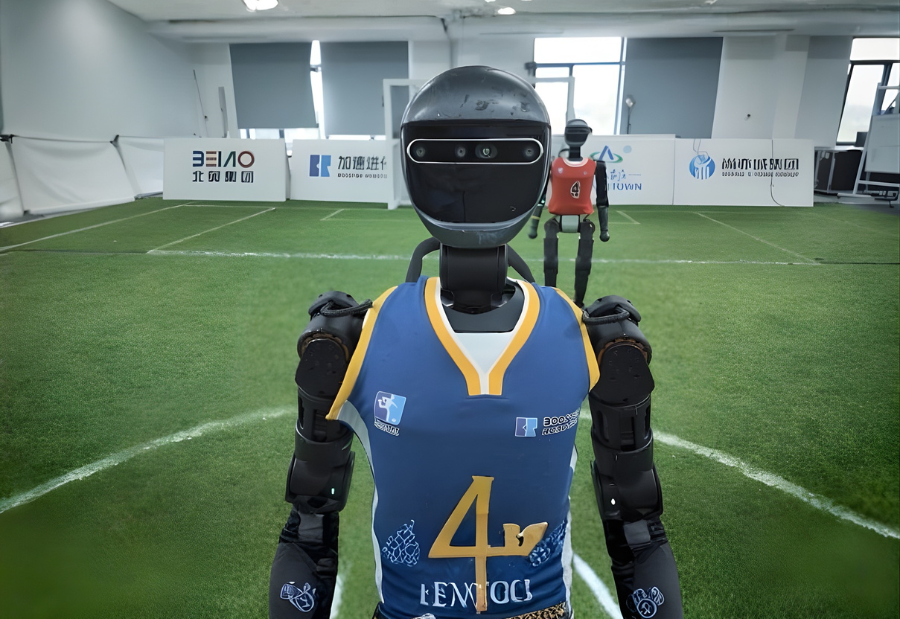
An unusual sports trend is shaping the future of humanoid robots in China.
On the outskirts of Beijing, engineers at Booster Robotics are training human like robots to play soccer using artificial intelligence. The startup, founded in 2023 by entrepreneur Cheng Hao, is part of China’s rapid push into humanoid robotics, with sports emerging as a key testing ground for real world capabilities.
“There are hundreds of robot soccer teams in the world,” Cheng said. “We need to be the first one in this niche market and then go to other markets.” Inspired by Tesla’s humanoid Optimus and ChatGPT 4, Cheng aims to build advanced soccer playing robots that can later be adapted for use in factories and homes.
China’s robotics sector has expanded quickly since 2015, when robotics was named a priority industry in a national upgrade plan. Today, the country has more than 150 humanoid robot companies. In 2025, this momentum translated into a surge of robot sporting events. Robots danced at the Spring Festival Gala, ran half marathons, and competed in the world’s first Humanoid Robot Games in Beijing, showcasing skills in soccer, boxing and material handling.
Experts say soccer is an ideal benchmark for robotics research. It tests vision, movement, balance, teamwork and decision making. “An inspirational goal of RoboCup is to create a team of robots that can beat the best human soccer team on a real soccer field,” said Peter Stone, a robotics expert and former RoboCup president.
The sports focus is also helping startups attract attention and funding. Booster Robotics sold more than 700 tickets at a robot soccer exhibition and secured over 14000000 dollars in Series A plus funding shortly after winning the 2025 RoboCup in Brazil.
Government support has played a major role, with subsidies, tax incentives and public events accelerating adoption. However, industry leaders say long term success depends on robots finding practical roles beyond showcases.
In 2025, intelligent robots were included in China’s annual government work report for the first time. Companies are now testing humanoids in factories, logistics and inspection tasks. Cheng believes this is only the beginning. “We think robots playing soccer is a test,” he said. “In the future, we will use this technology in factories or at homes.”
Also read: Viksit Workforce for a Viksit Bharat
Do Follow: The Mainstream formerly known as CIO News LinkedIn Account | The Mainstream formerly known as CIO News Facebook | The Mainstream formerly known as CIO News Youtube | The Mainstream formerly known as CIO News Twitter
About us:
The Mainstream is a premier platform delivering the latest updates and informed perspectives across the technology business and cyber landscape. Built on research-driven, thought leadership and original intellectual property, The Mainstream also curates summits & conferences that convene decision makers to explore how technology reshapes industries and leadership. With a growing presence in India and globally across the Middle East, Africa, ASEAN, the USA, the UK and Australia, The Mainstream carries a vision to bring the latest happenings and insights to 8.2 billion people and to place technology at the centre of conversation for leaders navigating the future.